



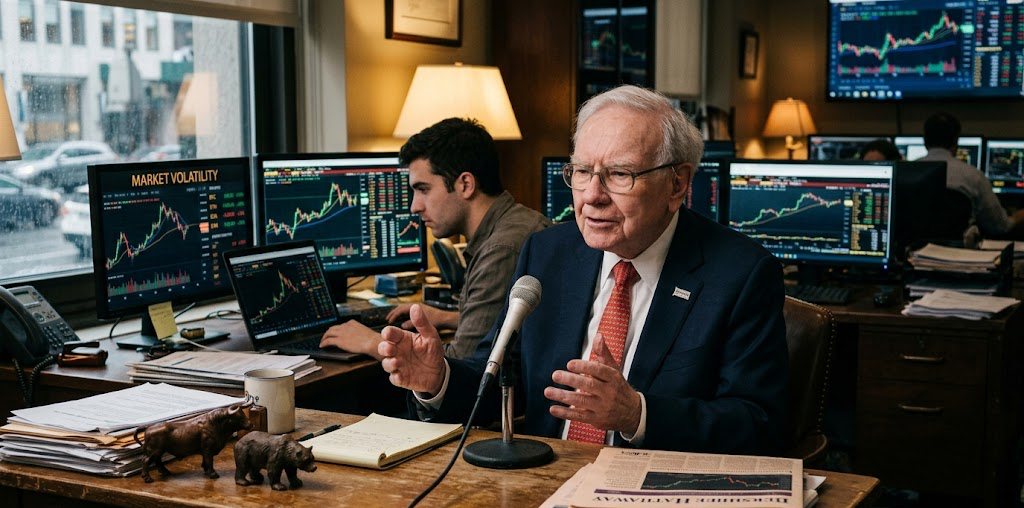
If you're an active trader and have not asked yourself, "Why should I listen to Warren Buffett?", you really ought to! The fact that he has never traded a single cryptocurrency or CFD does not disqualify his advice for you.
His success as an investor was not based on luck or even talent; it had primarily to do with two traits that kill most traders long before their accounts are wiped out: patience and discipline in valuing investments.
These two traits do not belong exclusively to any asset; they belong to anyone who is willing to learn.
This book contains examples of how Buffett's fundamental principles have been translated from the Boardroom to the highly volatile world of short-term trading, including CFDs and cryptocurrencies.
It will not suggest that you hold your Bitcoin for 30 years; however, it will demonstrate how you can act like Warren Buffett and become a better, more disciplined, and more profitable trader right now.
Why Buffett's Philosophy Still Matters for Short-Term Traders
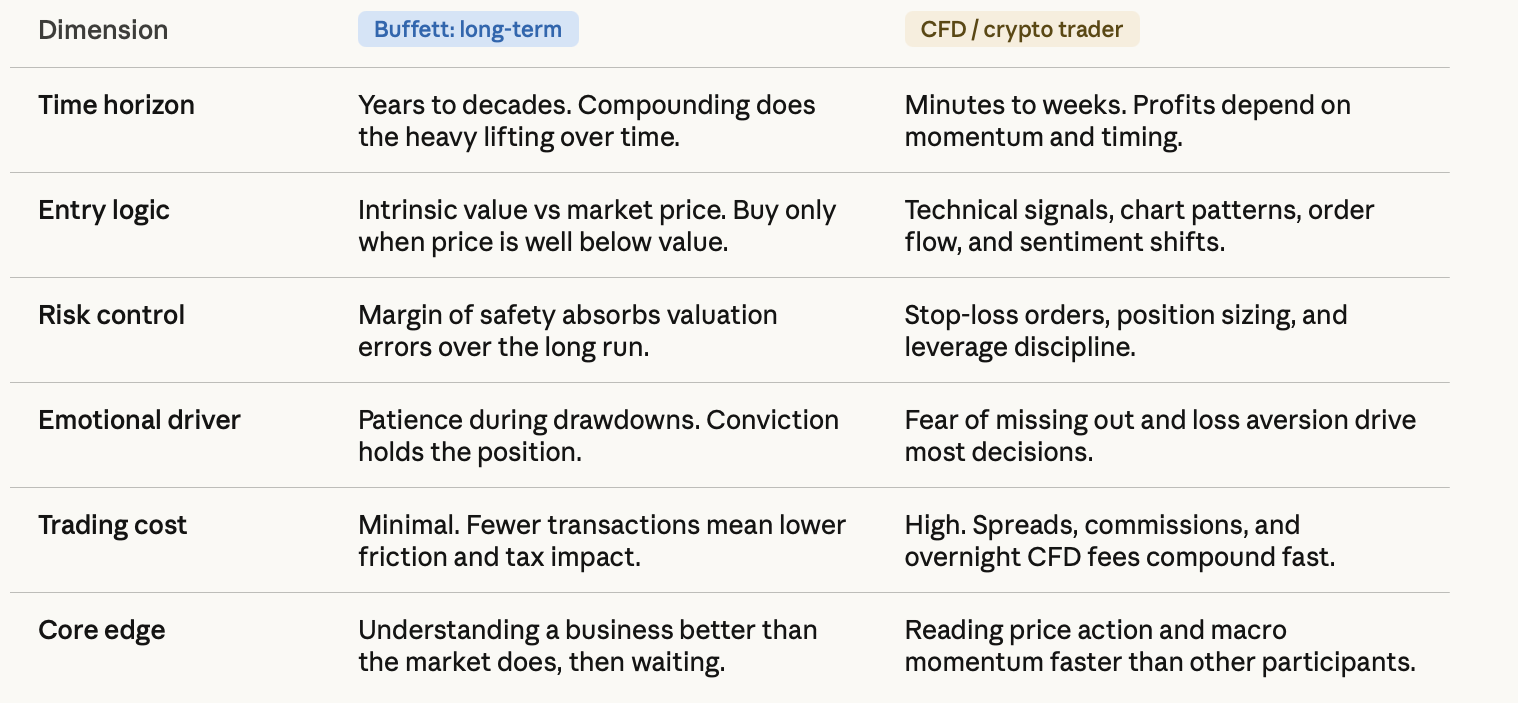
Many traders think there is no overlap between Buffett's universe and theirs; this thinking is why so many traders fail to be successful. The key concept from Buffet's universe you can translate to your trading universe is to never pay too much for an asset, as well as not letting the short-term fluctuations in price affect your long-term strategy.
Regardless if you believe your “long-term” to be defined by only the next 48 hours, consistently asking “what is the actual value of this asset, and what is the worst outcome that can happen if I am wrong?” is the key difference between trading and speculating.
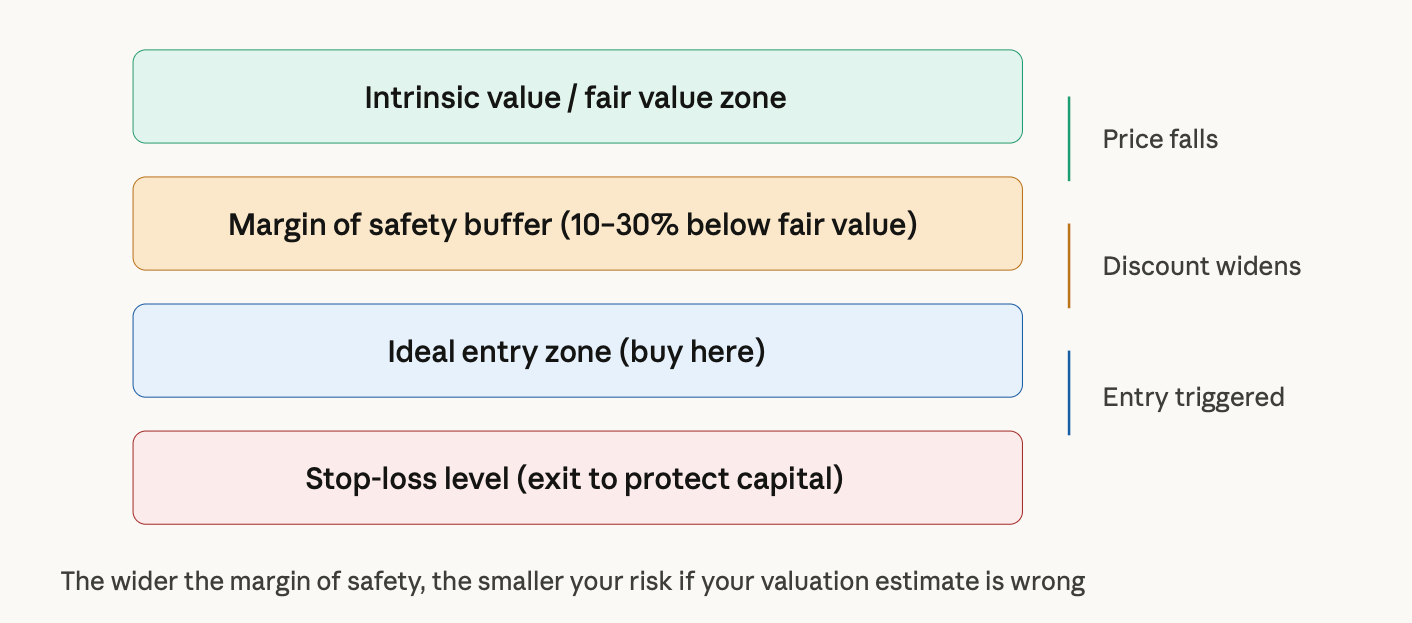
The idea that connects Buffet and traders is known as Margin of Safety. This term was borrowed from Buffet’s mentor Benjamin Graham, and represents the price at which an individual would purchase an asset if its market price is below their estimated intrinsic value by a sufficient amount.
Using this model allows for the margin of safety to act as a cushion against being incorrect, or premature in the timing of your entry points and being subject to sudden reversals in your position due to market volatility.
While short-term traders may not calculate intrinsic values in the manner of Buffet, they can establish a “fair entry zone” underneath present momentum and take trades only when prices retrace to that region. This creates a Margin of Safety designed for modern traders.
Buffett's Patience vs High-Volatility Trading: The Numbers Tell the Story
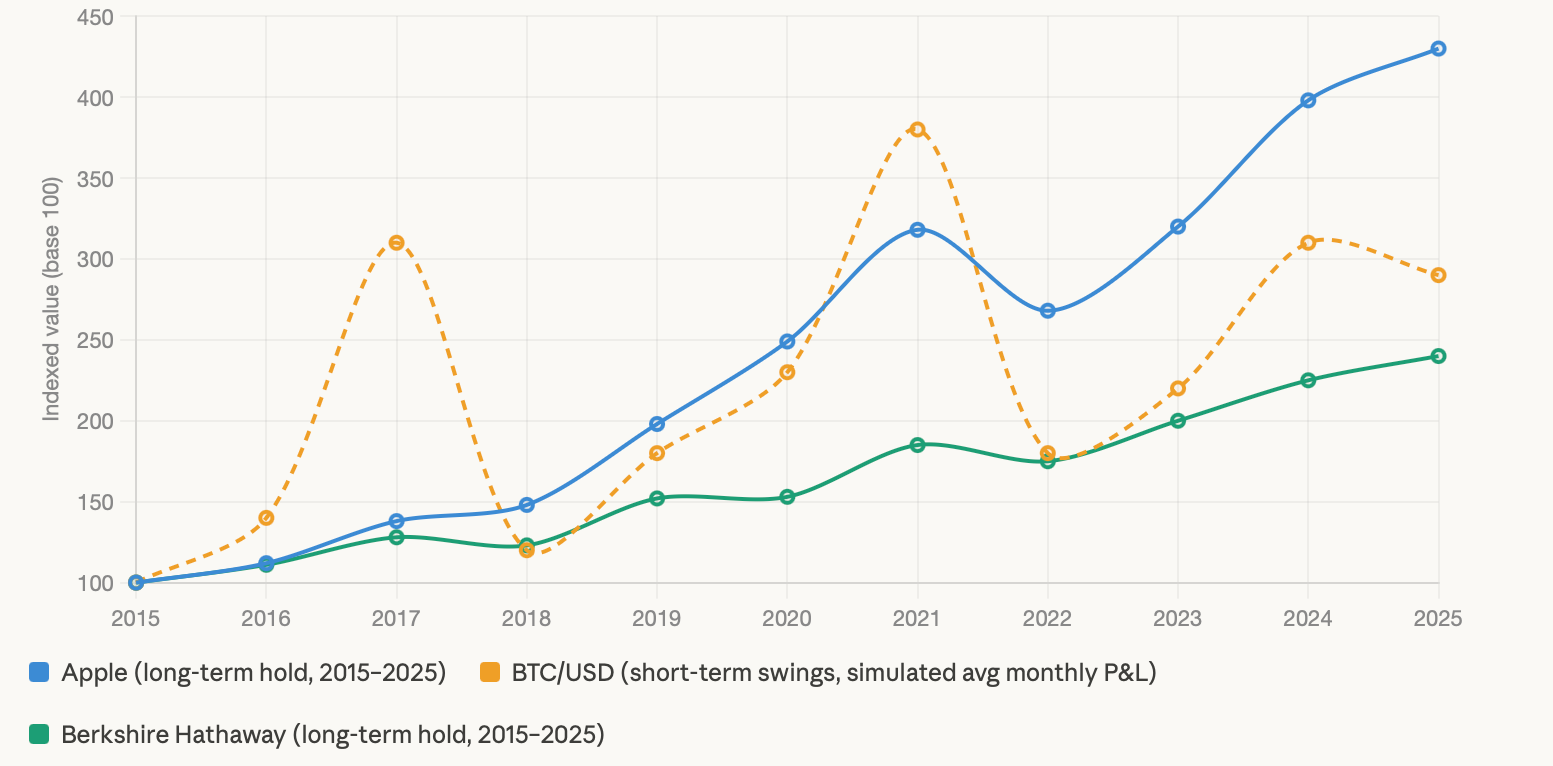
What this chart also highlights is the major gap in most educational courses about trading; long-term owners of great companies (Apple or Berkshire Hathaway) will routinely go through a significant drawdown lasting months at a time, yet the overall trend moving forward for these stocks has been one of consistent compounding.
On the other hand, when we look at how Bitcoin behaves as a short-term trade, we see that it has wild price movements that can lead to big gains followed by huge declines; thus, most short-term traders only get a small percentage of the theoretical potential gain in this market - for reasons of fear, greed, and entry time.
This does not mean that short-term trades are less than long-term trades; in fact, it actually means that short-term trading is much more challenging and requires a different level of discipline, and that is where some of the things that Buffett has taught us about how to think become extremely helpful.
The primary reasons people choose to trade long-term are that they have lower transaction costs, benefit from compound growth over time, and do not have the psychological burden of monitoring every tick of the stock price.
However, if a trader is using CFD leverage to trade a non-volatile crypto currency, the primary advantages to short-term trading are liquidity, flexibility and the ability to profit when the price moves up and down. The important thing is not which approach is better; rather, it is whether or not you are using the correct principles applicable to your chosen approach.
One real-world adaptation of this principle would be to select your assets with the same level of strictness that Buffett does, even if your holding period is only a few days.
For example, trading in Apple, gold or a commodity CFD that you have researched and know the fundamentals of, will give you a totally different type of context than trading in an obscure alternative coin that has no fundamental basis for value; the former will provide you with context in which you can evaluate whether or not a price pullback is a buying opportunity or a selling opportunity; whereas, the latter is pure speculation and without any sort of edge, speculation becomes a random guess with associated transaction costs.
How to Apply the Margin of Safety in CFD and Crypto Trades
Lessons for Day Traders from Buffett's Core Principles
Buffett's three investment rules can be translated to day trading/swing trading frameworks. For example, the first rule of only investing in what you know would transition to day trading as only trading things that you know really well i.e., you know why you trade oil because you are knowledgeable about these particular types of securities.
The second rule, "disregard market noise and only concentrate on the fundamentals," translates for day traders in that you wait for your setup instead of reacting to every price spike. For day traders, the third rule – "never lose money" provides the absolute requirement of putting in a stop-loss order on every trade.
Day traders primarily fail with their entry discipline. After seeing a strong trend, they chase the trade above the previous high and hold onto it as long as they think it's coming back. In contrast, Buffett watches an asset he knows, waits for the price to drop to a fair price, and waits to put on the position until that happens, which could sometimes be months after.
In an intra-day context, you do this by setting your buy alerts for the target price and walking away from your computer. Let the market come to you. This process is difficult to perform psychologically, but the mechanics are simple, which is primarily what separates the disciplined trader from the reactive trader.
Swing traders can also use Buffett's principles; the key is to focus on strong-trending assets and wait until they pull back to key technical levels before putting on a position. In a technical sense, this is equivalent to buying below the intrinsic value of the instrument. You're not chasing the high; rather, you're waiting for the markets to give you a discount and putting on your position with defined risk.
Common Mistakes Traders Make When Trying to Apply Buffett's Thinking
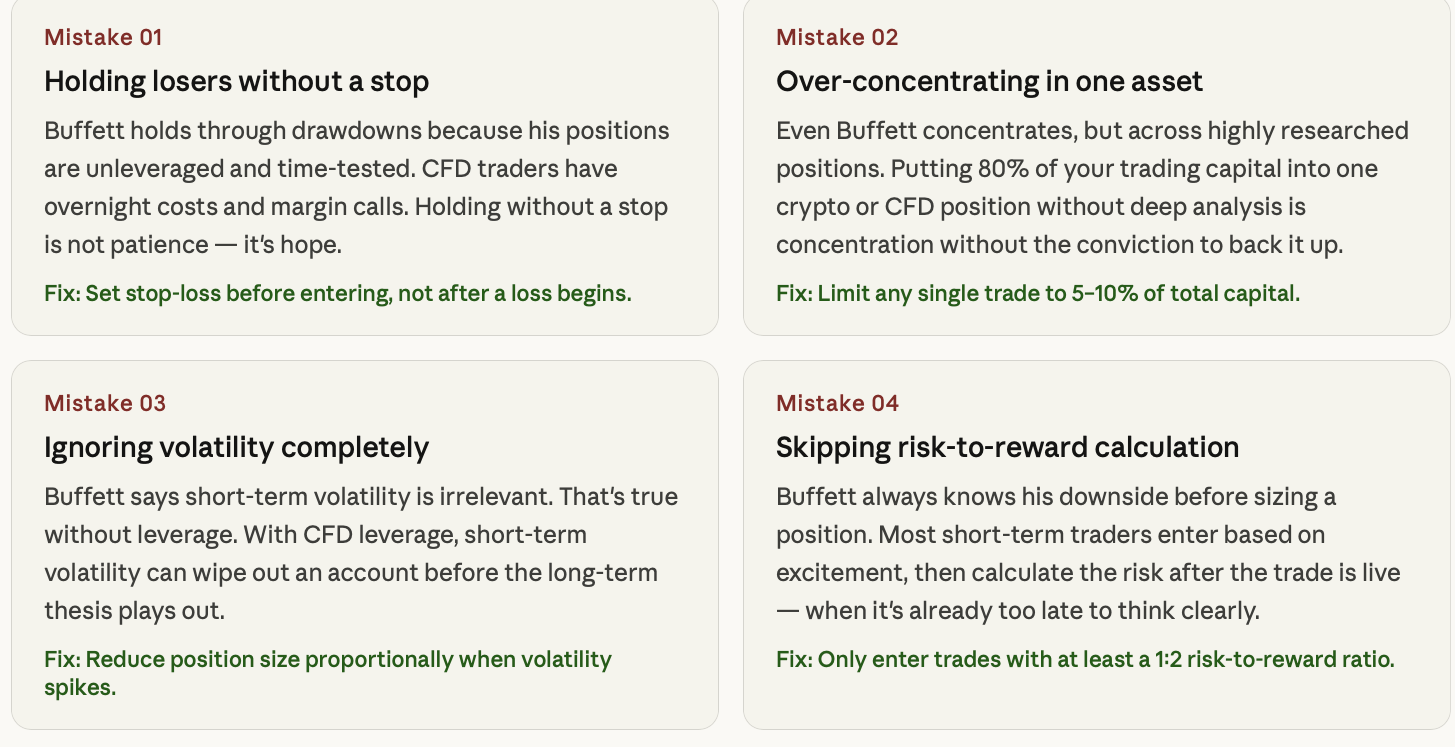
Many traders interpret Buffett's "buy and hold" strategy to mean that investing in a CFD or volatile crypto asset using leverage will also result in long-term gains. Unlike Buffett, who owns stock in businesses with positive cash flow, competitive advantages and solid earnings, using leverage means you are investing with borrowed money.
Additionally, unlike Bradley, traders are subject to margin calls, overnight financing and all the other risks associated with having a position of high volatility. Therefore, when a trader hangs on to a looser-trade position through several weeks hoping they will work out, they are in denial but this time they have to do additional work in order to deny they made a poor choice. Below are examples of where traders resist using Buffett's philosophy incorrectly without understanding the context.
Macro Analysis: Reading Buffett's Portfolio Moves as a CFD Signal
The quarterly filings (13-F) of Berkshire Hathaway are publicly accessible and analyzed extensively, and they also provide valuable macro signals for short-term traders able to interpret them.
For example, Warren Buffett's cash reserves over the past couple of years have been growing to unprecedented levels while at the same time, he has been delaying the use of his capital for investing purposes and waiting for the market to decline sufficiently before using his capital.
This is an indicative macro signal for any short-term trader as it provides a strong indication that Warren Buffett's investment team believes that the entire market is overvalued and therefore will be better off as patiently invested in a cash position.
As a result, CFDs traders will adopt a more conservative posture with regards to their positions; they will have smaller size positions relative to their account equity; they will take profits more quickly; and they will have a bias towards shorting sectors that are over-extended based on the overall market trend.
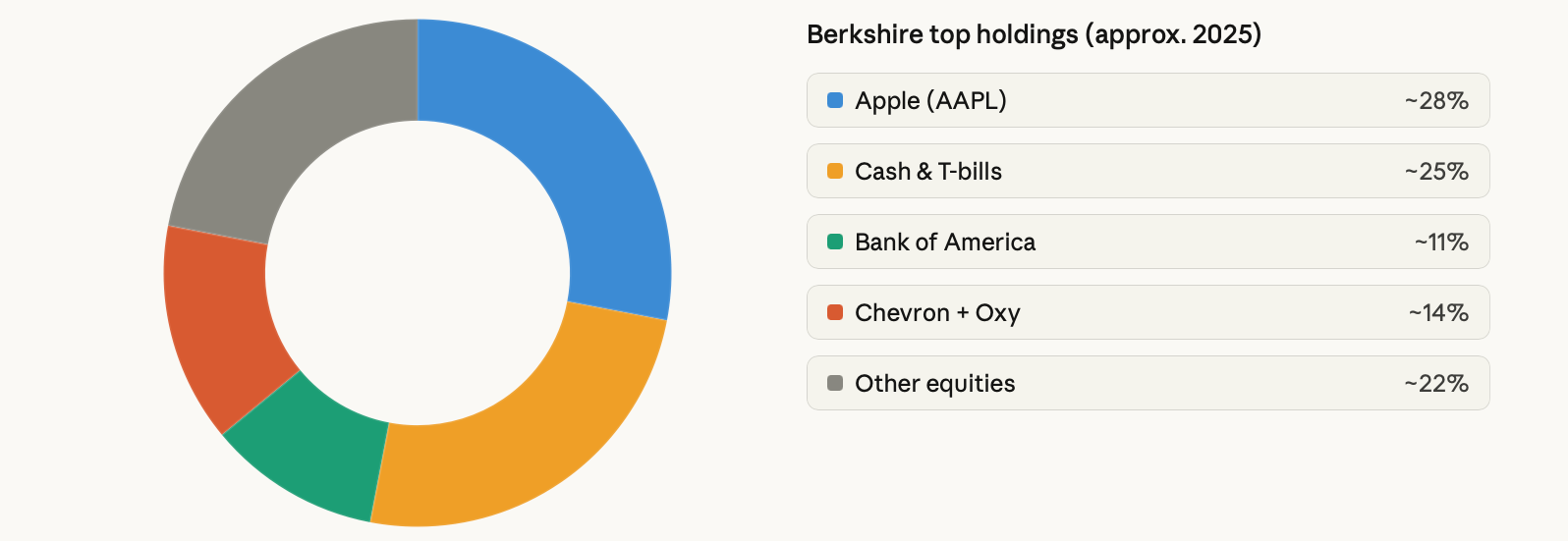
When it comes to energy stocks like Chevron and Occidental Petroleum, Buffett has a sizable investment in them, which is a solid clue to CFD traders that a world class fundamental analyst has a long-term investment view on the energy sector. A CFD trader should look at oil price charts, energy ETF technicals and global catalysts that could expedite the long-term price increases.
A CFD trader doesn't have to hold oil for the next five years but can interpret smart long-term capital being positioned long the sector as an indication that dips on the daily chart should be viewed as buying opportunities rather than trend reversals. This is how a CFD trader converts Buffett's macro view into a short-term trading advantage.
The Buffett Indicator vs Technical Analysis: Using Both Together
Buffett's Indicator measures the size of the total US stock market compared to GDP. Buffett believes that it is the best tool for measuring stock market valuation; when the ancestor is over 100%, the market is overvalued relative to the economy, but it is considered undervalued when below 80%. Whenever the ratio exceeds 150%, it suggests an increased chance of market correction based on historical correlation.
For traders, the key takeaway is that as a macroeconomic aspect of risk, the Buffett Indicator should help to inform decisions regarding leverage and size of positions, even on short-term trades.
This means that opening large long CFD positions on overvalued stocks is considered to be a failure of risk management, despite what the daily chart may indicate. When combining an awareness of macroeconomic factors such as the Buffett Indicator with standard technical indicators, traders can use the increased accuracy of filtering signals provided by these multiple perspectives to avoid trades that offer limited upside potential and high risk.
For example, when MACD on the weekly chart demonstrates bullish divergence in conjunction with the Buffett Indicator signalling a reasonable level of valuation, the long CFD positions have both technical and macroeconomic support.
A combination of historical overvaluation and RSI being overbought will result in a two-fold cautionary signal to reduce position size or tighten stop losses or abstain from trading altogether. This type of thought process of combining multiple inputs separates professional traders from those who make decisions spontaneously.
Contrarian Trading: Buffett's Most Powerful Quote, Unpacked
When others are overzealous, you should be scared; when others are scared, you should be overzealous. Most individuals have seen or read this saying by Warren Buffet and usually respond to it with a nod before moving on. However, traders utilizing this statement will take advantage of the panic and greed in the marketplace create money-making opportunities while the rest of the market will be panicking or taking chase.
The practical version of this principle for CFD and cryptocurrency traders is to look for extremes in sentiment, either extreme greed or extreme fear, then find convergence patterns in the opposite direction of where the current market has developed. For instance, during the COVID crash in March 2020, the bitcoin market dropped from $10,000 to $4,000 in less than a week.
This created one of the historical low buy signals described by Buffett. The traders that purchased bitcoin during this period and placed their stops below the recent highs and ensured their positions were relative to their size created an infinite amount of wealth during the recovery of bitcoin.
The euphoria at the top of the market in April 2021 was opposite of this position and represented extreme greed and fear of missing out from the market with maximum opportunity; therefore, it represented the best opportunity to mitigate or reduce their exposure and look for short trade opportunities.
The calculators of fear and greed indices, put to call ratios, and social media to gather sentiment information are all aspects of Buffett's contrarian approach to trading. They provide measurable, objective, and quantifiable trader signals; thus, they revolutionize gut trading during periods of extreme market emotion.
Trading Like Buffett with Small Capital: A Practical Starting Point
Many people argue that Warren Buffett's approach to investing relies on having a large amount of capital and being patient for years. To an investor starting with $100 or $500 on a CFD platform, the idea sounds irrelevant. However, as long as you emphasise the biggest three points – selectivity, having the correct amount of risk, and not overtrading – the principles can easily be scaled down.
The small amount of capital in combination with CFD leverage creates the highest risk to your account being the direction of the market; instead, the biggest risk comes from being overleveraged and taking trades impulsively. Instead of following Warren Buffett's example of investing in what you know – or restricting your investment instrument.
Only the two or three instruments that you are knowledgeable about, if you apply his principle of margin of safety, you will only take a trade that has a clearly defined entry point below the recent fair value of the instrument price, has an appropriate stop-loss, and is also at least double the distance from the stop-loss to the price at which you are entering; this is an example of a Buffett-inspired framework that can be used effectively regardless of the size of the account.
Small amounts of capital will force you to develop good habits if you allow them to do so. For example, you will not be able to overtrade since any loss incurred from a single trade will represent a significant percentage of your total account; thus, you will have to use stops to protect your capital because not managing your risk can place your entire account at risk.
The limitations created by a small amount of capital and their ability to create poor habits are the same limitations experienced by an investor who makes a conscious decision to follow Buffett's example; however, a trader with limited funds has had the discipline chosen for them.
FAQ: Your Buffett Trading Questions, Answered Directly
Is Buffett's strategy suitable for short-term trading? Not directly, but his principles of buying only at a discount, defining your downside before entering, and never trading what you don't understand apply to every time frame. The mechanics change but the logic doesn't.
How does the Margin of Safety reduce short-term risk? It ensures you only enter trades where the price has already pulled back to a level that provides a buffer against further downside. You're not buying at the top. You're buying at a discount to where the market just was, which structurally improves your risk-to-reward ratio.
Should I follow Buffett's approach or develop my own day-trading system? Both. Use Buffett's philosophy as the mental architecture for how you think about risk, position sizing, and entry discipline. Build your own technical system on top of that foundation. The philosophy without the system is vague. The system without the philosophy is a rule-following machine with no judgment.
Does the Margin of Safety work in crypto given how unpredictable valuations are? More than you'd think. Even without intrinsic value metrics, you can define "fair value" as a recent consolidation zone or moving average and use a percentage discount from that level as your entry trigger. The principle adapts even when the traditional methodology doesn't directly apply.
What's the biggest mindset shift a CFD trader can take from Buffett? Stop trying to trade more. Start trying to trade better. Buffett's edge isn't that he finds more opportunities than everyone else. It's that he waits for the right ones and then acts decisively. Fewer trades, better selected, managed with discipline, will outperform a high-frequency reactive approach in almost every account.
Open your account on BTC Dana and access the tools, charts, and market data that turn Buffett's principles into real trading decisions, starting from your very first position.