



The market does not always move in a straight line. Anyone who has held a stock through earnings announcements or any Federal Reserve announcements has probably felt how volatile the market can be. Many investors are unable to find opportunities due to their inability to manage downside risk and continue to leave options open to upside price movement. This is where option trading comes into play.
An option is a contract that grants the buyer the right to purchase or sell an underlying security at an established price at a specified time. Options come in two basic forms, called options or put options. All trades have a buyer and seller; therefore, the decision to be the buyer or seller should guide you in choosing a suitable options strategy to help accomplish your objectives.
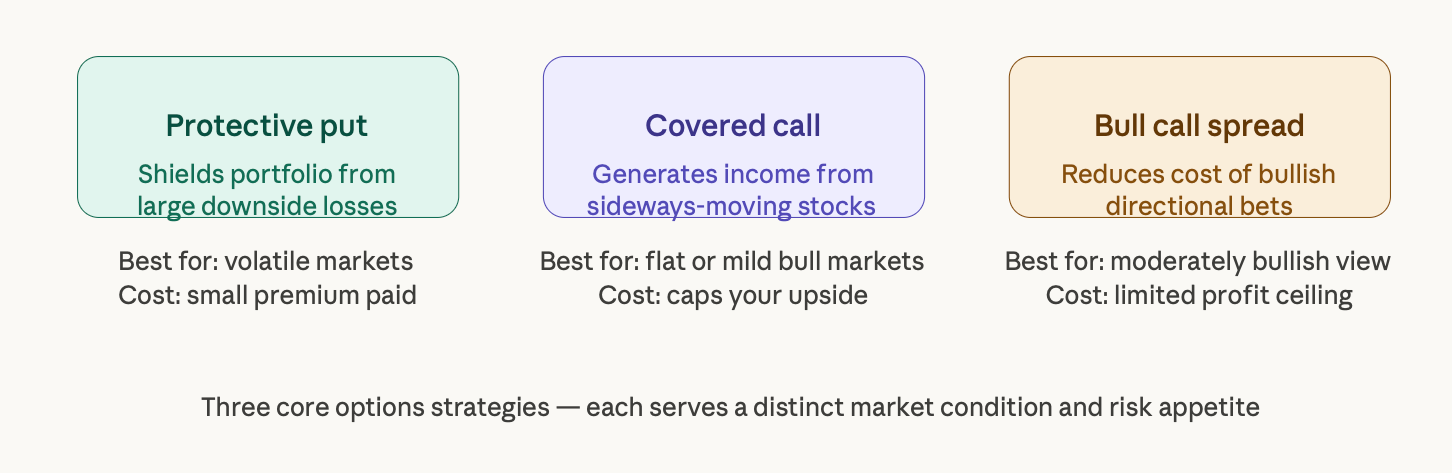
There are three primary uses for options in today’s investment environment: to hedge existing portfolios against large losses; to generate consistent income from existing assets you already own; and for experienced traders to create efficient and low-risk directional trades.
All investors, regardless of whether they work with a self-directed brokerage or trade technology stocks, should use these instruments when making investment decisions. This guide provides an overview of options, various option strategies, and examples of how professional traders use options-based strategies in various global marketplaces such as NASDAQ and the S&P 500.
Options as Investment Insurance: Protective Puts Explained
Purchasing a protective put option is akin to obtaining car or property insurance. When you purchase insurance, you pay a relatively inexpensive premium, and if something unfortunate happens, your insurance company reimburses your losses and reduces your liability. The concept of insurance applies to the value of your stock portfolio as well.
When you purchase a company’s stock, you may also acquire a put option for that same company. A put option grants you the right to sell your stock at a predetermined price, regardless of how much the market has fallen from that price; this predetermined price is the “strike price”, and it represents your puckered bottom level. Regardless of the negative information released about the company, you know you can liquidate your position at or near the strike price.
How to set up a protective put, step by step:
-
Identify the stock you want to protect and the number of shares you hold.
-
Choose a strike price below the current market price. A common approach is selecting a strike 5 to 10 per cent below the current price, which balances cost against the level of protection you need.
-
Choose an expiration date that covers the period of uncertainty you're worried about, such as an earnings announcement or a central bank decision.
-
Buy one put contract for every 100 shares you hold.
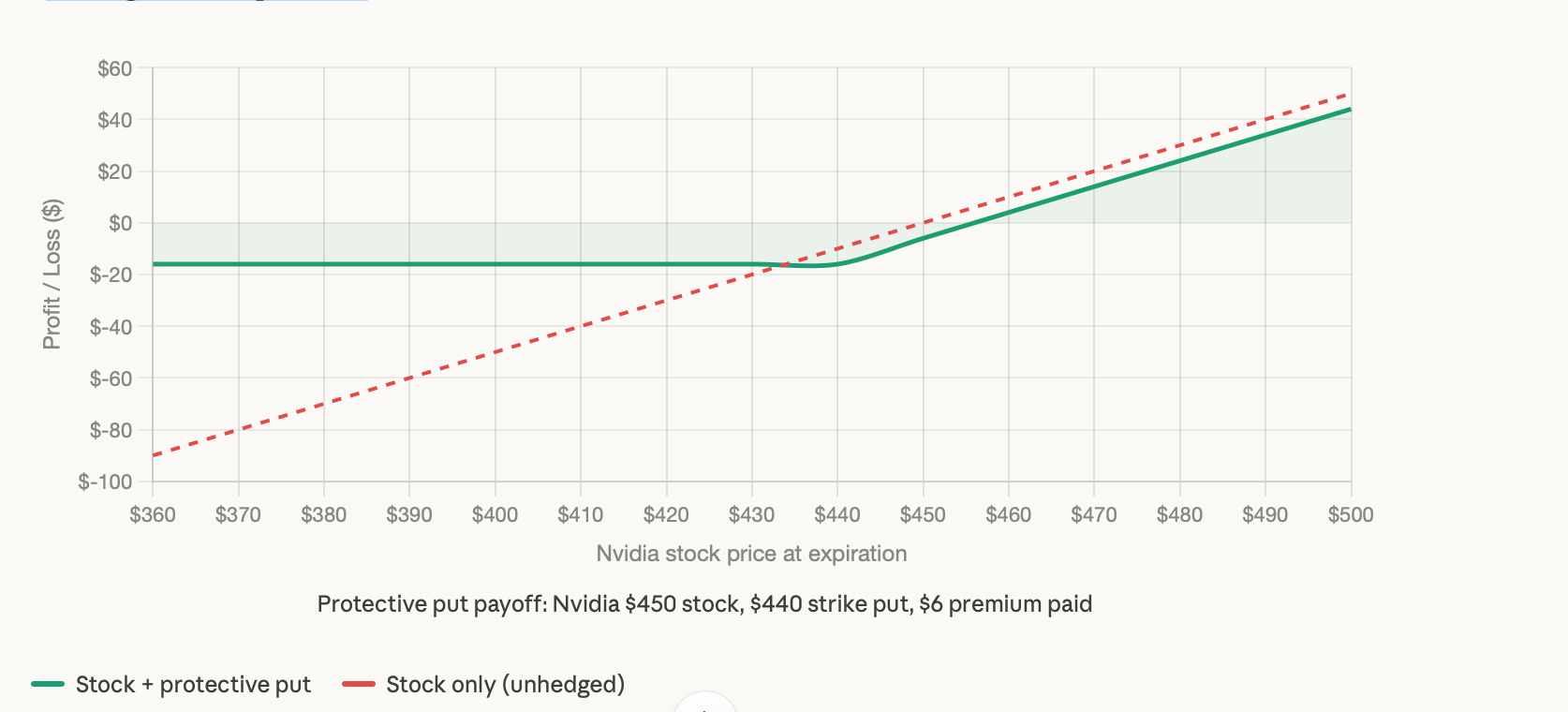
Let’s see how this works in real life. Let’s say that you have 100 shares of Nvidia, which is selling for $450. You are a little worried about the company’s upcoming earnings report, and because you plan on and want to be a long-term holder of this stock, you choose not to sell your position at this point. You decide to buy a put option contract with a strike price of $440 that expires in three weeks, for a premium of $6/share, giving you a total cost of $600 for the option contract. In the event that Nvidia's earnings are disappointing and the price drops to $390 off of the earnings report, your put option will now have a market value of approximately $50/share, therefore providing you with a payout that will offset the majority of your loss related to your shares.
In other words, you have capped your worst-case scenario at a $10 loss on each share you own, strike price $440 - price at expiration $390 = $50; $50 - $6 premium = $10, instead of losing $60 per share by not using a put option as a hedge.
For most beginners, the idea is very clear. You use a small amount of money to hedge against a very large amount of potential loss; the hedge costs a few hundred or thousands of dollars to hedge a much larger amount. By acquiring the put option to hedge, you will be able to sleep soundly through some very volatile times.
Beyond just the raw numbers, the primary psychological benefit to this approach is that when you have a clearly defined maximum loss before entering into a trade, it will allow you to make better decisions and, therefore, will help you avoid panic selling when the market falls or continue to hold a losing position in hopes of a recovery once the market rebounds. Options do not predict future price movement but rather are used to manage the consequences of uncertainty; in turn, understanding this distinction is critical to developing long-term discipline as an investor.
Generating Income with Covered Calls
Let’s flip it around, though. Rather than paying for protection, could you make money on the stocks that are already yours simply because they sit inactive? This is what we call the "covered call" strategy, and it is one of the more common methods of creating income from investment portfolios by using covered calls in their portfolios by institutional managers.
Using a covered call means you have a minimum of 100 shares of the stock you wish to sell, so you would sell a call option contract on your stock to another individual to get the premium or income derived from selling call options. Selling a call gives you immediate income as you receive that premium upon sale.
In exchange for selling the call option, you must agree to sell your shares in question to the buyer of the call option at the strike price if the stock goes above the strike price prior to the expiration date of the call option. "Covered," as in regarding the term “covered call,” only means you own the shares, and you are not assuming unlimited risk in your position.
The ideal conditions for covered calls are:
-
The stock is moving sideways or rising gradually rather than in explosive bursts.
-
You'd be comfortable selling the stock at a slightly higher price.
-
You want to enhance your return without adding complexity or significant risk.
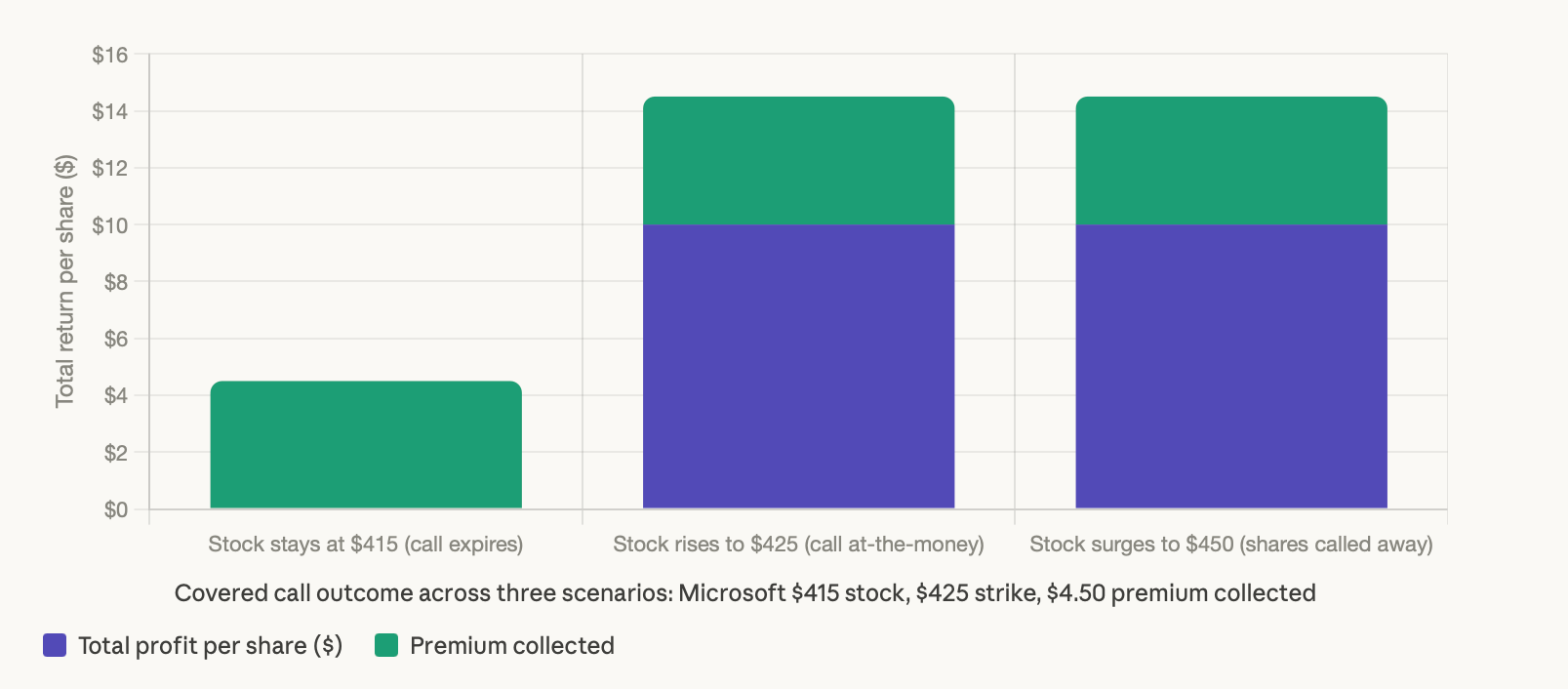
Let’s say you own 100 shares of Microsoft priced at $415 each. You write a call option with a $425 strike price that expires in 30 days, and receive a premium of $4.50 per share or $450. Now you have instant cash of $450 in your account. There are three outcomes. If Microsoft remains below the strike price of $425 at expiration, the option will expire worthless, and you can keep the entire $450 or receive dividends and fee appreciation. If Microsoft is near $425, you will still keep the premium.
Lastly, if Microsoft goes beyond $425, the option will be exercised, you’ll sell your shares for $425 and still keep the premium, giving you an effective selling price of $429.50 per share. The downside to this strategy is if Microsoft goes to $450 after you sold your shares and you missed out on additional profits; however, you still received income from the option premium.
Think of it as renting out a spare room. You still own the house, and you receive rent from it each month. You only have to give up your right to the room if an agreement was made and it is exercised by the tenant at a price you are satisfied with.
The main risk to highlight here is the possibility of your stock declining by a large enough amount that you will have lost most of your investment despite receiving cash premiums from previously written covered calls. While this strategy can earn you cash premiums, it is not an insurance method for a protective employee.
Covered calls are intended for generating income when stocks are stable, but they’re effective in only moderately bullish situations. They can only be written on stocks that you are entirely comfortable owning during periods of short-term drops.
Advanced Strategies: Bull Call Spreads
After mastering single-option strategies, you can mix them together to create new ways to save money and define your level of risk. Since they offer a simple and logical way to enter into a new level of using options, a bull call spread is where you should start if you think the underlying is moderately bullish and do not want to pay the full price of a call option.
To execute this strategy, you buy a call option with a lower strike price, which gives you exposure to the upside of the underlying. At the same time, you sell a call option with a higher strike price to offset part of the premium you recently paid. Your position will be profitable when the stock reaches the upper strike price; however, both your maximum gain and maximum loss will be capped.
As an example, suppose you believe Tesla (TSLA) will move from $240 to $260 over the next six weeks. You would consider buying a call option with a $240 strike price for $12 per share. You will also sell a $260 call option for $5 per share. Your net cash outlay is now $7 per share instead of $12, which represents a 42 per cent discount from the earlier strike prices. Your total profit potential if Tesla is trading at or above $260 at expiration is $13 ($260 − $240 − $7). Your maximum loss will always be limited to $7, and you'll know this prior to initiating a trade.
You could think about the above strategy in an easy-to-understand hypothetical scenario. If you booked a non-refundable hotel room with a guaranteed upgrade to a superior room, you could reserve a room at a better price than a walk-in customer and know the total amount you will pay by the time you check into the hotel; therefore, you have defined your risk profile prior to checking in.
Comparison: Options vs CFDs
A lot of traders looking at options have previous experience with CFDs, and wondering whether to use CFDs or options in a specific scenario is a valid question to ask.
Both of these tools provide investors with leveraged exposure without outright ownership of the underlying asset. However, there are distinct differences between the two instruments, which will impact how you utilise either instrument.
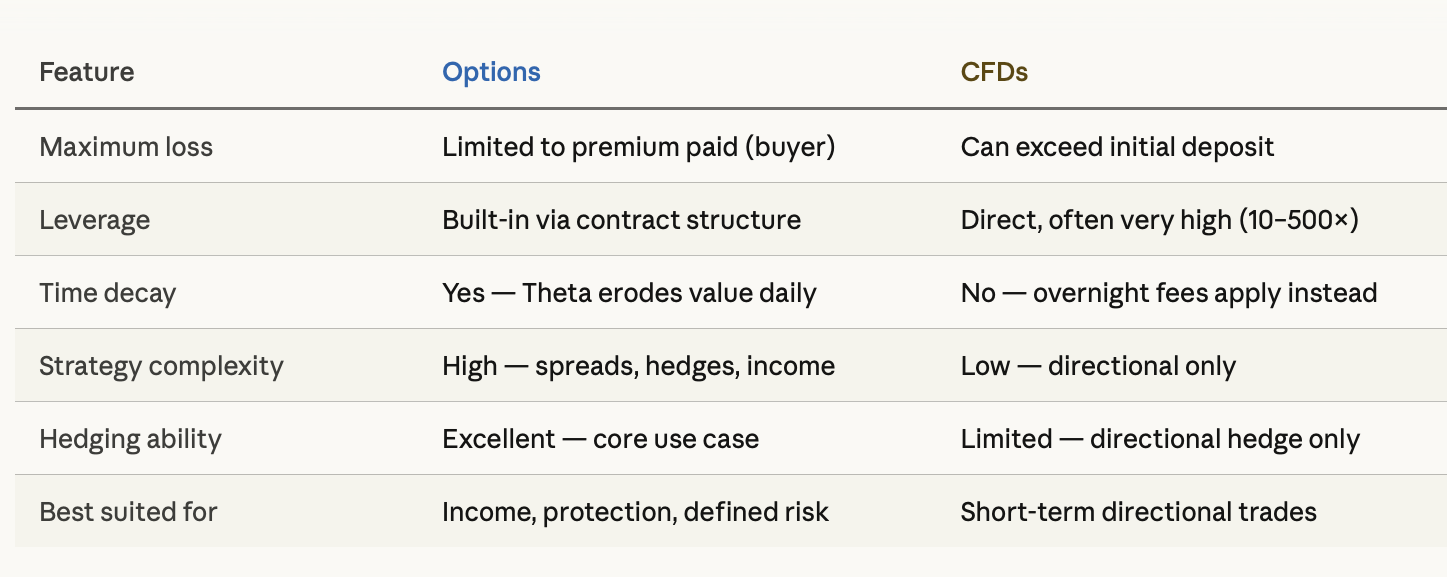
The most clear rule of thumb is this: If you've got a significant position that you want to protect from loss through a period of uncertainty, then options give you exponentially more surgical tools than CFDs do. If your interest is to make a directional bet on an instrument for a short period, but you want very high responsiveness to price changes, a CFD will be a simpler choice! Ultimately, these instruments are not directly competitive but different tools that can be used to accomplish similar trades; great traders are skilled at recognising when they should use each.
Pitfalls: Three Mistakes That Destroy Option Traders
When options are used correctly, they can be an incredibly potent tool; however, if not understood properly, they can also evaporate one's capital at an alarming rate. Three specific key pitfalls contribute to the majority of losses incurred by new options traders; therefore, recognising these three issues will be far more beneficial than memorising any payoff formula.
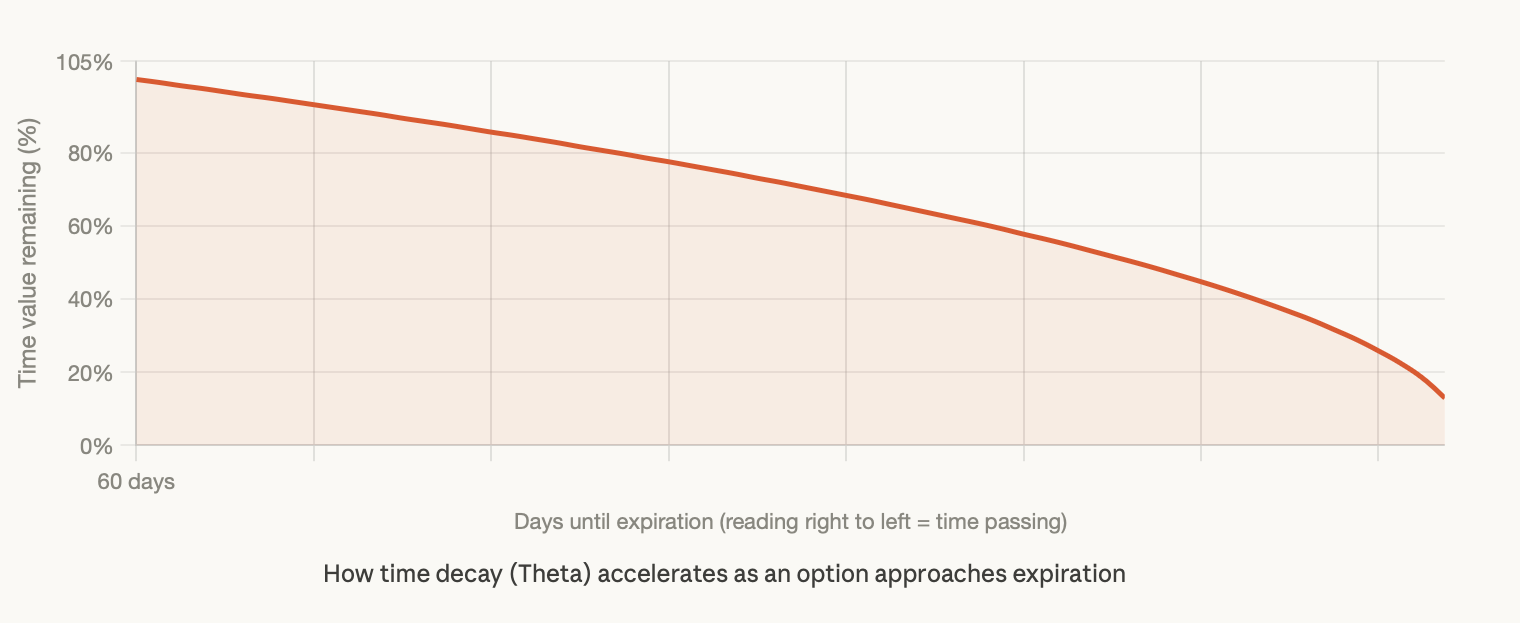
Time Decay (Theta): Every single day that goes by will result in some amount of loss incurred on the option, even if the underlying stock does not move one centimetre. The rate of decay at the end of two to three weeks before expiration will increase exponentially compared to days or weeks before. As many new traders do, they tend to purchase options that are inexpensive and have little time until expiration, and then expect to make a large profit on their trade when the stock moves quickly. Unfortunately, it is too often the case that even when the stock moves in accordance with the direction of the trade, the move happens two weeks late, and the stock price has already declined significantly prior to this substantial decrease in the value of their option position. Assuming one finds themselves in this situation, the only viable solution for the majority of strategies would be to either purchase options with sufficient time until expiration to allow for the trade to materialise (generally 45 to 60 days or more for most strategies) or take advantage of time decay by selling options using covered calls and/or spreads.
Implied Volatility Crush (IV Crush): The earnings trap. When a company announces an impending major event (earnings), the market will price in the uncertainty created by that announcement via the sale of inflated value options. Once that event occurs (no matter which way the stock moves), the uncertainty disappears, and the value of the options is reduced. As a result, many option traders who purchase options prior to the earnings announcement often find that even though the stock has moved in the direction expected, they still experience a loss due to the reduction in the implied volatility of the option overshadowing any gain from the movement of the stock. Consequently, it is essential to understand what one is paying for when purchasing an option and not just which direction the stock is expected to move.
Leverage Misuse: A catastrophic single loss. Because options give traders the ability to control a large amount of nominal shares for a relatively small amount of premium, there is a clear temptation to put more money into an individual trade than warranted. A $5,000 options position on a single stock can amount to a completely different risk/reward ratio than does a $5,000 share position in that same stock. Because, in the event that one's option expires worthless, he/she will have lost 100 per cent of the total individual option position. Maintaining individual option positions in the range of 2 to 5 per cent of one's portfolio will create the discipline needed to separate sustainable traders from those traders who are brought to their knees due to one bad trade.
Traders using options should treat them as defined mechanical instruments versus lottery tickets. When traders treat options as such and respect them with the things that go into being an option trader, you'll find that they consistently outperform traders treating options as a get-rich-quick scheme on one large open call.
Strategy Selection by Market Condition
Selecting the best options strategy is not only determined by whether you have a view on the direction of the stock, but also needs to consider how you can match the way you are structuring the trade based on the conditions of the underlying market and how much risk you are willing to take.
One of the biggest shifts in mindset for a new options trader will be the difference between asking yourself “What direction do I think the stock is going to go?” versus asking yourself “What do I know about the risk environment I am trading in, and what structure can I use to profit based upon that risk view while at the same time keeping my risk exposure defined?"
It is this change in thought from predicting the price of the stock to thinking about how the risks associated with that stock will be structured that distinguishes those traders who trade options consistently from those who are betting at the casino!
Practical Steps to Start — Build Before You Risk
You must read about options before trading, but it takes time to develop a natural instinct through doing some real-time trades to see how the positions actually move. One of the quickest ways to develop the intuition needed to trade with options is through simulated trading.
Simulated trading allows you to test each of the strategies detailed throughout this website using real market data and actual option chains without any financial risk. You can buy a protective put on Apple just prior to its earnings report and see how it would perform, as an example. You can place your cover call trade on Microsoft and see if it expires worthless or if it was exercised. You can create your bull call spread for Tesla and see how time decay and price movement interact during the life of the trade.
Once you move to a real trading account, you should first use single-leg option trades like cover calls or protective puts before adding spread trades. Additionally, all trades should be small relative to your trading account balance. You should approach each trade as an opportunity to learn with an established entry and exit strategy, rather than just a "bet" that you think the price will go a certain direction.
FAQ: Answers to the Most Common Questions
What is options trading? Options trading involves buying or selling contracts that give you the right, but not the obligation, to buy or sell an asset at a specific price before a set expiration date. The buyer of an option pays a premium for this right, while the seller collects that premium in exchange for taking on an obligation.
How does a protective put work, and will I lose money? A protective put limits your downside on a stock you own by guaranteeing you the right to sell at the strike price. You can lose the premium paid, which is a known, limited amount. If the stock stays flat or rises, your put expires worthless, but your shares have appreciated, meaning the premium was the cost of insurance you didn't need that time.
Who should use covered calls? Covered calls work best for investors who already hold stocks they're comfortable keeping long-term, believe the stock won't make explosive moves in the near term, and want to enhance their return through premium income.
How does a bull call spread differ from a regular call? Buying a call alone gives unlimited upside but costs more in premium. A bull call spread reduces your cost by selling a higher-strike call, capping your maximum profit but also capping your maximum loss. For moderately bullish views, a spread typically offers better risk-adjusted returns than a single call.
How should I manage risk in options trading? Keep individual positions small relative to your total portfolio, understand your maximum loss before you enter any trade, be aware of upcoming events that could cause implied volatility changes, and never rely on options as a substitute for a fundamental investment thesis.
Can I practise these strategies on btcdana.com? Yes. BtcDana's simulated account lets you explore real option chains and test every strategy in this guide using live market data, without committing real capital.
Ready to move from theory to execution? BtcDana's simulated options environment gives you real market data, live option chains, and zero financial risk, so you can build the muscle memory that turns strategy knowledge into consistent trading decisions. Open your simulated account on btcdana.com and place your first protective put trade today.