




What Are Blue-Chip Stocks and Why Do Investors Love Them?
You can think of blue-chip stocks like the star players on a championship sportsThese stocks offer a distinct assortment of advantages that appeal to investors of all experience levels and financial goals.
Consistent Returns and Dividend Income
Blue-chip stocks likely won’t produce an astronomical 500% return that you see when technology startups are profiled, but that is what they are worth – boring, predictable. Investors in the S&P 500 index (mind you the S&P 500 index is loaded with blue-chip stocks) have received around 10% a year return over the past 100 years – fact.
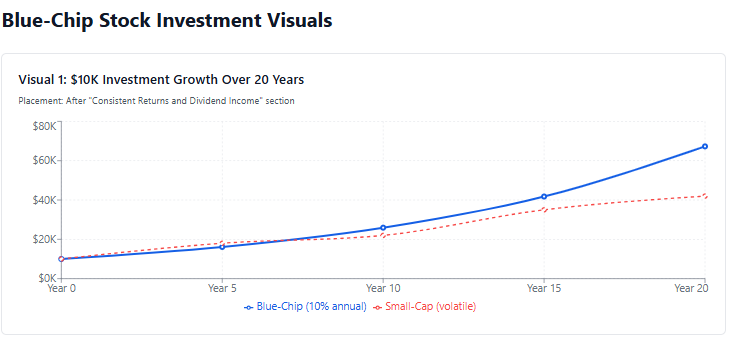
If you include dividends, returns actually improve. While 2-4% dividend yield may not seem impressive, when those dividends are reinvested over the years it is a great multiplier of total return. That quarterly dividend check that you accumulate can be used for new investments or living expenses in retirement, or better yet reinvest it back into your total holding.
As an example, if you had invested $10,000 into a blue-chip stock like Johnson & Johnson two decades ago, with dividend reinvestment today you would have around $60,000 off of a boring old healthcare company (or a 6x return).
Wealth Preservation and Long-Term Wealth Type of Growth
When stock markets tank, the first thing everybody thinks about is how to preserve their wealth. When the market begins to tumble, blue chips serve as a preserver of wealth. Even though the values of their shares and bonds may drop, blue-chip stocks usually do not face financial catastrophic issues that smaller companies face.
This problem of capital preservation is especially important when you are approaching milestone timeline events in life, for example, if you are 5 years from retirement, you cannot afford to play around with speculative stocks!
In addition to the concept of capital preservation, blue-chip stocks also enable investors to benefit from market long-term growth opportunities and maintain the risk of permanent loss (loss of capital) while building retirement wealth.
Lower Volatility than Growth or Smaller Cap Stocks
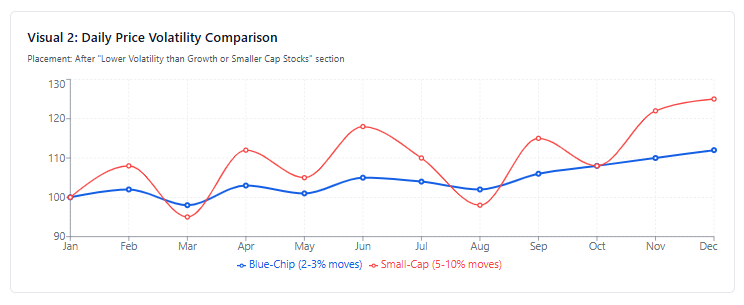
"Sleep-at-night" investing is not a real exaggeration. The psychological benefit of owning solid stocks cannot be underestimated. An investor's portfolio watching small-cap stocks rise and fall daily 5-10% will create market stress which results in poor decisions (e.g. selling in panic).
Blue-chip stocks do have larger price moves from time to time, for example a 2-3% daily price move is a significant move for most blue-chip stocks, however they do not fall 10% or > and indicate doomsday is coming. A less volatile stock or sector (in the case, blue-chip stocks) is favorable for supporting an investor's long-term strategy as opposed to day to day emotional trading.
Portfolio Diversification Anchor
Think of your investment portfolio as a balanced meal. You may add a little bit of spice in the meal such as high-risk (growth stocks or cryptocurrencies) but in order to hold everything together you need to add a rich stable of the most reliable staples (blue-chip stocks).
For many strong investors professionals/portfolio managers, blue-chip stocks serve as the foundation/value of the portfolio. Blue-chip stocks provide reliable returns as offsets versus the large risks associated with other assets.
During a strong bull market blue-chip stocks will capture upside trends and during a bear market blue-chip stocks will have a place to protect against losses (real or not) in the portfolio.
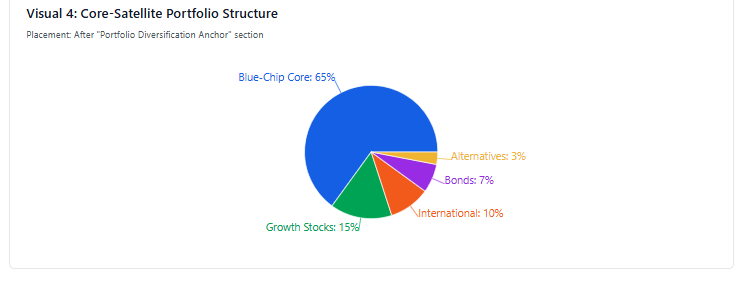
This is also the other reason why some investors utilize a 'Core-Satellite' approach in their investments. The core of the investment (60-70% of an individual investment portfolio) consists of blue-chip stocks and/or index funds; the satellites (smaller portion) of the asset assembly interacts with combinations of other equities, international, growth, alternatives, etc. to allow for a little more potential out-performance.
Understanding Blue-Chip Stock Risks
Blue-chip stocks provide less volatility than other stocks but labeling them “safe”A methodical method that combines qualitative evaluation along with quantitative metrics can lead you to invest in companies worthy of your capital.
Financial Metrics: The Significant Numbers
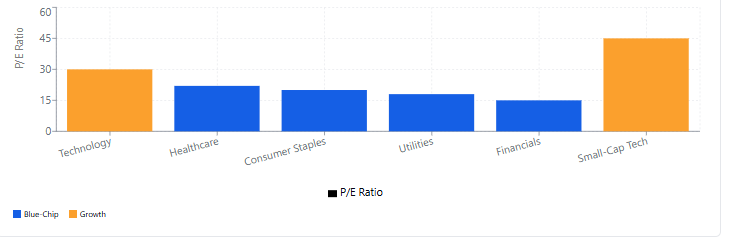
Start with three ratios. The Price to Earnings (P/E) ratio is a ratio of how much you are paying for every dollar of the company’s profits. For example, if the company has a P/E of 20, you are paying $20 for every dollar of annual profit. Compare this ratio against averages in the industry. If Microsoft has a P/E of 30, it can be justified for a tech company on a growth trajectory. If you saw the same ratio for a utility company that is more mature you would presume that it is overvalued.
The Price-to-Book (P/B) ratio comparing the stock price to the company’s book value per share. The book value measures whether you are purchasing stock at a premium or at a discount given the book value of the company’s net worth. Value investors will focus their selection based on a low P/B ratio, while growth stage companies will tend to trade at higher multiples.
The dividend yield explains how much dividend is paid each year expressed as a percentage of the stock price. Dividend yield is straightforward. If the stock is priced at $100, and the company pays a $3 dividend, the dividend yield is 3%.
As you analyze dividend yield, you need to remember that bigger isn’t always better. Generally, if the dividend yield is over 6 or 7%, the dividend yield isn’t sustainable. Either the company will be reducing prices, under duress, or able to pay dividends now but not in the future.
Industry Position and Competitive Advantage
Numbers can encapsulate some of the story, but you want to consider the drivers of how the company is above the line in its field. Does the company have brand recognition that is meaningful? Does the company experience economic scale in prices that competitors cannot compete? Does the company own important infrastructure? Does the company have patents?
Warren Buffett seeks companies that have a “wide economic moat”. The moat is a competitive advantage or sufficient advantage, whether direct or indirect that protects the company’s profit from competition. Coca-Cola has had their brand moat for over 100 years. Amazon has a logistics moat because they are operating at scale. A moat allows the company to have a reasonable position to be profitable for decades.
Profit and Dividend History
You can have good confidence in blue-chip companies because they have a history of performance to observe. Watch for 10 or more years of solid profitability. The more the better! If the company has made it through numerous economic cycles, they will have had time to demonstrate resilience.
If you are a dividend investor you want to observe not only were dividends not reduced, but also increased the dividend and by what percentage in the prior year or beyond. A company that raised dividends consistently 5-10% each year can show confidence in future earnings and profitability.
In addition, you want to recognize the payout ratio and understand that, for expected stability, you want payout ratio under 60%-70%. Higher payout ratios provide less cushion for covering the dividend obligation anyway, during adverse conditions.
Consider ETFs as a starting point
Investing in the blue-chip space through individual stocks requires research, monitoring, and discipline. This is where many investors will look to obtain exposure to blue chips, with an Exchange-Traded Fund (ETF). An ETF can give you immediate diversification across hundreds of blue chips.
Some of the more commonly used blue-chip ETFs would include the SPDR S&P 500 ETF (SPY), or the Vanguard Total Stock Market ETF (VTI). You could also find blue-chip ETFs category specific with sectors (e.g. technology (XLK), healthcare (XLV), consumer staples (XLP), or financials (XLF)). A sector fund allows you to overweight trends in industries you feel will prosper and yet be diversified within that category.
ETFs are often low cost, professionally managed, and easy to invest in. You will not pick the next big growth tech company like Microsoft, but you risk not picking the next big failure like Enron. For most investors this tradeoff is a good trade off for blue-chips as part of investing!
How to Choose High-Quality Blue-Chip Stocks
Selecting the appropriate blue-chip stocks involves more than simply naming the brands you are familiar with. A systematic decision-making process employing a mix of quantitative metrics you see in a company's financial report with qualitative review of the company's growth prospect will help identify the right companies to invest into.
Financial Indicators: The Numbers You Want to Know
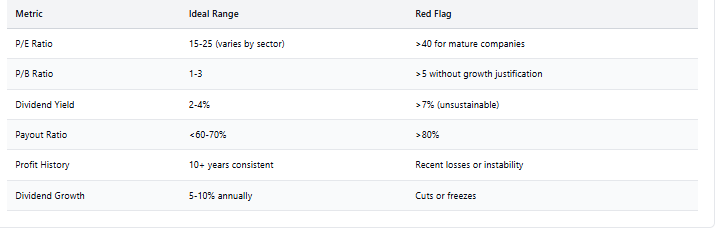
Let's start with three important ratios. The Price-to-Earnings (P/E) ratio indicates how much you are paying for each dollar of company earnings. A P/E of 20 means you are paying $20 for $1 in annual income. It is worth looking at the average P/E for the industry or sector you are reviewing for benchmarking purposes.
For instance, Microsoft's P/E is around 30, which seems like it is high, but not when evaluating growth companies in the technology space. However, if you saw that P/E on a mature utility company, you would view that as a red flag.
The Price-to-Book(P/B) ratio compares the price of a stock to the company's bookkeeping value of equity per share (the net worth). It allows you to determine if you are paying a premium for that company's worth, or forgoing some of the net worth of the company. Value investors are always on the look out for low multiples of P/B and it is usually what you will see, though growth companies will make overall the sector multiples higher.
The dividend yield tells you what the annual dividend payout is as a percentage of the market price of the stock. For instance, if you buy a stock for $100 and the stock pays you $3 annually in dividends, your yield is 3%. The higher the yield, the higher the returns but only to a point. Typically, any stock that has a dividend yield north of 6-7%, you will see that as a reason it is unsustainable.
Industry Position, Competitive Advantage
As mentioned, the numbers will tell part of the story but you will need to see if the company has a superior market position. Does the company have brand recognition, so that they can charge a premium for the product or service? If the company creates products or services that have a similar quality to other competitors, then they can take advantage of increased economies of scale, which reduces any prices. If the company is a good company, do they have an infrastructure or a patent that turns the company into a monopoly, or at least the only game in town?
Warren Buffet, has been known to search for recommendations for companies that he calls "wide economic moats". An economic moat is a sustainable competitive advantage that protects the company's profitability. Coca-Cola has had the brand moat for over 100 years. Amazon created the scale moat due to their logistics systems. These economic moats stop their competitors from successfully doing any business, which allows the company to continue to profit.
Profit and Dividend History
As a general guideline with blue-chip, you want to know the history of profitability. Ideally, you would find a business that has been consistently profitable for more than ten years - the more history the better. If a business can survive economic cycles in the past, or a war, that can give an indicator that the company has a path to survival into the future.
For the dividend investor, you would also want to see growth of dividends along with payout ratios. If the company can record 5-10% growth of the dividend objectives, that is a sign that the company is financially stable and confident in their guidance. The payout ratio (i.e., what is paid in dividends, as a percentage of earnings) is not an exact science but a general rule of thumb, you would want to avoid a payout ratio (i.e., what is paid in dividends, as a percentage of earnings) if above 55-70%.
ETFs as Entry Points for Blue Chips
If you have chosen to invest in individual stocks, you are going to have to do the research, monitoring, and temperance skills to be successful. Many investors prefer to invest in blue-chip stocks by investing in ETFs. For example, SPDR S&P 500 ETF (SPY), and Vanguard Total Stock Market ETF (VTI), will immediately provide you with diversification in hundreds of blue-chips.
Another option is to find an ETF for some of the sector specific blue-chips stocks, that you can overweight, depending on your own prediction that the sector will outperform. For example, ETFs for technology (XLK),healthcare(XLV), consumer staples (XLP), or even financials (XLF).
ETFs now provide diversification, professional money management, low costs, and easy to use. You may not identify the next Microsoft, but you also have no need to take a shot at the next Enron.
For the most part, on the dataset tradeoffs, the majority of the investing population will be satisfied with the ETF, with regards to their returns and volatility.
Proven Investment Strategies for Blue-Chip Stocks
Owning blue-chip stocks is only part of the equation. How you purchase, when you purchase, and what you do with your dividend income could have a significant impact on your long-term returns. Here are the strategies that actually work.
Buy-and-Hold strategy: Time in the market beats timing the market.
Typically, often the best strategy is the simplest. Buy quality blue-chip stocks and own them for decades. It reduces trading costs, eliminates the tax bill, and takes advantage of the intricacies of compounding for longer periods.
For instance, let’s say someone purchased $10,000 worth of S&P 500 stocks in 1980 and held on during every recession, crash, or bear market until today. That investment would be worth over $1 million. However, someone that tried to time the market in and out would have actually performed far worse.
The buy-and-hold strategy works because blue-chip stocks tend to recover from a correction or decline, and they will have new highs over time. Short-term volatility can be ignored, especially when your investment time frame is 20-30 years.
Dividend reinvestment: Compounding on autopilot.
Here’s where it gets interesting. Rather than spending your dividend checks, automatically reinvest them to purchase additional shares. This will snowball over time, because more shares lead to more dividends paid, which leads to purchase even more shares again, which leads to more dividends again.
For example, if you own 100 shares of a $50 stock ($5,000 contribution), a company pays a 3% dividend ($150 total). If you reinvested your cash dividend, it would allow you to buy 3 additional shares. Now next year, you would own 103 shares and have a total similar to $154.50.This carries on year after year, multiplying your share count and dividends exponentially.
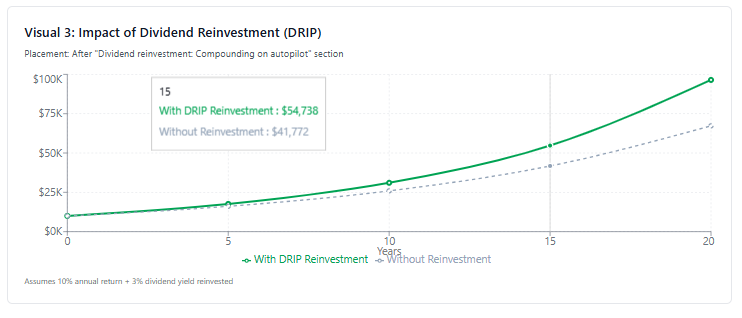
Most brokerage services have Dividend Reinvestment Plans (DRIPs) that implement this strategy automatically. You set it up once and forget it for decades. The results can be astonishing. A $100,000 dollar portfolio invested in dividend stocks yielding 3%, increasing dividends at 5% per year, would grow to over $400,000 over a 20-year period, even if the stock never increased a penny.
Dollar-Cost Averaging: Smoothing Market Volatility
Trying to forecast the perfect time to enter the market is futile. Is now a good reason to invest $50,000 into "blue-chips?" What if the market crashes next month? What if it rallies and you miss it all?
Dollar-cost averaging (DCA) eliminates this decision-making.
Rather than investing all at once, simply spread the investment out over time. For example, invest $1,000 a month for 50 months. Some months you'll buy high, other months you'll buy low. However, over time your average purchase price smooths out the volatility.
DCA has psychological benefits too. You won't have the "regret" of investing everything, only to see the market crash immediately afterward. You'll benefit in rallies but still have cash to buy dips. Most importantly, you'll actually be investing instead of waiting for the "perfect" time to invest.
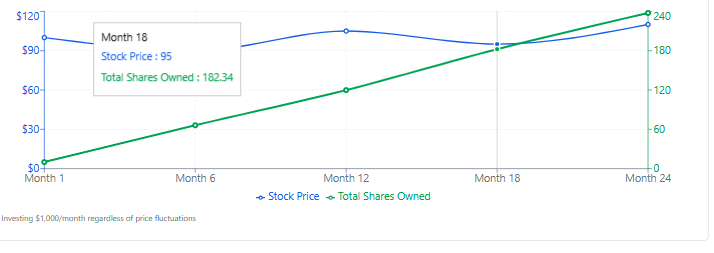
Professional investors may debate the merits of DCA versus lump-sum investing, but individual investors should focus on adhering to DCA since it fosters the discipline of investing consistently. As a behavioral finance issue, this is more powerful than any theoretical mathematical optimization of returns.
Are you ready to start confidently owning a portfolio of blue-chip stocks? The strategies in this book will work only if you take action. Start with one quality blue-chip stock or ETF this week. Set up the automatic dividend reinvestment. Make your first dollar-cost averaging purchase. Your future self will thank you for getting started today rather than waiting until tomorrow.