



Bitcoin has transcended the realm of a tech buzzword, and it is undeniably a financial phenomenon that has altered the way millions view money, investment, and economic freedom. Whether you are a newly curious individual wondering what the hype is all about, or a far more experienced trader wanting to improve your trading, understanding Bitcoin and what it is about is no longer optional in the world we live in today.
This guide attempts to cut through the white noise. We will be looking into what Bitcoin is, how it works, and most importantly, how you can trade it educationally and intelligently, and not be badly hurt by the common mistakes that wipe out new traders in their first experiences.
What Is Bitcoin and Why Does It Matter?
Bitcoin (BTC) is the first of its kind decentralized digital currency that was launched in 2009 by a figure using the name Satoshi Nakamoto. Unlike traditional money held and managed through central and government institutions, bitcoin operates through a peer-to-peer network. No one in the middle, no central authority, just direct digital transactions via the network that are independently verified by thousands of secured computers across the globe.
Think about it like this. When you send money through a bank, the bank verifies the validity of the transaction, and they take their cut for the transaction. Bitcoin completely takes away the intermediary. Instead of having the bank, the network independently confirms everything through blockchain technology, which is simply a transparent ledger that can be verified by anyone and that no one can tamper with.
To the average user, Bitcoin is just a way to shop online without having to share your credit card information or dealing with international transaction fees. For example, a student in Jakarta can pay for his Netflix subscription using BTC just as easily as someone in New York paying for a domain name.
To traders? Bitcoin is a whole lot more fun. Bitcoin is a highly liquid market with 24/7 trading and volatility. Volatility that allows you to make gains that are practically impossible with stocks or forex. Trading platforms such as Binance, Coinbase and BTCDana allow you to speculate on the direction of BTC through spot trades or contracts for difference (CFD) where you can take a position whether the price goes up or down.
Bitcoin gave birth to the entire cryptocurrency ecosystem. Every single altcoin, every decentralized finance (DeFi) protocol, every blockchain [insert your favorite innovative blockchain solution] can trace its lineage back to the original Bitcoin whitepaper. To truly understand BTC is to understand the roots of digital finance.
From Pizza to Billions: Bitcoin's Wild Journey.
Bitcoin reads like a work of fiction. In 2008, an unknown person using the pseudonym Satoshi Nakamoto published a 9 page whitepaper titled, "Bitcoin: A Peer-to-Peer Electronic Cash System." In January 2009, the Bitcoin network launched. The first transaction: Satoshi sent 10 BTC to developer Hal Finney.
The pivotal moment occurred in 2010 when programmer Laszlo Hanyecz paid 10,000 BTC for two pizzas. If you think that sounds outrageous, today that equates to around $430 million worth of pizza. This incident shows how far Bitcoin has come from a nerdy experiment to a legitimate financial asset.
Bitcoin is based on blockchain technology, which is essentially a distributed ledger that records every transaction; it spreads that data across thousands of computers in the blockchain network. When you send Bitcoin, there will be miners (special computers) that compete against one another to solve very difficult math problems that verify your transaction. They have to prove this work, which is what gives Bitcoin a high level of security since a hacker would have to take control of 51% of the network's computing power to do any damage.
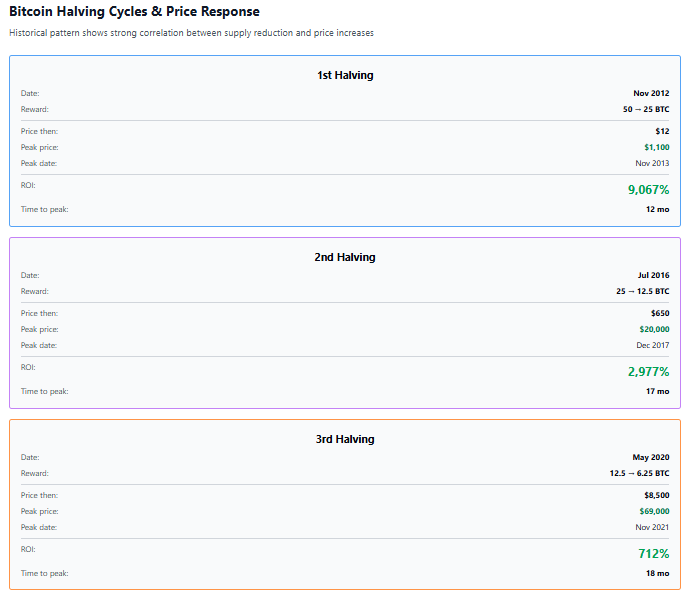
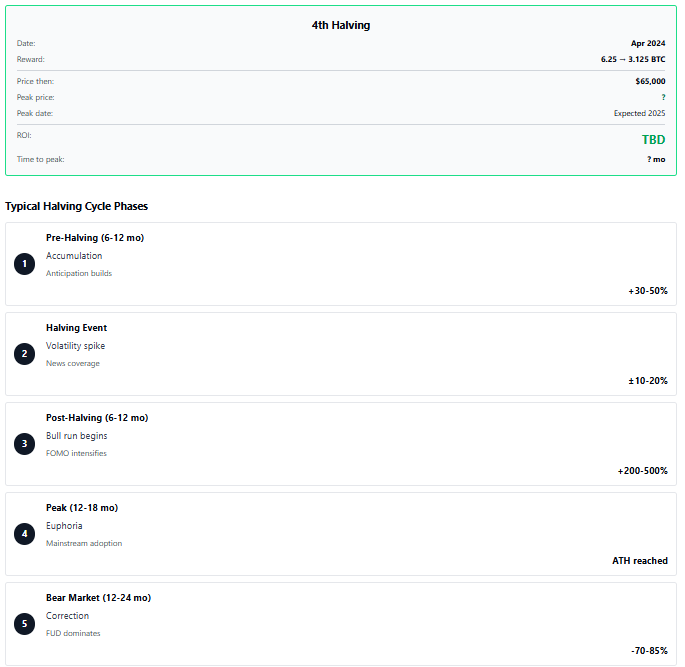
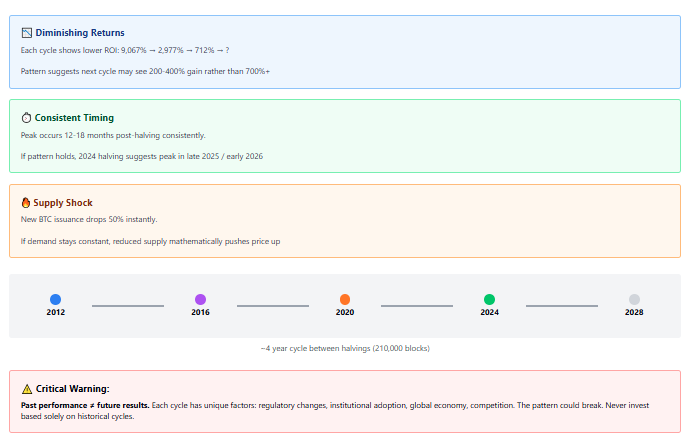
Every four years, Bitcoin goes through a “halving” event, where the rewards miners receive for processing transactions get cut in half. This scarcity principle limits the available Bitcoin in existence to 21 million. Each of the previous halvings (2012, 2016, and 2020) were followed by massive price increases, as a lack of supply went against growing demand.
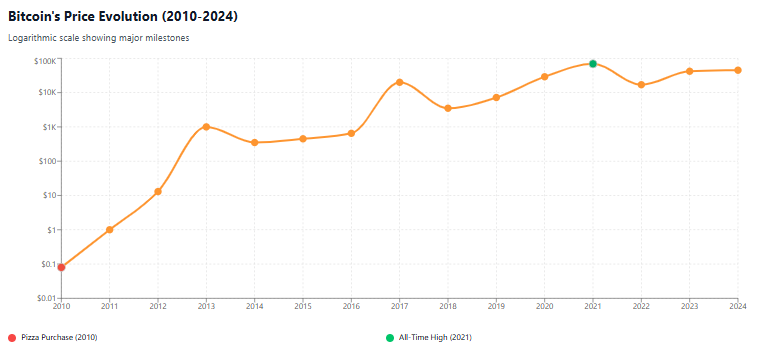
At the beginning of 2017, Bitcoin reached a price of $20,000 before it began to decline in price. Then, in early 2021 we saw another bull run with Bitcoin hitting highs of $69,000 in large part due to institutional investors like MicroStrategy accumulating significant amounts of BTC and other companies like Tesla adding BTC to their balance sheet. At that point we could no longer ignore Bitcoin in traditional finance.
The technology behind Bitcoin generated thousands of competing cryptocurrencies that were all inspired by Bitcoin, however Bitcoin has retained its dominance as the gold standard of cryptocurrency. When people talk about cryptocurrency it is Bitcoin we base the conversation around to gauge the movement of the crypto market.
How to Trade Bitcoin
When you are trading Bitcoin it is a very different experience compared to buying Bitcoin as a long-term hold for investment purposes. When you trade, you are going to try to profit off movements of price rather than holding Bitcoin and hoping for appreciation.
When trading Bitcoin on the spot market, you are actually buying and then owning Bitcoin. This means you are purchasing BTC at the current market price on an exchange, then storing that Bitcoin in a wallet until it goes up and selling; simple and easy. For example if you are trading Bitcoin and bought 0.5 Bitcoin at $40,000 and sold at $45,000 for $2,500 profit (gross, minus fees).
CFD trading (contracts for difference) allows you to speculate on Bitcoin's value without completely owning the digital currency. Essentially, you are "betting" on whether Bitcoin will increase or decrease in value. CFDs include leverage, which is the ability to control larger positions without fully funding the whole position. For example, using 10x leverage, you have the ability to control $10,000 worth of Bitcoin with $1,000. This is great until you realize that losses on leverage operate the same way, you lose as much as you gain!
Bitcoin's value runs on supply and demand, just like any other commodity. When more people want to buy than sell, the price increases. Major news events, regulatory announcements, and market sentiment contribute to the volatility. Unlike stock markets, which close for weekends and holidays, Bitcoin trades 24 hours a day, 7 days a week, 365 days a year. It is constantly moving, which provides some opportunity but vague prices can change violently while you sleep.
Exchanges such as BTCDana, Binance, and Kraken act as intermediaries for buyers and sellers and charge a small amount to facilitate trades. Not all exchanges provide the same level of liquidity, though. High-volume exchanges offer billions of dollars worth of transactions daily, which means you will be able to enter and exit positions quickly with little price movement.
A practical example would be if you saw BTC was consolidating over the $42,000 price level for a number of days, and technical indicators pointed to a breakout scenario. You might decide to go long on a CFD (Contract for Difference) with 5x leverage. If BTC subsequently moved up to $44,000 your long position would have delivered a 23.8% return rather than 4.8%. Conversely, if BTC moved down to $40,000, you would be subject to a 23.8% loss rather than a 4.8% loss. This is one of the advantages and disadvantages of leverage.
Bitcoin's Role in the Global Financial System
Calling Bitcoin "digital gold" isn't just marketing hype. Like physical gold, Bitcoin has limited supply, can't be printed by governments, and serves as a hedge against inflation. When central banks flooded economies with stimulus money during COVID-19, savvy investors poured capital into Bitcoin as a store of value.
Beyond investment, Bitcoin solves real problems for millions of people. Cross-border payments that normally take days and cost 7-10% in fees? Bitcoin handles them in minutes for a fraction of the cost. Freelancers in developing countries receive payments without needing bank accounts. Remittances that would lose 15% to Western Union now cost pennies.
Institutional adoption tells you everything about Bitcoin's legitimacy. MicroStrategy holds over 150,000 BTC as a treasury asset. Tesla bought $1.5 billion worth in 2021. Major banks that once called Bitcoin a fraud now offer crypto custody services to wealthy clients. In 2021, El Salvador became the first country to adopt Bitcoin as legal tender, giving its citizens an alternative to the US dollar.
Pension funds, hedge funds, and family offices allocate small percentages to Bitcoin for portfolio diversification. The argument goes like this: if there's even a 5% chance Bitcoin becomes a global reserve asset, the potential upside justifies the risk even if it fails.
Bitcoin represents more than just another asset class. It's a parallel financial system that operates outside traditional banking, resistant to censorship and government control. That terrifies some regulators and excites libertarians in equal measure.
Essential Bitcoin Trading Terminology
Navigating Bitcoin discussions without understanding key terms is like trying to read a foreign language. Here's what you need to know:
Blockchain is the distributed ledger technology recording all Bitcoin transactions. Think of it as a shared accounting book that thousands of computers verify simultaneously.
Mining refers to the process where powerful computers solve mathematical puzzles to validate transactions and secure the network. Miners get rewarded with newly minted BTC.
Wallets store your Bitcoin. Hot wallets connect to the internet (convenient but vulnerable to hacks), while cold wallets stay offline (secure but less accessible). Ledger and Trezor make popular hardware cold wallets.
Private keys are like passwords that prove you own specific Bitcoin. Lose them, lose your BTC forever. No password recovery service exists.
Public keys are like email addresses where others can send you Bitcoin. They're safe to share publicly.
Exchanges are platforms where you buy, sell, and trade cryptocurrencies. Think of them as crypto versions of stock brokerages.
Halving events occur every 210,000 blocks (roughly four years) when miner rewards get cut in half, reducing new BTC supply.
Market cap means total value of all Bitcoin in circulation. It's calculated by multiplying current price by total supply.
Volatility measures how much and how quickly prices change. Bitcoin's high volatility creates trading opportunities and risks.
HODL started as a typo of "hold" but became crypto slang for long-term holding despite market turbulence. Real traders HODL through dips.
Bull markets see sustained price increases, while bear markets feature prolonged declines. Bulls push prices up, bears drag them down.
Leverage lets you control larger positions with less capital. It amplifies gains and losses proportionally.
Margin is the capital required to open leveraged positions. If your position moves against you, margin calls force you to add funds or close positions.
Liquidity measures how easily you can buy or sell without affecting price. High liquidity means smooth trading; low liquidity causes slippage.
Gas fees (network fees) compensate miners for processing your transaction. Fees spike during network congestion.
Fiat refers to government-issued currencies like USD, EUR, or INR. Bitcoin is exchanged for fiat on most platforms.
Understanding these terms transforms confusing crypto conversations into clear strategic discussions.
Established Trading Strategies for Bitcoin
Different objectives necessitate different methods. Here are three fundamental approaches:
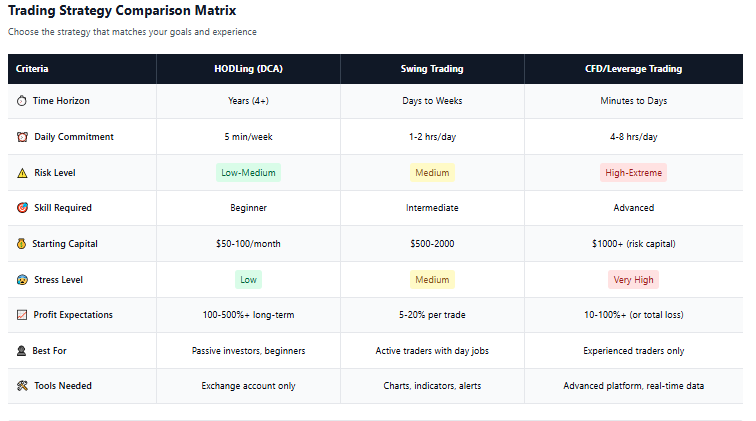
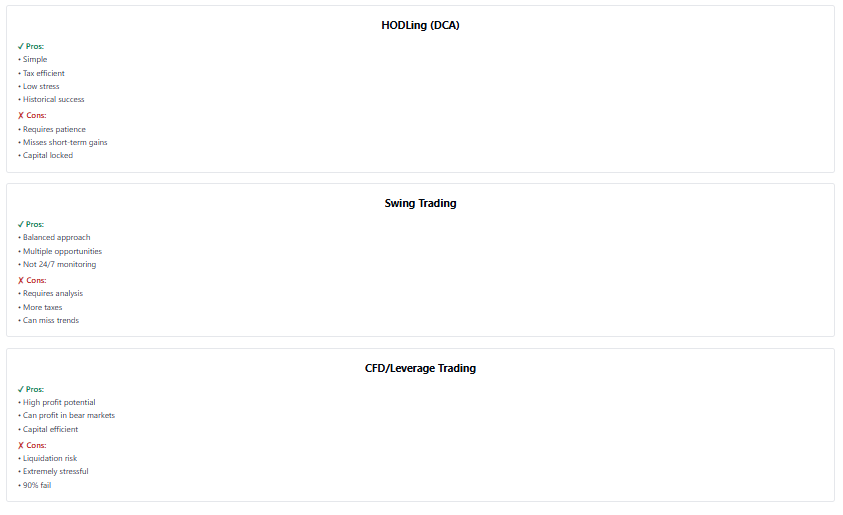
HODLing (long-term investing) entails purchasing Bitcoin and simply holding it for multiple years, regardless of what the price does in the short term. The thought process is that Bitcoin's long-term price trajectory is upwards regardless of short-term volatility. Historical data supports this logic. If you bought Bitcoin (BTC) more than four years ago and held it, you will have accumulated profits today. With dollar-cost averaging (DCA), investing a set amount on a regular basis can take this concept even further. For example, invest $100 every Monday, regardless of price. Doing the strategy with DCA allows you to ignore volatility and the idea of timing the market with your emotions.
Swing trading looks to profit from medium-term price movements lasting a few days or weeks. Swing traders will look for technical analysis to determine price support and resistance level. They buy near support and sell near resistance. For example, if Bitcoin repeatedly bounces off of $40,000, that is a strong level of support. A swing trader may buy around $40,000 and look to sell near the $45,000 level of resistance. Swing trading requires more active involvement than HODLing but less than day trading.
CFD/Leverage trading is the strategy for experienced traders that are comfortable with risk. A trader will speculate on price movement but with borrowed money. A trader may see Bitcoin forming a bullish pattern generously after weeks of consolidation. The trader decides to open a long position using 10x leverage. If BTC rises 3%, the trader gains 30%. However, if BTC falls 3%, the trader loses 30% and potentially faces liquidation. As a result, portfolio position sizing and even stop-loss orders become incredibly important tools for survival as a trader.
The Relative Strength Index (RSI) is an indicator used to determine if Bitcoin is overbought (above 70) or oversold (below 30). Moving averages are smooth averages of price action utilized to determine continuing trends.When the 50-day moving average rises above the 200-day moving average, it represents a bullish "golden cross." The Momentum Average Convergence Divergence (MACD) will indicate momentum changes.
Example: You are swing trading and see Bitcoin's RSI has reached 25 (oversold zone) after a panic sell. Historical events show that BTC tends to bounce back strongly from oversold situations. Because it bounces back strongly, you enter the trade at $38,000. As the RSI returns to neutral, and the price returns to $42,000, you exit with a 10.5% gain in approximately two weeks.
Remember, the most important advice is to link your strategy to your own risk tolerance, your time commitment to trading, and your knowledge of the market (what you think will work, based on past cycles). I advise NEW traders to practice WalMart "DCA" and "HODL" before considering leverage.
Risks, Regulations, and What's Next
Bitcoin's volatility is not a bug, it is a feature. Bitcoin decimal prices can move 10% -20% in a day, based on a tweet or regulatory announcements. From a peak of $69,000 in 2021 to less than $17,000 late 2022, many over-leveraged Traders or Emotional Traders got destroyed. Volatility creates opportunity, but it also requires a strict risk management strategy.
Regulatory climates vary greatly. The US has treated cryptocurrencies as "property" for tax purposes, but governments have scrutinized exchanges. The SEC approved spot Bitcoin ETFs in early 2024, providing legitimacy to BTC for traditional investing. Europe passed the MiCA framework as more straightforward regulations for crypto. Singapore has embraced innovation with regulations. China has banned trading of cryptocurrency. Trading globally will be messy with all these differing rules and regulations.
Lastly, market manipulation is a risk in an immature market like crypto. The "whales," or those holding large amounts of BTC, can manipulate the market with large trades. Pump-and-dump schemes exist within smaller cryptocurrency, however Bitcoin is large enough as an asset to escape a lot of these schemes.
Environmental critics highlight the energy consumption of Bitcoin mining since the network uses more electricity than some countries. The industry states that mining is becoming increasingly reliant on renewable energy and Bitcoin's value justifies the environmental impact of mining, claiming that we would not have the same public outcry about the environmental impact of mining gold.
In the meantime, institutional adoption is only accelerating. With more ETFs, clearer regulations, and more mainstream acceptance, Bitcoin could find its way into six figures. The caveat is that Bitcoin's popularity could face competition from another improved cryptocurrency or be regulated into irrelevance. Next, the next halving isn't far away . In 2028, miner rewards will be slashed in half yet again, and, if history holds, this could spark another bull market.
Essentially, the future of Bitcoin revolves around three elements: regulatory clarity providing confidence, technological advancements keeping the Bitcoin ecosystem secure, and educating new participants about what they are actually investing in.
Tools for Your Bitcoin Trading Experience
Perhaps this is all moot, but if you consider yourself a smart trader, here are some of the most common tools:
Buying / Trading Program (Exchange): Some of the biggest names in the "Exchange trade" of Bitcoin are BTCDana, Binance, Coinbase, and Kraken. Depending on the exchange, the features, trust, fee structure, and usability all vary to fit your needs. BTCDana exchange is one of the few exchanges that allows for a global activity stream, has competitive spreads, and education resources (Live stream + blockchain school) for new participants.
Charting Program: TradingView offers a variety of professional tools for price analysis. You can overlay indicators of your choice, draw trend lines, and set alerts at price levels you specify. A simple reference for tracking price, market cap, volume, etc. is Coin Market Cap.
Portfolio Tracker: CoinStats and Delta provide category performance. Do you have multiple wallets and/or exchanges? You can monitor all your holdings, calculating taxes on gains/losses and seeing allocation by assets.
Security Tools: Security tools quickly became the most important part of your investing overall. Hardware wallets such as Ledger and Trezor can help comfortably store your private lock up, offline. This creates a buffer between you and exchange hacks. (If I were you, I'd never plan on keeping larger amounts of currency on exchanges long-term).
Professional example: A trader identifies BTC breaking up and out over a descending resistance line on TradingView. They confirm the breakout with upswings in volume via CoinMarketCap then place the trade on BTCDana with a stop-loss 5% below entry and take-profit to the next resistance level while managing their position and security practices at each step in order to protect their capital.
Beginner example: Someone new to trading downloads BTCDana's app, opens a demo account using virtual funds, and practices reading BTC/USDT trading charts. The demo account allows for no-risk learning and practice, while watching Youtube videos, or CoinMarketCap to track Bitcoin's 24-hour volume and market dominance.
Even having the right tools and bundling it doesn’t guarantee you will profit, but it will improve your chances significantly; simply because you have good data to consult and you can enter and execute trades quickly and systematically.
Common Mistakes that Cost Traders Money
Learning from others mistakes will beat learning from your own:
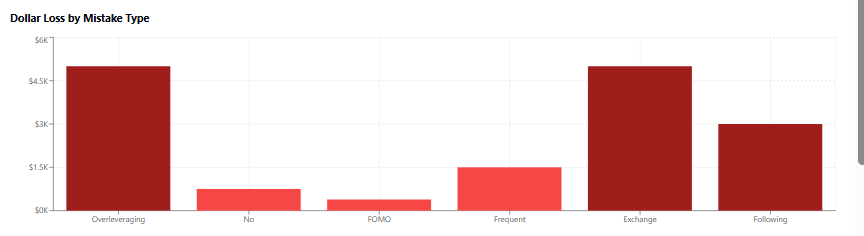
Trading without a plan can lead to emotional decisions substituting for systematic strategy. You will become the person that buys in a FOMO rally after market resistance and then panics sells at declines for loss. Solution: Write down your criteria for entering a trade, entry price, your position size, stop-loss and take-profit, and record that all before making the trade.
Overleveraging is essentially how newcomers blow up accounts. That 50x leverage sounds appealing until you take a loss on a 2% movement against you and get liquidated. Solution: Start trading with no leverage at all...experience some movement, then learn how to use the leverage, and always risk no more than 2% of your capital in a trade.
Security: If you ignore your security, you are susceptible to having your funds stolen. Keeping your Bitcoin on an exchange means you are trusting them with your money. The market has seen exchanges like Mt. Gox, Quadriga, and FTX collapsed and people lost all their funds.Solution: Transfer important assets to cold storage. Implement two-factor authentication everywhere.
Emotional trading wrecks accounts. Media hype gets investors to FOMO buy at the top. Fear gets investors to panic sell at the bottom. Solution: Set rules and stick to them mechanically. If you’re going to buy and sell under stress during heated markets, take breaks.
Confusing fees can make you lose profits quickly. Trading fees, spread, network fees and slippage add up quickly with frequent trading. Solution: Calculate your all-in costs before trading. It's important to know the fee structure and choose exchanges with clear fee structures.
Hype often leads you to buy tops and hold bags. Every crypto YouTuber said it was time to buy because they projected massive gains in the 2nd quarter of 2022. Solution: Do your own analysis. Make sure you are comfortable with what you are buying and why.
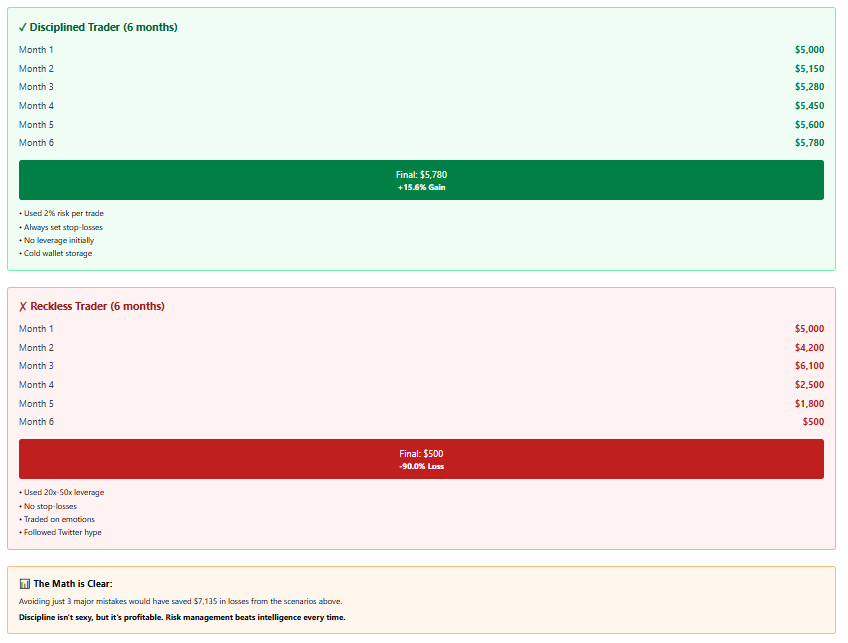
Real life example: Someone sees Bitcoin is pumping on Twitter. They buy with 10x leverage at $65,000. Then Bitcoin drops to $60,000, and their position is liquidated for an entire loss. What if they used no leverage and were disciplined about position sizing? They would have been waiting all day to potentially recover some of that position because they'd still be in the game.
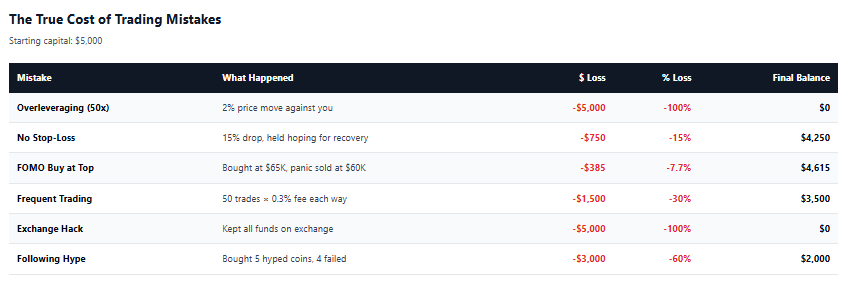
In trading, discipline will always win over intelligence. The smartest person in the world that risked nothing is still going to lose to a person with the average intellect who strictly followed their risk management rules.
Your "Bitcoin Trading Checklist"
Are you ready to get started? Let's get started:
-
You will need to create a BTCDana account. This is done in a few minutes or less by simply verifying your email and completing some basic information.
-
Complete your KYC verification by uploading your identification. This helps ensure confidence in both whether or not the platform will be safe and compliant with regulatory agencies.
-
Utilize the education pages expecting to learn something while opening a demo account to safely practice trading with virtual funds before risking your real money.
-
Choose your strategy based on your time investment commitment and risk tolerated. As a passive investor, DCA could be ideal; For someone who would consider themselves active, swing trading could be enjoyable in an effort portfolio; If you enjoy risk and are an experienced trader, you may be inclined to try using CFDs.
-
Start slowly using amounts you can abstractly afford to lose. If you put $50 into a demo account and learn how that amount risks all-in, you will learn more than reading an article for 20 minutes. Incrementally scale up for the increased confidence and skills you're developing.
-
Risk management and trading should go hand in hand. You should never risk more than 2-5% of your trading capital on any single position. Make sure you are religiously using stop-losses.
-
Weekly review to analyze what worked, what did not work, and why.
-
Keep a trading journal of when you entered trades, exited trades, your reasoning for the position, and what the outcome was.
Beginner example: You open a demo account with BTCDana and spend a week watching what Bitcoin does in the different market sessions. You watch how it bounces off levels of support and resistance, then practice by entering trades for small positions and see if you can exit close to the resistance. When you understand there are basic principles to watch, you deposit $100 and your heart races as you enter a real position for 1% without getting excited while waiting to see how it plays out.
Professional Example: A professional trader, who I would consider an expert using the BTCDana analytics dashboard, is monitoring Bitcoin's correlation to the traditional markets and the funding rates. They notice it is time to investigate an opportunity because they observe negative funding on a short. They quantify their decision and ride the tail end of a calculated long position in a potential short squeeze.
The important part isn't if you start perfectly. The most important part is starting safely, learning, and managing risk in a ruthless way.
Are you ready to take charge of your financial future with Bitcoin? If so, open your BTCDana account today and join thousands of traders who now have a smarter opportunity for trading in crypto markets. You could be within minutes of your first trade.