



If you've been involved in crypto for a while now, you have likely heard traders busy talking about "altcoin season," one of those periods in crypto that feels somewhat mystical: Everything seems to be appearing green in your portfolio, and coins you bought on a whim are suddenly pulling 2x, 5x or 10x. So what is going on? More importantly, how do you spot it before anyone else can?
Let's dive into everything you need to know about altcoin season, from the basics of its meaning and symptoms to practical tactics that can position you ahead of the next altcoin season.
What Is Altcoin Season?
To start, let's establish what an "altcoin" is: if a cryptocurrency is not Bitcoin, it is an altcoin. Ethereum, Solana, Cardano, XRP—the list is long. While Bitcoin might be the first rowdy kid on the blockchain street, altcoins are the experimental, venture-capital frontiers of the cryptocurrency world.
An "altcoin season" takes place when, simply put, alternative cryptocurrencies begin to outperform Bitcoin over a significant amount of time. Altcoin season is a broad shift in market momentum—in fact, you could even remember it as the moment when a force (An altcoin season) started a widespread rally oriented altcoins. If we want to put a number to it, you'll see seeing at least ~75% of the top 50 cryptocurrencies have performed more advantageously than BTC. This is not because of a few altcoins having success; it's because prices are rallying across the market.
The biggest altcoin season in recent years was during the 2021 cycle, where Ethereum didn't just keep up with Bitcoin or even lightly outperform it, but outperformed Bitcoin to an even greater degree. The ETH/BTC ratio absolutely skyrocketed while all of this took place, mostly because DeFi protocols became popularised and the hype drove the entire sector up with it, with all of these previously unknown projects meanwhile becoming well known in crypto thinking and delivering life-changing returns to early investors.
Let’s break it down: think about the stock market and how blue-chip stocks like Apple and Microsoft are taking a break at that moment, causing medium-cap tech stocks to shine a bit more. This is exactly what happens even during altcoin season, but with greater gains or losses and volatility.
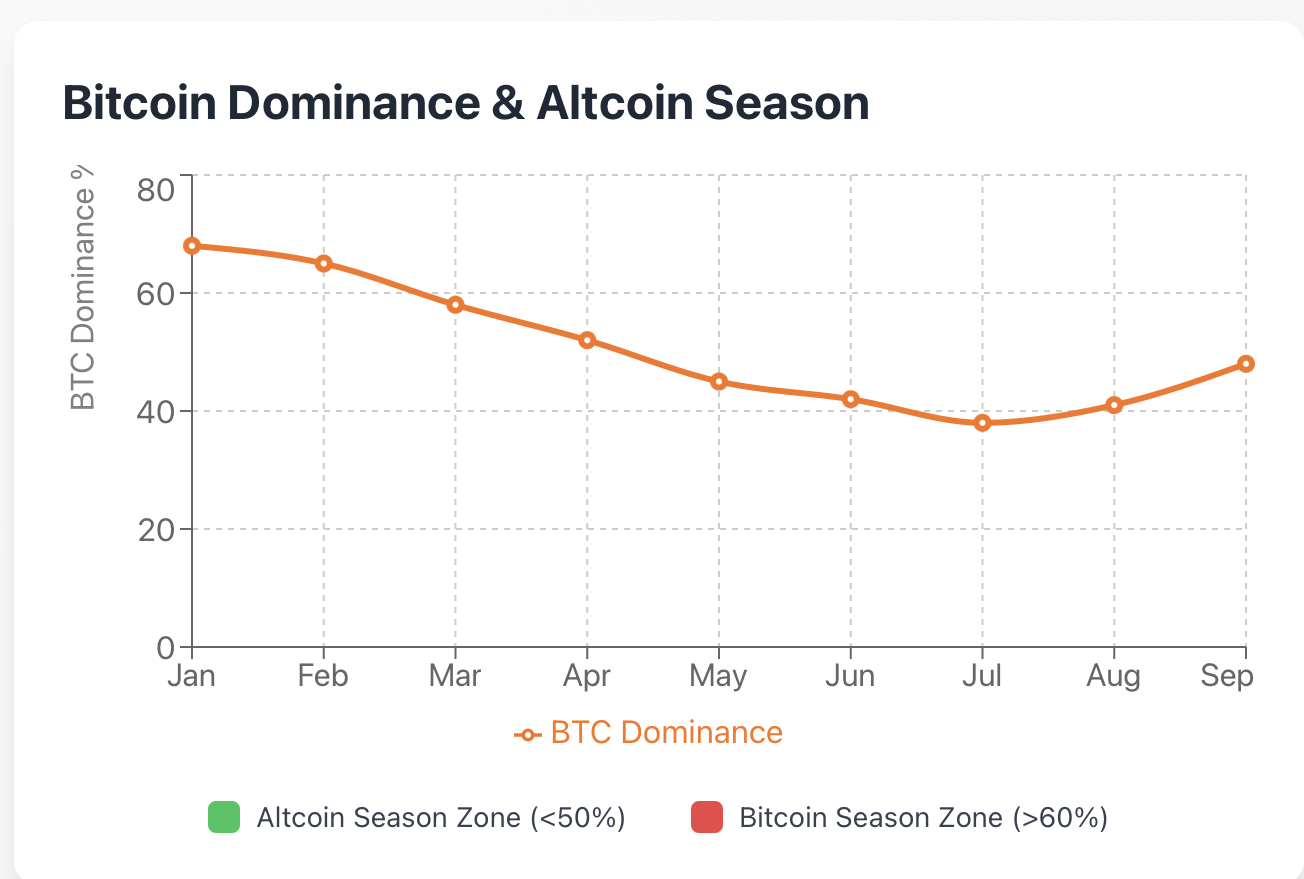
The clearest sign is how Bitcoin dominance - the percentage of Bitcoin's market cap is relative to the total crypto market - is declining. When the percentage of Bitcoin dominance drops from, say, 60% to 40%, the capital is not gone; it has rotated into the altcoins.
Why Does Altcoin Season Happen?
Altcoin seasons do not materialise spontaneously. Rather, they are driven by commodity flows and behavioural finance. The cycle typically begins with Bitcoin. BTC rallies first, as it attracts the attention of mainstream media and brings in new money to cryptocurrencies. Early investors (and whales) will begin taking profits after bitcoin rallies. However, they will not cash out completely, so they should deploy those profits into altcoins in search of the next big opportunity.
Then the cascading effect follows. In most instances, Ethereum benefits from this first, as it is the largest altcoin and underpins most of the DeFi activity. After that, money usually trickles down into lower-market deals, layer-2s, and eventually the most speculative plays like meme coins. Innovation also drives a fair amount of this. Narratives emerge - DeFi summer, NFT mania, AI blockchains - and suddenly everyone wants to appear to be involved in the hottest sector.
Remember Dogecoin in 2021? It did not take off because of fundamentals. It took off because of speculation on social media and FOMO.
The psychology is simple: after a big Bitcoin rally, Bitcoin has stabilised, and traders start getting impatient and they want to see those 10x opportunities after having seen BTC go 2x or 3x. Altcoins are the next logical place to search for opportunities because they have smaller market caps, higher volatility, and inertia means more potential upside.
Consider it like a party. Bitcoin is the first one to show up, and the crowd gets all excited. Then, once BTC has settled into a groove, they decide to make an entrance, and things really get going. The big takeaway? Altcoin season is not a separate bull market. It's just another round of capital rotation in the middle of an overall crypto bull cycle.
Historical Altcoin Seasons: What Past Cycles Teach Us
Reflecting on the history of crypto, we see a trend: Altcoin seasons are cyclical and follow similar trends.
The first major altcoin season was during the 2017 ICO Boom. Initial coin offerings were the hot narrative, and projects were able to raise millions of dollars simply by publishing a white paper. Ethereum soared to new heights, as it was the main platform of most ICOs. Coins like Cardano, NEO and Litecoin achieved astronomical gains. The party lasted about five months, before the 2018 crash wiped out the vast majority downside there.
The 2021 DeFi and NFT Explosion was even more explosive with a new narrative: decentralization financing and digital collectables. Ethereum again led the charge, but new chains like Solana, Avalanche, and Polygon were rapidly capturing market share with faster and cheaper alternatives. This altcoin season lasted from approximately January to May 2021, with some coins attaining returns of 50x or even 100x. DeFi protocols were able to achieve blue-chip status, including products like AAVE and Uniswap.
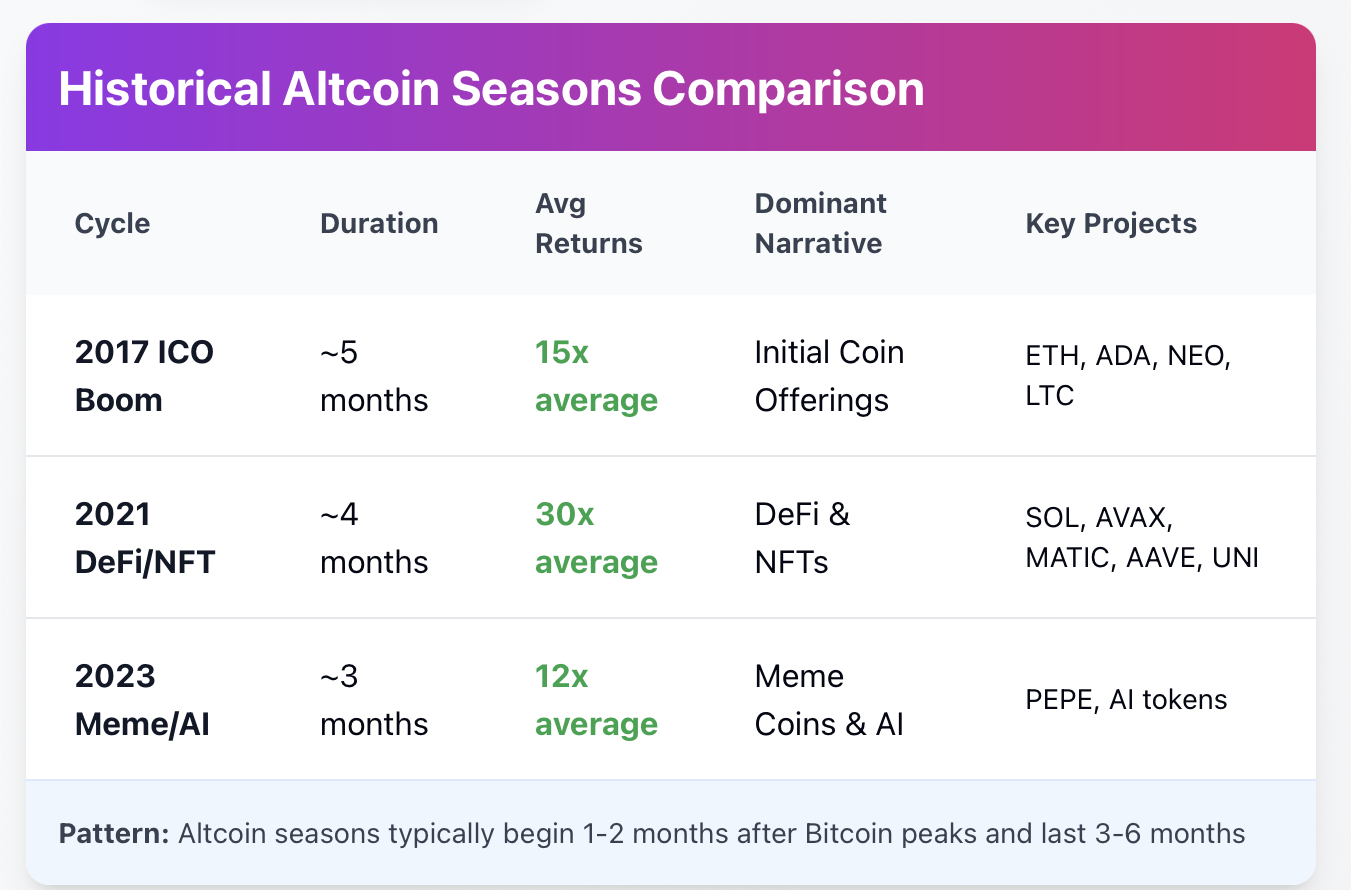
The 2023 Meme and AI Surge has demonstrated that altcoin seasons are maturing. Although this cycle was shorter in duration, the intensity was far stronger. Meme coins like PEPE took off, and anything with "AI" in its name was attracting capital. Although the cycle only lasted around three months, the volatility was through the roof.
What do these cycles have in common? Typically, altcoin seasons will begin one to two months after Bitcoin peaks. The average cycle will last between three and six months. Gains during the altcoin season happen in whatever narrative is driving market interest during the season.
So, what can we take away from this? If you know where we are in Bitcoin's cycle, you can estimate when we can begin looking at altcoins. History does not repeat perfectly - but it does rhyme.
The Macro Picture: How Global Economics Shapes Altcoin Season
Understanding cycles of crypto requires a broader understanding of the global economy. Altcoins don't exist in a vacuum. They're subject to the same macro forces that affect trading in stocks, bonds, and commodities.
Central bank policy has a huge effect. When the Federal Reserve cuts interest rates and injects liquidity into the financial system, risk assets generally do well. Crypto is included in this category. The bull market for crypto in 2020–2021 during the pandemic was an example of monetary stimulus that had never been experienced before, due to COVID-19. Cheap money entered speculative assets, and altcoins went parabolic.
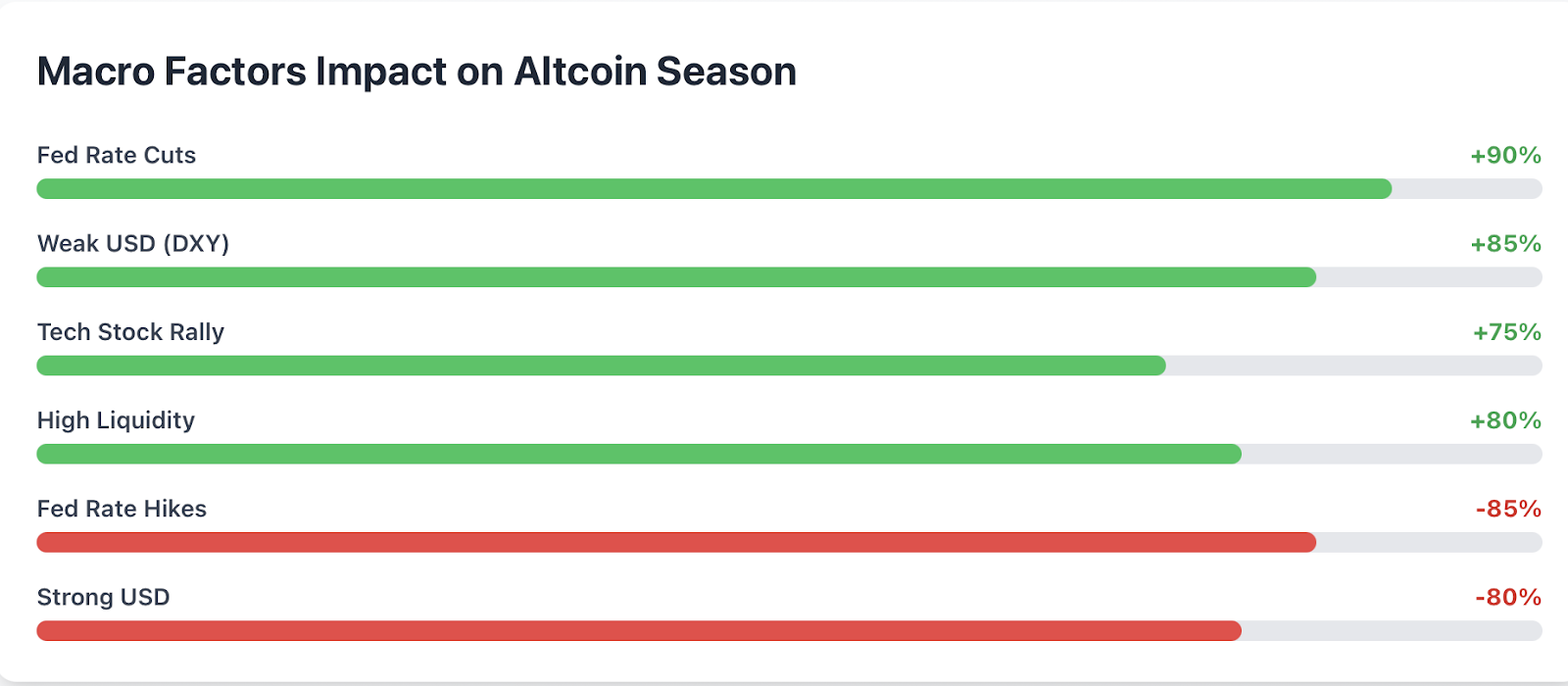
On the other hand, when interest rates go up and liquidity contracts, crypto will suffer, especially in the 2022 bear market, which severely impacted altcoins, as the Fed increased interest rates to combat inflation.
Conversely, when central banks inject cash into the economy, the rising tide will lift all boats. Bitcoin will absorb a relative benefit, but again, the smaller altcoin boats will rise even faster than Bitcoin's, as they're generally larger betas relative to changing risk appetite.
There is also some correlation with traditional risk assets. When tech stocks are rallying and the S&P 500 is making all-time highs in the past month, crypto tends to trail them. Investors are in risk-on mode, willing to chase returns higher and higher. When stocks sell off, crypto is then perceived as an even riskier asset and often sells off deeper than stocks do, further underscoring the correlation.
The strength or weakness of the US dollar is also significant. As the dollar weakens, measured in terms of DXY (a dollar index), the effect will often be a stronger crypto price. Why? A falling dollar is often bullish for crypto, as it usually means a more accommodative monetary policy, leading investors to find alternative assets like crypto.
If you are aware of these macro conditions, you can better determine whether it is time to invest in altcoins. For instance, if the macro situation is tight and the Fed sounds hawkish, do not expect altcoins to run anytime soon. But if the macro condition changes, that's when you need to start paying attention.
Capital Rotation Across Blockchain Ecosystems
Not every altcoin is perfectly correlated. Capital rotates through altcoin ecosystems during an altcoin season is often fairly predictable. The process usually begins with Ethereum. As the largest and most well-established altcoin, ETH acts as the point of access for capital leaving Bitcoin.
However, it creates problems when ETH is successful. When the Ethereum network gets overly congested and gas prices soar to $50 or $100 per transaction, developers and users start looking for alternatives. That's when Solana, Binance Smart Chain, Avalanche, and other layer-1 blockchains get their opportunity.
These blockchains promise to be faster and cheaper versions of Ethereum. In the 2021 cycle, Solana's total value locked (TVL) skyrocketed as DeFi users moved to save on exorbitant gas fees and were looking for something more cost-effective. Layer-2 solutions like Arbitrum and Optimism also benefit from this trend, as they exist on Ethereum but offer a cheaper solution. As the cost-benefit analysis begins, the capital flows.
Eventually, the rotation will enter more speculative areas of the market. After the major layer-1 blockchain protocols have seen their runs, the hunt is on for the next 100x coin. That is when the meme coins, micro-caps, and experimental protocols start to pump up. This is usually the late stage of alt-season, and is probably the riskiest.
The typical rotation looks something like this:
Bitcoin → Ethereum → Major Layer-1s → Layer-2s → Niche Sectors → Meme Coins.
If you're hearing your barber tell you about the latest dog coin, that cycle is near the end.
It is essential to understand the inner rotation when investing. By determining which rotation phase we are in, you can ensure that you'll be ahead of the EA and discover the next wave, instead of chasing after coins that have already pumped.
How to Spot Altcoin Season Early
The positive aspect is that you will not need to speculate about when the altcoin season begins.
You will have tangible, quantifiable metrics that you can track.
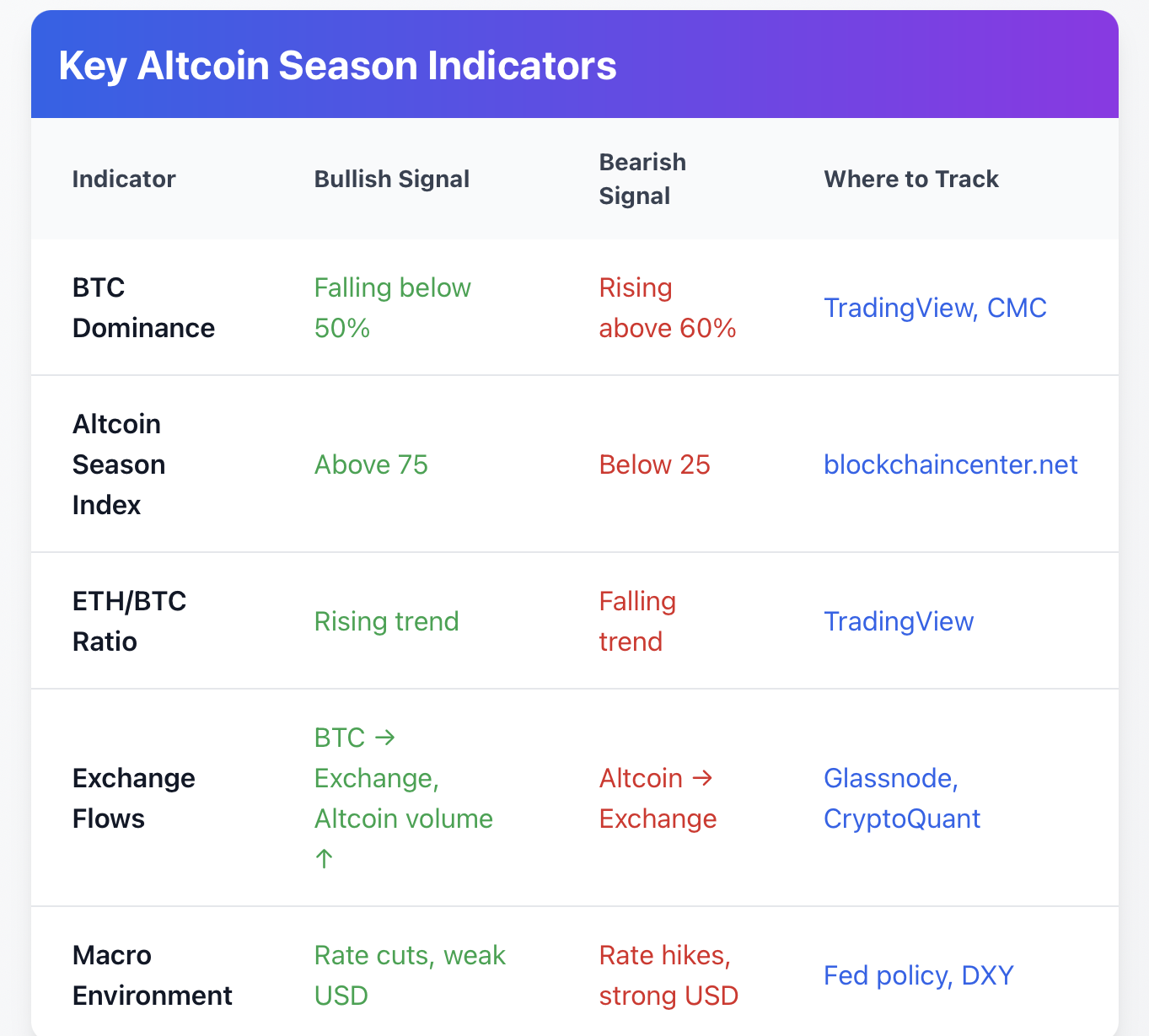
Bitcoin Dominance is the paramount metric. When BTC dominance falls below 50% and continues its downward trend, it indicates capital is rotating into altcoins. You can track this in real time on websites such as TradingView or CoinMarketCap.
The Altcoin Season Index on blockchaincenter.net is another helpful tool. It indicates how many of the top 50 altcoins have outperformed Bitcoin over the last 90 days. Any timeframe over 75 indicates that Altcoin season is in full swing. The index reached 80 in 2021, and coins such as Solana obtained 10x returns shortly afterwards.
Data on exchange flows or flows of value between wallets and exchanges can help substantiate your view. Large sums of Bitcoin moving from wallets to exchanges usually indicate profit-taking. If you also see a rise in altcoin volume, that's a rotation.
Using tools like Glassnode and CryptoQuant, you can see a much greater range and depth of on-chain metrics to help you spot these early. Professionals are studying this data continuously, and so should you.
In summary, altcoin season can be examined more quantitatively. You don’t need a feeling or Twitter FOMO to know altcoin season. Data is there, you just have to know what to look for.
Trading Strategies for Every Experience Level
The way that you treat altcoin season will depend on your experience and risk tolerance. For beginner traders, the emphasis should be on diversification and risk management. You never want all of your capital tied into one moonshot. Ensure you spread that capital over established projects with actual utility. Don’t forget to set stop losses to protect your investment against unexpected moves. I wouldn’t touch an altcoin or anything else that has already pumped 500% in one week. Those are the moves when you become exit liquidity for better traders.
If you are an intermediate trader, then you can incorporate some technical analysis into your trading. Analyse your entries and exits through moving averages, RSI, and MACD. Look for altcoins that are breaking out of consolidation while BTC dominance simultaneously falls. Typically, when you see that setup, a strong rally is right around the corner.
Advanced traders may experiment with using derivatives to hedge their trading strategy. For instance, you could go long on ETH/USD while shorting BTC/USD. This trading strategy profits if Ethereum rallies more than Bitcoin rallies, regardless of what happens to the market as a whole. CFDs and futures allow for these advanced strategies; however, they are much riskier.
No matter your level, the primary rule still is to manage risk. Altcoin season can yield awesome gains and also wipe you out if you are overleveraged or caught holding through the pullback.
When Will the Next Altcoin Season Arrive?
We can make informed assumptions based on historical trends for future market cycles. Altcoin seasons (periods of sustained price increases in altcoins) usually occur six to nine months after a Bitcoin halving. A Bitcoin halving is an event that reduces Bitcoin production and creates a supply disruption that, in the past, caused bull markets.
The last Bitcoin halving was in April 2024. If the trend holds, we may find ourselves in altcoin season in late 2024 or early 2025. We will want to examine data from CoinMetrics and Santiment to confirm whether the timeline plays out.
Note that this time might be different: altcoin seasons may be shorter but more powerful. With better market infrastructure, information travels faster. Trends may develop faster and burn out faster. The old pattern of months-long time frames may produce no more than two to three months’ time periods before a pullback or consolidation cycle returns.
What should you do? Rely on data, not hope. Examine Bitcoin dominance, assess macro conditions and on-chain data. Once multiple indicators support a position, that would be the time you consider stacking.
The altcoin season marks one of the most lucrative but unpredictable aspects of the crypto sphere. Capital rotating rather than true demand shifts drives the season and can lead to many market participants speculating on trends and subsequent price movements. There is some influence from the macroeconomic environment as well. Understanding market behaviours and cycles, recognising price action with key indicators, and managing your risk will allow you to benefit from the next cycle.
Timing and discipline can be the difference between earning life-changing gains and being an exit liquidity for somebody else. The hardest part is identifying the cycles, having respect for the volatility, and never investing more than you are willing to lose.
Ready to apply these insights in real market conditions? Create a demo account at BTCDana.com and practice tracking altcoin cycles with zero risk before committing real capital.