



What Is a Token in Cryptocurrency?
Tokens are a type of digital asset built on a blockchain. You can think of a token as a programmable piece of value within the crypto space.
Tokens and coins are not the same. Coins like Bitcoin (BTC) and Ethereum (ETH) have their own blockchains. Tokens are built on existing blockchains. For example, USDT is a token built on Ethereum's blockchain. USDT does not have its own blockchain.
Tokens can also serve many purposes. Some tokens serve as payment methods, while others can give a voice on decisions made to a project's direction. Some tokens can provide a reward for being a part of the ecosystem. Other tokens represent ownership of digital or real-world items.
To illustrate the concept of a crypto "token", you can think of a token, in relation to a video game. Tokens (in the game) serve a purpose and are always able to be exchanged with other players in the game. Tokens can be redeemable for real money (depending on the game). Game designers set rules for how those tokens work.
Gaming tokens such as SLP from Axie Infinity function precisely in this manner. Players earn these tokens through gameplay and can then trade them on exchanges or transform them into new characters with "breeding" functionality.
Tokens are simply representatives of value based on blockchain ecosystems. Tokens do not themselves represent a cryptocurrency. They depend on which blockchain they are built on to hold any value. Although some will say this makes them easier to create than coins, it makes them more functional for special application.
Tokens are designed for specific use cases. Some tokens prove value faster than traditional payment systems. Some allow new ownership systems for digital art. Finally, many tokens allow decentralized organizations to operate. A variety of applications then, is the strength of tokens.
Token vs Coin: What's the Real Difference?
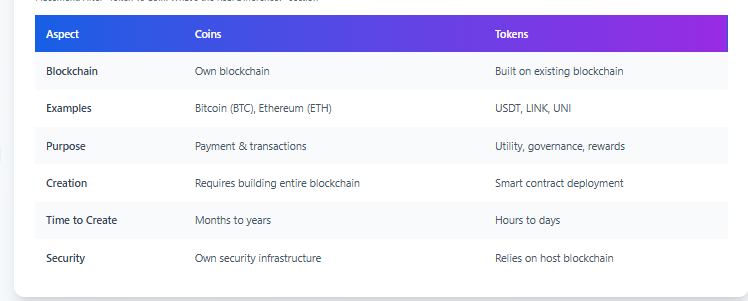
Coins are independent blockchains. Bitcoin is run on the Bitcoin blockchain. Ethereum would run on its own network. They are both standalone systems.
Tokens rely on existing blockchains. Most tokens are run on Ethereum as an ERC-20 token. Chainlink (LINK) is a token. It runs on the Ethereum infrastructure. It doesn't require a stand-alone blockchain.
Coins and tokens serve vastly different purposes. Coins are payment systems more than anything. Bitcoin was invented to be digital money. Ethereum to deploy smart contracts.
Tokens are used to encourage participation within an ecosystem. BNB tokens let users pay lower fees on Binance. UNI tokens are voting rights in the Uniswap ecosystem. These roles go beyond payment systems.
You can think of the difference this way: coins are like currency that are controlled by a government. The government controls the currency and everyone in a country is able to conduct basic transactional exchanges. Tokens are used as loyalty points from a company. Holding tokens gets you additional offerings and discounts from the company ecosystem.
This distinction is important to traders. Coins are mostly stable because they have proven technology and larger user bases, while tokens can expand faster at a significantly higher risk. Tokens may succeed, or fail based on the projects.
To create a coin, you'll need to build an entire blockchain. You need miners or validators. You need security to be established. You need to convince people to run nodes. Entire teams of resources and lots of technical know-how are needed to build out a new coin.
Creating a token is much easier. You just write a smart contract on an existing blockchain. You define the rules. You deploy it. This can take hours instead of months.
Tokens rely on underlying blockchains for security - if Ethereum has a problem, every ERC-20 token on Ethereum has a problem - and this dependence is both a strength and a weakness.
Tokens are essential for building out DeFi, NFTs, and Web3 ecosystems. Almost every cutting edge blockchain application utilizes tokens as a part of their product offering. Tokens are building blocks of the 'new internet.'
How Do Tokens Work?
Tokens are created using smart contracts. A smart contract is a computer program that runs on a blockchain. It executes the rules of the smart contract automatically, without human intervention.
The most common token standard is ERC-20 running on Ethereum. The ERC-20 standard requires the basic functions that every token needs to have: transferring tokens, checking balances, and approving others to spend your tokens. Token functions defined by this standard will also ensure that your token is compatible with wallets and exchanges.
When you create an ERC-20 token, you create a smart contract. The smart contract will contain all of the rules of your token: total supply, whether you can mint new tokens, how transferring works, and all other functions of the token are coded, and made transparent.
When someone transfers you a token, the token transfer is completed by consensus on the blockchain. The other party will send tokens from their wallet. The transaction is sent to the network of nodes and mining validators who process the transaction. They verify that the other party has sent enough tokens based on the balance in their wallet. They will then validate the transaction based on the signature and make sure that the transfer was initiated according to all rules set forth in the smart contracts.
All transactions are recorded on the blockchain. Once the transaction is confirmed, all parties can be sure that the transaction is done, and that it is permanent, verifiable. No bank, or other middleman, is necessary. Everything is done through the smart contract.
BEP-20 tokens function in the same manner as what you'd find on Binance Smart Chain. The concepts are exactly the same. Different types of blockchains implement different standards, but the central function is the same.
Smart contracts add to the transparency of the arrangement. Anyone can read the code. You can confirm the total supply. You can see how chips are distributed. This level of openness creates trust surrounding 'legitimate' projects.
Token movement is fairly straightforward from a user standpoint. You enter your receiving address. You click send. Your wallet prepares a transaction. The blockchain processes it. Your receiving wallet has the tokens. The smart contract updates the balances seamlessly behind the scenes.
Gas fees justify these transactions. Each interaction with the blockchain requires computing power. Users compensate validators to process their transfers. Higher fees will mean quicker processing. Lower fees will cause longer wait times.
Types of Tokens Explained: From Utility to NFTs
Tokens fall into several categories, and each serves a special purpose within the blockchain economy.
Utility tokens enable access to utility. BNB allows you to pay trading fees on Binance. UNI allows you to participate in governance decisions for Uniswap. These tokens have practical use within their given utility for the platform. They are not intended for investment purposes, although many people are trading them.
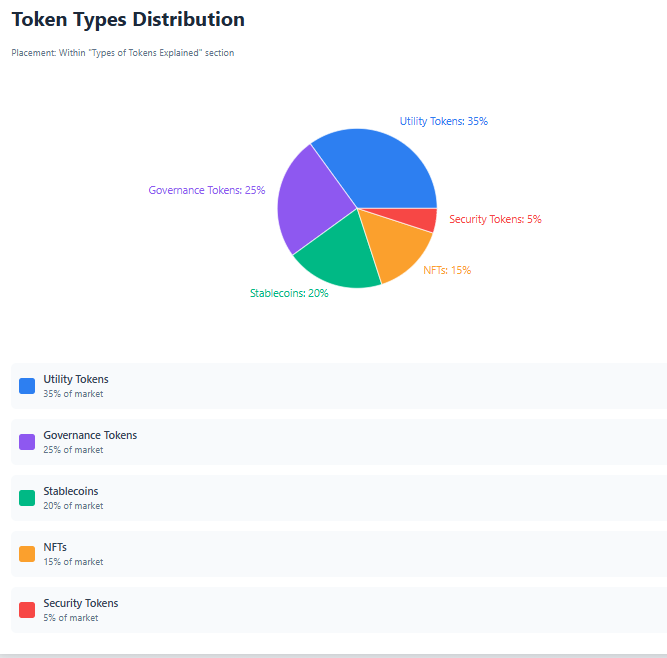
Security tokens enable ownership of securities. Security tokens are like digital stock certificates. Another example can represent ownership of a property or commodity. These are considered securities, so they are strictly regulated.
Governance tokens provide holders the ability to vote on other decisions for the project. Holders of AAVE can vote on protocol upgrades, and UNI holders can vote on fee structure and other features. Governance tokens give you a say in decentralized organizations. The more tokens you hold, the more voting power you have.
Lastly, stablecoins aim to have a constant value. USDT and USDC are pegged to the US dollar. One stablecoin should always equal one dollar. Stablecoins provide stability in a very volatile market. Traders use them to move between assets without cashing out to fiat currency.
NFTs are digital collectibles with a unique identity. Each NFT is distinct. They signify ownership of digital art, music, virtual land, and other items. For example, Bored Ape Yacht Club NFTs are very popular. Unlike other types of tokens where each token is the same as another such as cryptocurrencies, each NFT is different from every other NFT, which means no one NFT will sell for the same price as another.
Each type addresses different issues. Utility tokens are critical to the platform's operation. Security tokens bring traditional assets onchain. Governance tokens allow a decentralized decision-making process. Stablecoins stabilize prices. NFTs provide proof of digital ownership.
The levels of risk for the different types of tokens also manifest differently based on the type of token. Stablecoins are generally the least risky because they are pegged to a fixed price. Utility and governance tokens can be very volatile. Security tokens are more regulated and protected than utility and governance tokens, but their trading volume is often less. NFTs have very high volatility and can experience wild swings in value.
By understanding the different types of tokens, you can evaluate tokens types. A utility token, for example, should have real use cases developed. A governance token should have an active community backing it. A stablecoin requires proper reserves and strong 3rd party verification. Each type has different metrics for success.
How Are Tokens Created?
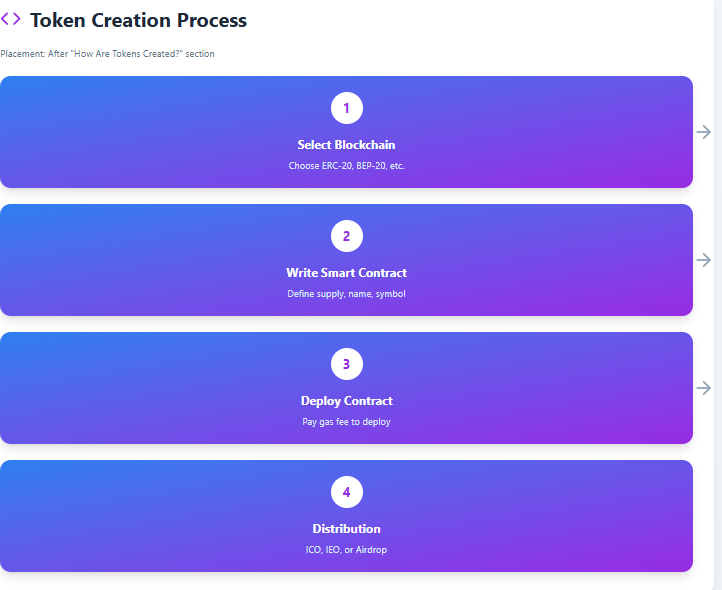
The process of token creation begins with selecting a blockchain standard. For Ethereum, ERC-20 is the most commonly used, while BEP-20 is utilized on Binance Smart Chain. These standards are frameworks that specify how tokens function.
You write a smart contract utilizing the selected standard. The contract defines a few particulars, including, the total supply of tokens, the name of the token, the symbol of the token, and the decimal standard. You can introduce customized features to the contract like burning mechanisms and transfer restrictions.
When you deploy the contract, you are officially putting your token onto the blockchain. You will pay a gas fee to deploy that contract. Once deployed, your token exists for eternity (or until the blockchain ceases to function). The token smart contract address becomes the identifying address for the token from that moment forward.
ICOs (Initial Coin Offering) were the first method of distribution. Many projects sold tokens to early backers. The backer sent ETH or BTC to the project, and in return, the project sent them new project tokens. Many ICOs raised billions, but sometimes token projects were scams.
IEOs (Initial Exchange Offering) provided additional credibility. Investing in an ICO required a level of trust in the project. With an IEO, an exchange would vet a token project before listing the project on its exchange. The exchange would host the sale, adding another layer of credibility and security for buyers.
Token minting is the process of creating new tokens. After an initial supply is distributed, tokens will be minted based on the parameters of the contract. Some contracts have minting functionality, while some contracts define a total supply that can never be changed or increased. For example, Bitcoin has a capped supply, while Ethereum has no capped supply of ETH. Ethereum can mint more ETH as a block reward.
Token burning is the act of permanently eliminating tokens from circulation. To carry this out, projects send tokens to an address where they will never be retrieved. This decreases the supply of tokens. If demand remains the same, the price will go up. For example, Binance tokens (BNB) burn tokens each quarter based on volume of trading.
Think of token creation like you are printing event tickets on a blockchain. For instance, the tickets are limited. Each ticket has a number and tracking. You can program ticket rules. A VIP ticket may offer different benefits. A limited early bird ticket may have a different cost. Because it is on a blockchain, no one can create events and counterfeit the tickets.
Tokens are not printed money; they are programmed assets. The code describes how the token operates, enforced by rules in the blockchain. This is what makes tokens more portable and flexible than traditional currencies or securities.
Tokenomics: The Science Behind Token Value
Tokenomics refers to the economic system that governs a token. It defines the future value of a token.
Supply is critical to the token's value. Total supply indicates how many tokens exist in total; it is the sum of all tokens that will ever exist. Circulating supply indicates how many tokens are available to trade today. If the total supply of a token is high, but the circulating supply is low, the potential to have future releases can lead to a lower token price.
Demand comes from two sources: utility and speculation. If the token's utility increases with the popularity of the project, then demand will increase. If traders think that the token will have growth in the future, they will purchase the token and hold it. When there is high demand and low supply, the price increases.
Utility is required to build sustainable demand. For example, BNB is required to trade at lower prices on Binance. This utility offers a real price value rather than speculation. Tokens lacking utility will rely purely on hype.
Staking is a process by which a token is locked to ensure the security of a network. In doing so, stakers receive a reward for staking their tokens. Staking reduces circulating supply and can lead to price appreciation on the token. For example, Ethereum has migrated to proof-of-stake and requires users to stake ETH.
Burning is a process that creates scarcity. For example, BNB burns tokens quarterly. Over time, and with consistent burning, the supply will get smaller. The consistent deflation of the token creates a support for long-term price appreciation. As an example, Ethereum burns a percentage of every transaction fee through EIP-1559.
The allocation of tokens impacts price stability. If a limited number of wallets have the majority of a token's hold, they can manipulate price. Generally, a wider distribution of tokens is a better sign indicator of sustainable price action. Always check the overall distribution of token holders.
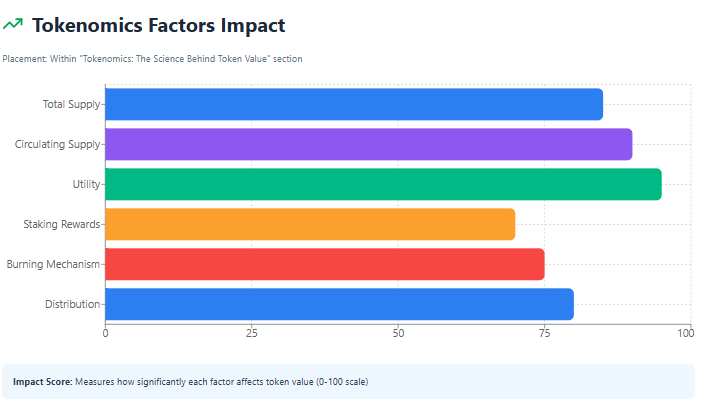
Vesting schedules dictate when team members and/or investors can sell their tokens. A good project will typically have the team token locked up for an extended time. Vesting aligns incentives since everyone wants the project to succeed over the long haul. Flipping the other side, a bad project, will allow team members or investors to dump their tokens right away.
Inflation and deflation contribute to balancing each other out. It is inflation, via new tokens going into circulation, and deflation through burning and/or staking.
Healthy tokenomics get to a point of balance. Too much inflation can destroy the value of the token. Too much deflation and you risk liquidity.
Investors will consider the sustainability of a token through some of these metrics. A token that has strong utility, anticipated supply, and fair distribution is generally a better investment than a token that has an unclear purpose and is being held by the team.
Ultimately, the value of a token is created through the economic design, not just through hype and speculation. A healthy, balanced token economy supports stable growth in the long run. Always feel comfortable doing research on tokenomics prior to your investment decision.
How Tokens Power DeFi and Web3 Applications
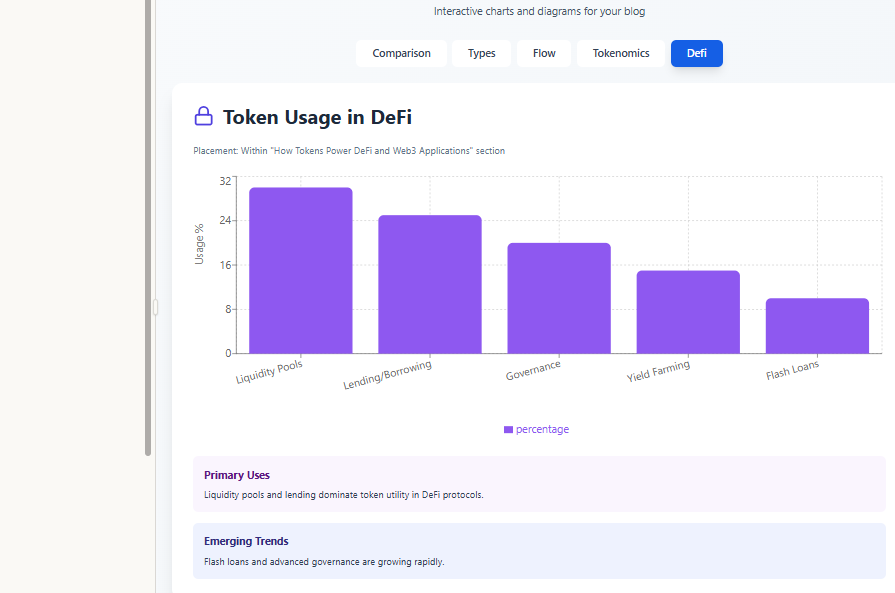
Tokens serve as the driving force behind decentralized finance. They are the main product of DeFi operating platforms and the way in which customers are exchanging value or using their services.
Liquidity pools operate by using pairs of tokens. Users deposit pairs of tokens into a liquidity pool in exchange for a trading fee. Other users trade against these pools. Liquidity providers earn fees for their deposits. Tokenizers are also important for any decentralized exchange to function.
Collateral for loans depends on tokens. When you choose to borrow funds, you deposit ETH (or any other token) as collateral to gain access to stable coins. If the underlying value of your collateral (ETH) drops significantly, it will trigger liquidation of your collateral assets. AAVE and Compound use this model.
Governance allows token holders to have control of the protocol. Users hold UNI (Uniswap) tokens and vote on protocol upgrades. They may change transaction fees or approve new features. On-chain governance is a real word example of decentralized decision-making.
DAOs (Decentralized Autonomous Organizations) focused entirely on tokens. Members need to hold tokens upon joining, future casting votes with their token ownership. They will use the majority vote to automatically and self-enforce action through smart contracts. MakerDAO is a well known example of managing billions in value.
You may also think of tokens in DeFi like chips in a casino. You exchange your cash for chips at the casino entrance. You then use those chips to make bets, and have the potential to exchange your winning bets back into cash. The entire casino ecosystem operates on those chips. DeFi operates with tokens in a similar way.
Yield farming allows you to earn more tokens by providing liquidity. You deposit your tokens into a protocol (a smart contract with rules). The protocol pays you more tokens, usually at a high rate, but takes on risks such as impermanent loss.
Flash loans allow you to use tokens in a way that participants in traditional finance cannot. You can also borrow money (or tokens) instantly with no collateral, repaying in the same transaction. Traders use this when arbitraging potential price difference in protocols. This is only feasible due to being on the blockchain (smart contracts).
Tokens also enable composability. One protocol's tokens will work with another protocol. If you have UNI tokens, you can use them as collateral on AAVE. That AAVE token can be traded on Uniswap. Bringing different tokens into different protocols makes it powerful.
Web3 applications are using tokens for identity, access, and rewards. Hold certain tokens and gain exclusive access to material or content. Earn tokens for your contribution to the platform. Use tokens to pay for decentralized storage or computational power (e.g. filecoin, IPFS).
Tokens are the first principles of the Web3 economy. Tokens enable decentralized ownership, as well as decentralization of participation. Traditional finance can (and does) create barriers for participants. DeFi and tokens have opened financial systems, for the most part, to any participants with the internet.
Stablecoins and Tokenized Real-World Assets
Stablecoins serve as a link between cryptocurrency and traditional fiat. Their pricing is stable and typically equal to one dollar per token.
USDT (Tether) is by far the largest stablecoin. In theory, there should be one dollar in reserves for every token issued. You should always be able to redeem one USDT for either one dollar or close to one dollar. This is useful for trading as you can remain within the crypto world.
USDC (USD Coin) also has this peg but is done so with more transparency. Circle (the issuer of USDC) regularly publishes the results of audits to verify the reserves. The reserves of the USDC token are kept with regulated banks which makes it a little bit more trustworthy than the Tether stablecoin.
The peg is maintained through arbitrage. If USDT is trading at less than one dollar, an outside person may buy some USDT at the discount, and then redeem it for one dollar (in this case USDT is simply a money encoder). The buying activity of the one dollar ransom of USDT pushes the price of USDT back above one dollar.
Conversely, if a buyer would like to purchase USDT however the market price is at a premium (one dollar or more) new USDT will be minted and sold. The supply of USDT will, in theory, drop one dollar or lower, until supply or demand brings the figure back to one dollar or higher and vice versa.
Tokenization of real-world assets, also known as RWAs, allows tokenized versions of physical assets to be on-chain. Gold, real estate, bonds, stocks, etc. can all be tokenized.
Tokenized gold represents gold in a vault or multiple vaults, with the agreement that each token or each x tokens equals a specific gold weight. In essence you can purchase x/1 ounce of gold. In short, you can also trade your newly tokenized gold instantaneously and you don't need to worry about storing physical gold.
Real estate tokenization enables fractional ownership of properties. For example, a building worth millions of dollars could be divided into thousands of tokens, and even the smallest investors could own a piece of that building. Rent would be distributed pro-rata to the token holders just like they would for traditional ownership, and the securities could again be sold without the need to sell the entire property.
The growth of tokenized bonds and funds is on the rise. Companies such as Ondo Finance are creating tokenized versions of traditional investment products. BlackRock has introduced tokenized versions of money market funds. These products are helping institutional money begin to flow into the blockchain.
Tokenization adds valuable liquidity. In traditional real estate markets it can take months to close. With tokenized real estate, trading can take place instantaneously. Making trading a reality will bring in more market participants, including buyers and sellers.
The accessibility of investment is dramatically improved. With traditional real estate investment, it often takes thousands of dollars to invest in a single property. With tokenized real estate, it may take hundreds if not a few thousand dollars. Tokenized real estate can afford opportunities to many many more people, democratizing the opportunity to invest.
Cross-border transactions simplified. Tokenized assets may be sent to anyone instantaneously. There are no delays associated with banking. Fees are lower. This is especially powerful in terms of investing in international real estate.
Tokenization is transforming traditional finance into a borderless digital financial economy. The distinctions between the digital financial economy and traditional assets are on the verge of being erased.
Ready to explore the token market? Visit btcdana.com to discover live token prices, trading pairs, and start your crypto journey today.