




Why Contract Size Matters in CFD Trading
Have you ever asked yourself why two traders could be working the same market and end up with drastically different outcomes? One trader makes money and walks away positively affirmed by doing what they are trained to do, while the other takes a devastating loss, even though they are both trading EUR/USD or gold CFDs!
The response is usually quite simple and is typically the most overlooked factor by a new trader, and that’s contract size.
Contract size is the amount of units per CFD trade. Contract size is more than just a number that you see on your trading software, it is the direct calculation of your potential profit and more importantly, the risk exposure of each trade you enter. Think about it as the volume on your trading plan/panel. If you turn the volume up too loud, you will blow out your trading account. If you turn the volume down too low, you will make barely enough to pay for your coffee.
This concept relates very directly to lot size and leverage, and are the holy trinity of position management. When a professional trader is holding 0.5 lots of the EUR/USD, (noting the standard contract size is 100,000) they are actually controlling the volume of 50,000 units of currency. This is where real money travels with every pip.
In simple terms, think of it as if you were buying packs of basketball cards - each pack contains 5 cards and you chose to buy 4 packs of cards. For a total of 20 cards your "contract size" becomes 20 cards. A situation of easy math, but the same principle applies with CFD trading - you need to know exactly what you are controlling.
This guide will take you through everything about contract size, from definitions to advanced risk management strategies. You will learn how to calculate the optimal size of a position and avoid mistakes when controlling contract size. You will also see real-world examples to practice this skill that you must master in order to be a trader.
Contract size is not something you can ignore, and you need to understand the potential scope for risk - these tools can make or break your trading career.
Understanding CFD contract size: The foundation of the trade
Contract size is simply the number of units of the underlying asset that is contained in one CFD contract. It sounds technical and perhaps intimidating, but once you break it down, it is really not complicated at all. This number determines how much you are going to make or lose with every price move.
The reason contract size is important is that it helps to calculate potential profits and losses before any trade is placed. It is essentially a crystal ball for assessing risk. It tells you exactly how much skin you have in the game and how much you stand to gain or lose for each move of the price.
It's important to understand that contract size is different than lot size or position size- but they are related. Lot size refers to how much a unit would be in the market. Position size is how many actual units you hold.
Contract size is in the middle, whereas contract size defines how many total units are attached to each contract that is traded.
This matters in regard to risk. Contract size dictates your profit or loss when price moves one pip or $0.01 in the underlying price change. For example, in trading EUR/USD, if you trade with a contract size of 100,000 euros, a price movement of one pip is about $10. Because if you don't understand this, you may risk significantly more than you can afford to lose.
The easiest way to understand is to treat contract size as buying lottery tickets or a $1 each ticket when you buy lottery tickets, there is the potential to win $2. If you purchased ten lottery tickets and a ticket has won you simply know that, you will gain if you win. Similarly, this same reasoning applies to CFD contract size - you know what is coming into your wallet with each price movement.
Professional traders never enter a position without knowing their contract size. You couldn’t drive a car blindfolded without knowing how many units you were controlling. While the math might feel boring, it’s what differentiates traders who are successful from those who blow up their accounts.
Contract Size is the basis for every profit and loss calculation. If you master this concept, you're on your way to understanding the fundamentals of CFD trading.
The Development of Contract Size: From Paper to Electronic Trading
Contract size did not just magically appear. In the early days of the futures markets domains, traders literally wrote quantities by hand on paper contracts. Can you imagine how it felt trying to calculate P&L with a pencil and calculator while prices were moving against you? Ahhhh... those were the good ol' days.
Electronic trading changed everything. Each market developed its contract size, both standardized and simple to calculate. Naturally, the advent of electronic trading machines eliminated human error and the frantic calculations with a pen and paper when things were volatile.
Regardless, there were unwrapping standards associated with each virtually contracted market. Stock CFDs have a standardized quantity of shares and therefore are quite easy to calculate. Forex CFDs are typically standardized some in currency units 100,000 for standard lots. Commodity CFDs typically will have a physical measurement element (e.g., tons for metals, ounces for precious metal, barrels per oil,).
The transformation of technology has changed the way we deal with sizes of contracts. Managing contract sizes was once complex with a lot of manual calculations. Today, everything happens in an instant. With modern trading platforms, you can see your potential profit or loss before pressing "buy" or "sell." The automated systems have removed the human error in the basic calculation. However, it does not erase the need to understand the concept behind all of this.
The standardization of contract size creates a level of consistency globally. A standard lot in EUR/USD will mean the same thing whether you are trading from London, New York, or Tokyo. This standardization allows traders to move from broker to broker and trading platform to platform without needing to retrain the basic calculations.
When I reflect on what has happened, tfhe movement from manual to automated handling of contract size generally reflects the changes in the financial markets. Technology has made the ability to trade more open to more people but has also made it more fast-paced. Today's trader must understand the size of the contract inherently because the markets move too fast for any hesitation.
Contract size has become an industry-tested and standardized parameter that serves as the base of modern CFD trading.
Contract Size by Asset Class
Contract sizes vary widely across asset classes, and understanding these differences can save you from costly errors. For example, in Forex CFDs, the contract size is typically in standard lots of 100,000 units, with many brokers offering mini lots of 10,000 units for the smaller account sizes.
Commodity CFDs function on their own terms. Gold CFD contracts typically represent 100 ounces, so if the gold moves $5 an ounce, you are looking at $500 profit or loss per contract. Crude oil CFDs generally represent 1,000 barrels (per contract). This is not arbitrary; it is how they trade in physical markets.
Stock CFDs are simpler, as almost all represent one share per contract option. You can control your number of shares. If you own 100 shares of Apple and the stock moves $2, then you make or lose $200. The arithmetic is simple.
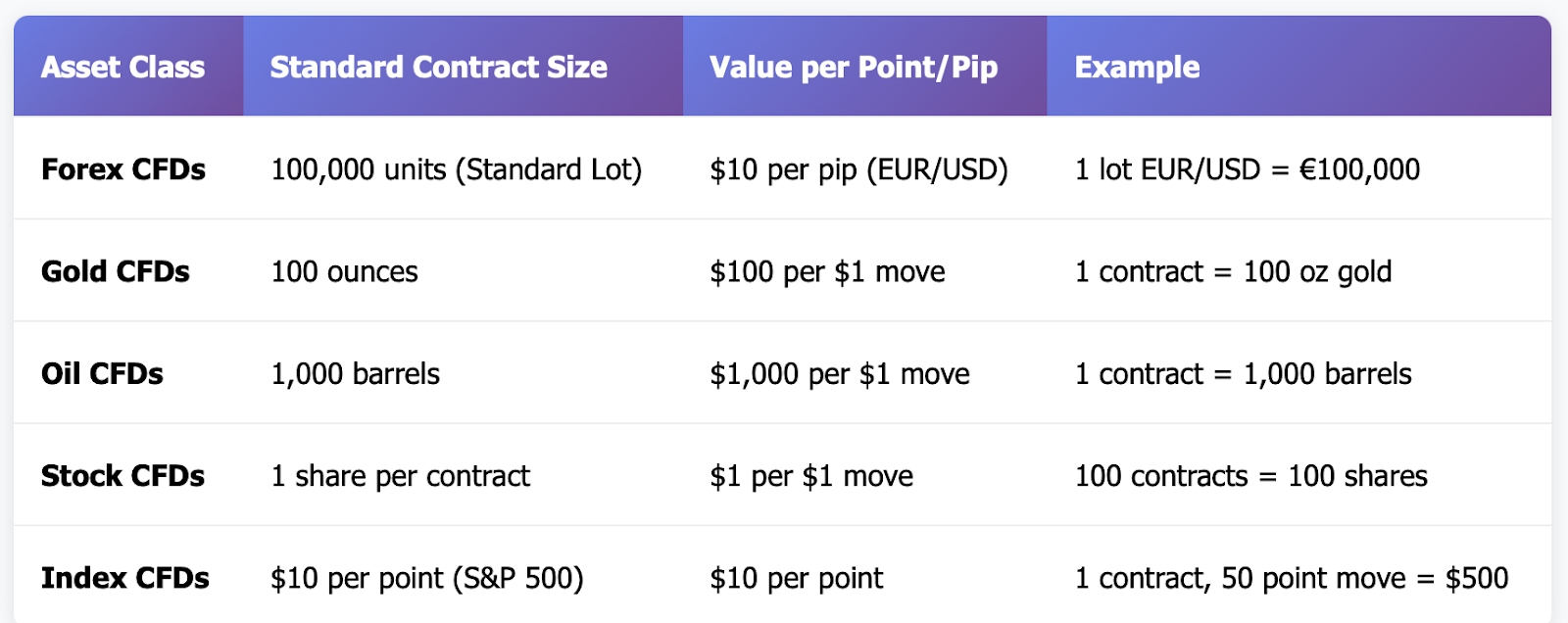
Let's look at some of these examples in real life. If a professional trader buys 1 gold CFD contract, they have the equivalent of controlling 100 ounces of gold. If the price of gold moves $5 an ounce, they have made $500 based on contract size. If they had bought 10 pairs of sneakers for $50, if the resale price went up $5, their total amount is only $50 not $50 per shoe.
Now you add in index CFDs. The S&P 500 is $10 per index point contract size. If the index moves 50 points, that's $500 a contract. The multipliers are different cases with the different indices, and it even depends on the index so make sure you verify before you trade.
The number of cryptocurrency CFDs will depend on the broker and specific cryptocurrency. For example, Bitcoin CFDs may offer 0.1 Bitcoin per contract, while Ethereum CFDs may offer 1 contract per coin. The crypto markets can change quickly, so being aware of your exposure is more important than ever.
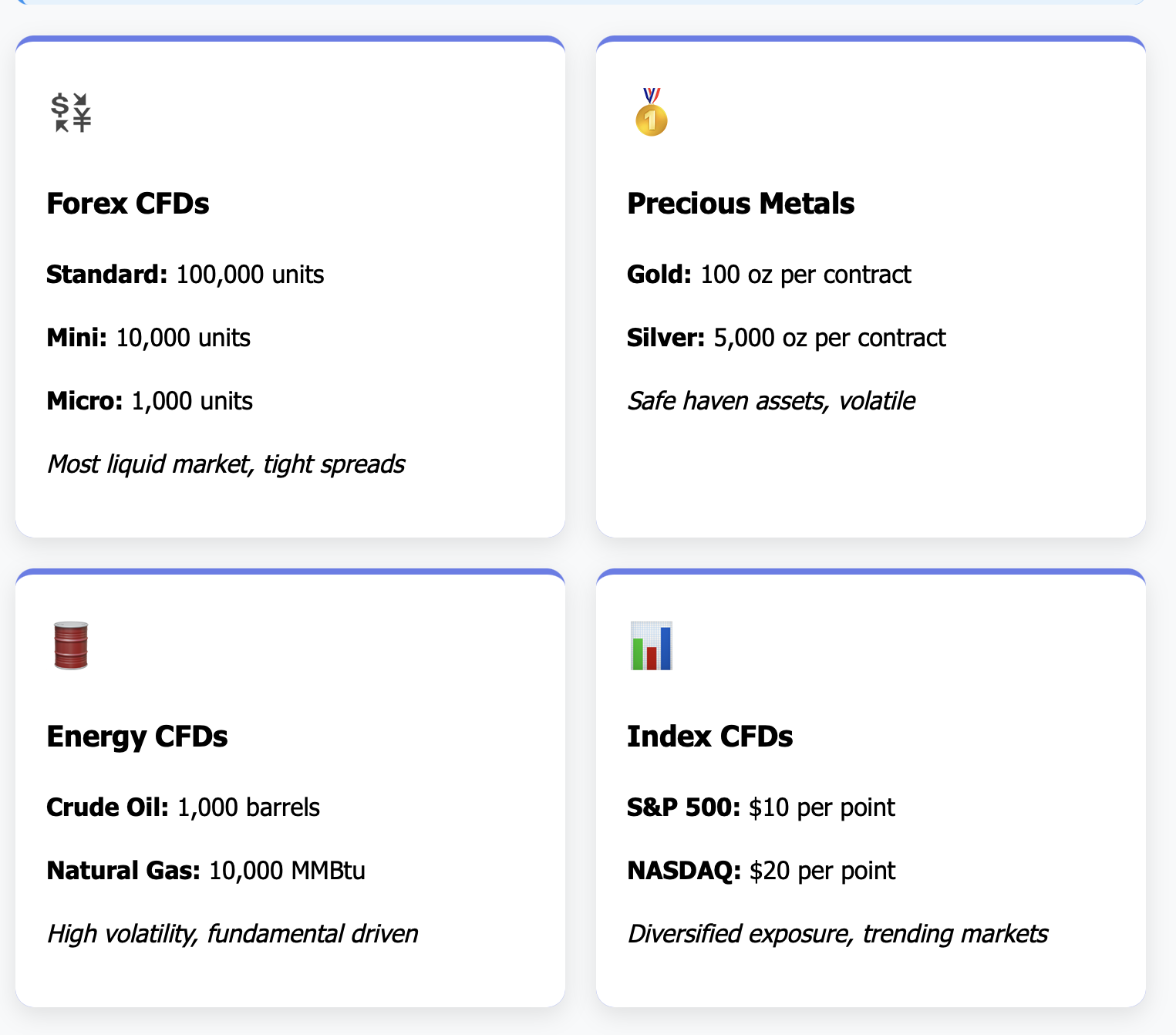
The take-away? Always double check the contract size before executing any trade. What may appear to be a very small position in one market can represent a sizeable exposure in a different market. Doing this will help you avoid unnecessarily unpleasant surprises when the market goes against you.
Trading Psychology and Discipline of Contract Size
Setting contract size is not just a math issue, it is also a matter of controlling your emotions and staying disciplined under pressure. Greed draws traders to larger-than-required contract sizes based on the thought that bigger sizes equal bigger profits. Fear leads others to go so small with their position sizing that their gains cannot be meaningful.
Common psychological traps include revenge trading with larger contract sizes after a loss or doubling down in reckless money management symmetry when a trade goes bad. Professionals do not fall into those patterns because they set contract sizes based on risk management rules (note: not based on emotions).
Discipline involves adhering to the plan without regards to the recent wins or losses. If your risk management approach suggests a position size of 0.2 lots, and you have a $50,000 account, do not move to 0.5 lots because you feel lucky. That feeling of being lucky will probably dissipate very quickly when the markets move against you.
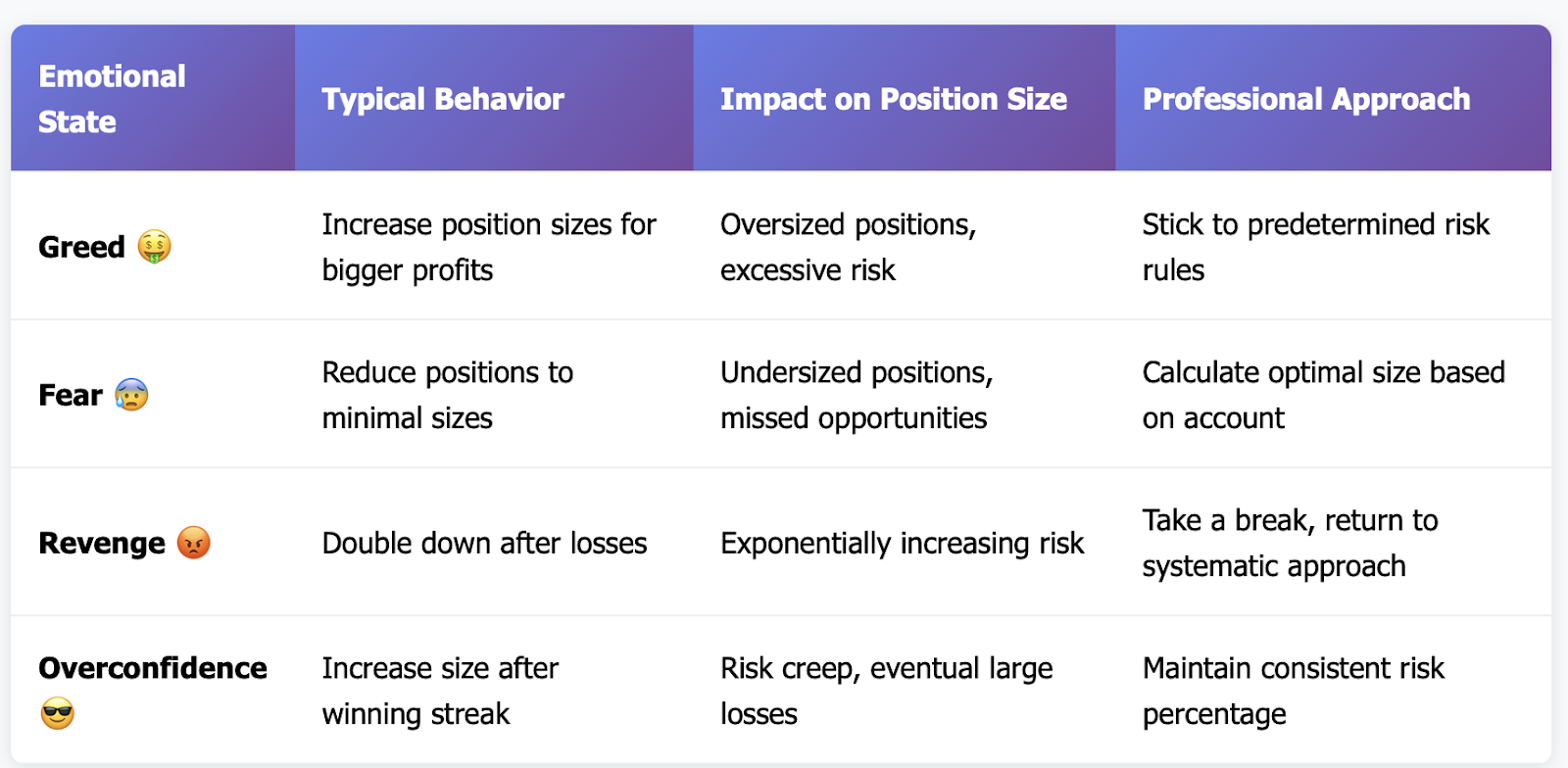
Think about it like you were spending money at the casino. If you set a budget prior to going (your contract size limit), then you are less likely to make emotional decisions during the enthusiastic moments when the energy is high. A professional trader with a $50,000 account who is risking 1% of their account on trade, will have calculated their maximum amount of positions before the market opens and not during volatility of price action.
A new trader should start small. If using a demo account (simulated money) you could risk $5 per trade. By instituting a fake constraint, you can build emotional/psychological discipline without real, painful financial loss. The goal is to develop solid habits when it comes time to risk real money.
When traders are winning, there is often an overconfidence in the ability to structure position sizes. Once alights flood lean more traders begin to think they understand the market and they often take larger positions. A longer streak of winning is followed by inevitable losing trades, as would be expected.
The solution requires seeing contract size as a risk management option instead of a profit maximization tool. Your position size should be a reflection of your account balance and your risk tolerance, period. Emotions should not enter the equation.
Correctly selecting contract size requires a clear head and predetermined rules. If you can master this psychology, then you are halfway to being a consistently profitable trader.
Determining Optimal Contract Size: A Step-by-Step Process
Determining an optimal contract size requires a systematic process based on account balance, risk tolerance, and stop loss levels. Most professional traders risk 1 to 2 percent of their total account in any single trade. This conservative nature maintains capital during a losing streak.
The starting point is your account balance. For example, if your account balance is $50,000, and you decide to risk 1 percent per trade, then your maximum loss is $500. Now you can work backwards from your stop loss distance to get a position size.
Here is the formula: Account Balance × Risk Percentage ÷ Stop Loss Distance = Maximum Contract Size
For example: $50,000 × 0.01 ÷ 50 pips = $10 per pip = 0.1 standard lots in EUR/USD terms.
Leverage impacts your calculations. Being more leveraged doesn't change your risk per trade, but it changes what margin you need. For example, rather than tying up $10,000 in your 0.1 lot position at 100:1 leverage, you would only need $100 due to the leverage. Don't allow leverage to influence you into larger positions - the way you calculate risk should be relative to your own account size.
When calculating risk, consider the volatility of the market. A volatile pair like GBP/JPY may require smaller position sizes than a more stable pair like EUR/USD, even if both have the same stop loss distance. The goal is the dollar risk remains consistent, not position size.
Finally, think about the costs of transactions in your calculations. Spreads and commissions can take away from your profit - especially if you have a smaller account. All trading costs should be considered in your risk calculations to avoid messing this up and having a nasty surprise.
You should practice all of these calculations until they become habitual. A professional trader can tell the optimal position size in seconds after they finish analyzing the setup - this speed just comes from repeating it many times and knowing the underlying math.
Also, use a trading journal to track your position sizing decisions - you will soon start to see trends in what you tend to do well, and not so well. This may say that you have much better results in the smaller sizes or that your sizing is simply too conservative in the big picture thus missing out on larger profits.
Calculating contract sizes scientifically leads to risk control and a framework for long-term profitability. If you can master this manipulative process, you will enjoy a considerable edge over emotional traders who are taking guesses (appropriate size).
Common Contract Size Mistakes You Don't Want to Make
The most common mistake that traders make when calculating their contract sizes is to use positions that are simply too large for their accounts. This creates an abundance of risk and will result in a margin call during even the most normal price upheaval in the market.
If you are working with an account value of $5,000 and you are controlling one full lot of the EUR/USD currency pair, you are asking for trouble, even if your full lot is located well within your risk management strategy!
In contrast is the fact that many traders only use a contract size so small that even when they find profitable trades; they will never earn any sort of meaningful profit. Capital preservation is important, however a trader will need enough exposure in order to make it worthwhile to take the risk to trade once you consider the time involved, transaction costs, etc.
Last, ignoring the effects of leverage is another serious mistake. New traders see an account leverage capacity of 500:1 or similarly and think they can control huge positions of currency safely. Leverage is a tool, it is not a strategy.
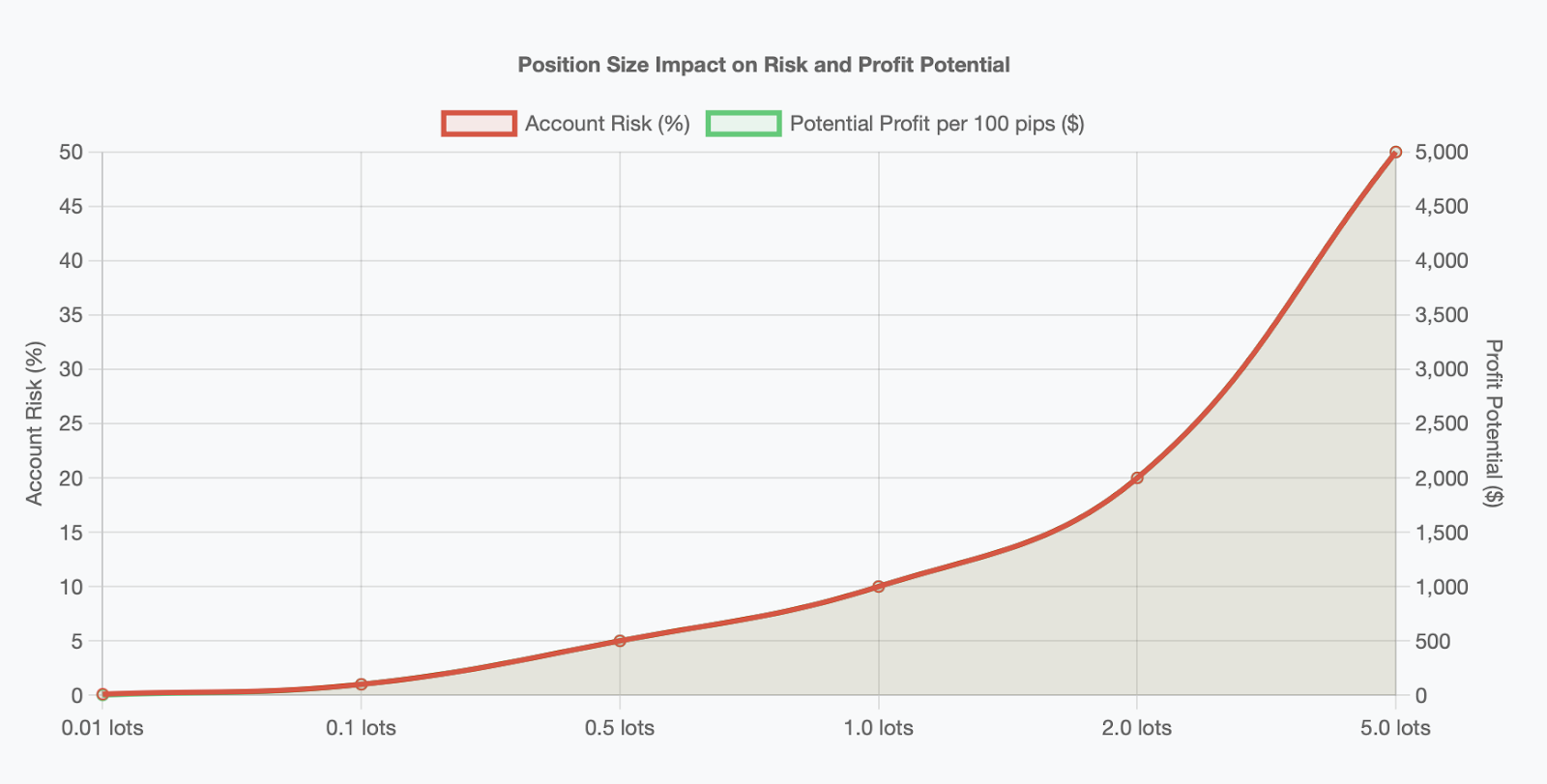
Leverage should allow a trader to maintain relatively small account balances while controlling normal position size. In all instances, trading should not allow for an outsized risk to occur.
Lastly, many traders do not adjust their actual contract sizes based on a change in their level of volatility in the market. When volatility increases in the marketplace, the same contract size that worked well previously in relatively calm market conditions could destroy accounts, unless account size is adjusted accordingly.
Thoughtful risk management size formulas should adjust to market volatility. The question is objective. What size of a contract can I control profitably and maintain my risk management, and then firmly adjust or decrease in problematic volatile conditions.
Neglecting the correlation of positions takes on a silent risk. If you think you are diversified by being long EUR/USD, GBP/USD, and AUD/USD, nothing could be further from the truth – you have essentially made the same USD-short bet three times and your actual size of contracts is more than you anticipated.
Furthermore, a trader is typically unaware of stop losses and this leads to bad position sizing. Traders who set arbitrary stop losses (like all trades will be 50 pips) with no regard for market structure do not consider an appropriate contract size. Your stop loss should represent the reality of the market and then you can appropriately size your position.
Emotional decision making regarding position sizing adds to all the aforementioned mistakes. Increasing your contract size after taking losses to "get even" or decreasing your contract size after winning trades because you are "playing with house money" breaks consistency in risk management.
Any change in account balance should adjust your size and position. Strategies that incorporated a $10,000 account do not hold up when your account grows to $50,000 or declines to $5,000; you should alter your position size. If you are consistently reviewing your size/position you will mitigate issues before they occur.
Your contract size should be appropriate depending on your account size, risk appetite and current market situation. If you ignore any of these element you will set yourself up for failure.
Case Examples of Actual Contract Size
Case Example 1: The Forex Professional Trader
Sarah manages a $100,000 trading account with a strict risk management plan. She notices a EUR/USD setup with a stop loss 50 pips away from the entry. Based on her 1% risk rule, she calculates: $100,000 times 0.01 divided by $10 per pip = 0.1 lots maximum position size.
She enters with 0.1 lots and sets her stop loss. When her trade moves 100 pips in her favour, she books a gain of $1,000. Since her risk was limited to $500, she has a reward-to-risk ratio of 2:1. Because she uses this method, she continues to achieve the same results over and over again across hundreds of trades.
Case Example 2: The Gold CFD Trader
Mike only trades gold CFDs. One contract is equal to 100 ounces, and Mike has a $25,000 account. He identifies a gold setup where he expects a move of $20 with a stop loss of $5. For Mike that equals: $25,000 times 0.02 (2%) divided by ($5 times 100 ounces) = 1 contract maximum.
He purchases a CFD contract on gold for $1,800 per ounce and has a stop in place to limit his loss to $1,795. The price of gold rises to $1,830, and he profits $3,000 (which is a $30 price increase times the 100-ounce contract). His maximum exposure was limited to $500, which gives him a 6:1 return on his investment.
Case Study 3: The Learning Curve
Tom has a $5,000 dollar account and immediately makes every mistake in the book. He buys 0.2 lots of EUR/USD without even doing the risk calculation. After the trade moves 100 pips against him, he loses $2,000 or 40% of his entire account on one trade.
After this event, Tom downsizes and starts learning proper position sizing. He has about $3,000 remaining in brokerage capital, sets 1% risk, which means the maximum he should lose on any trade is $30. If he calculates risk correctly, this forbids him from becoming too large making him utilize micro lots and narrow stop losses, but also prevents him from blowing out during the learning curve of trading.
Case Study 4 - The Correlation Trap:
Lisa believes she is being prudent by trading small position sizes on each individual trade. She buys 0.1 lots each on EUR/USD, GBP/USD and AUD/USD. Her thought process is that small position sizes equals relatively low risk. When USD strengthen against all three currencies on the same day, all three of these trades incur a loss at the same time.
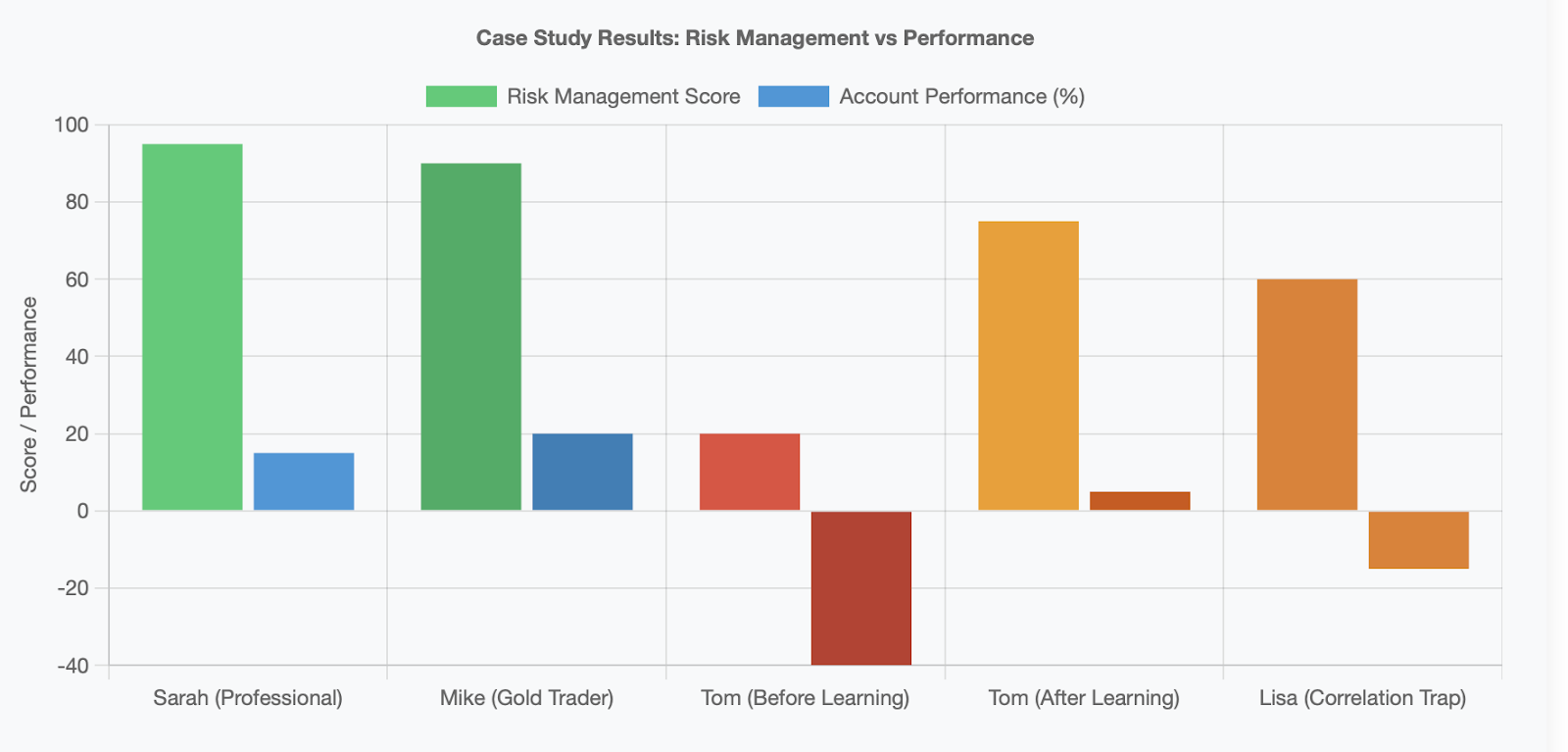
While unintentional, Lisa’s risk in a single trade was not only 0.1 lots, but instead 0.3 lots. Lisa's experience led her to try to a new perspective on position correlation as well as effective exposure. She now considers total USD exposure, across all of her positions, as opposed to focusing on position size on an individual basis.
These case studies highlight how the decisions you make regarding contract size will influence trading results. Trading, like many professions, requires a system or strategy to be successful. This is the systematic approach used by successful traders like Sarah and Mike, where risk management is at the forefront of their mind. Less experienced and learning traders like Tom and Lisa figure this out, through experiential learning sometimes quite painfully.
In all of these cases, the underlying factor was contract size influences profit potential and exposure to loss. If you master the balance of both profit potential and exposure to loss, you will find consistency in your performance over the long term.
Understanding Contract Size for Long Term Profitability
When we talk about 'contract size' in trading, it's so much more than just a number on your trading platform. It's the link between your trading strategy and your account balance; it's what's between market analysis and potential for profit or loss. When you execute a trade, understanding size means knowing how to manage your risk and maximize your potential profit.
The core principle is the same across all timeframes and all markets: build your position size based on account balance and risk tolerance, not emotion or recent trading performance. You need to know your potential maximum loss before you enter a trade, and that means using stop losses to identify that potential maximum loss and then working backward to what your contract size needs to be. In addition to using stop losses to manage position sizes you want to always take into account volatility, the correlations between positions or currency pairs, and transaction costs.
Once you are comfortable with the concepts presented here, put it into practice with demo accounts before risking any real money. Even practicing paper trading will allow you to make mistakes without losing real money and develop the discipline necessary to manage actual real trades with money involved. Focus on a consistent approach to position sizing than trying to hit home runs with large position sizes.
Maintain a trading journal that includes your position size choice with your trade outcomes. Over time you'll start to see trends that will allow you to improve your process. You may find that you are a better trader when your position sizing is smaller. Or, maybe you've been too cautious in your position sizing and you now need to increase your risk a little bit to meet your performance targets in trade.
Keep in thought that the optimum contract size evolves as your account grows or shrinks. Periodic review will make sure that your position sizing plan is consistent with your account size. What worked at a $10,000 account might not work at a $50,000 account, or when your account shrinks to $5,000.
Mastering contract size will not happen overnight. It will take practice, discipline and the commitment to risk management over short term gain. Traders who master position sizing allow themselves a good footing for success, while traders who ignore position sizing may be looking for their new careers.
There will always be opportunities in the markets. Your job is to participate in those opportunities with acceptable contract sizes to your risk tolerance - and account size. If you can master this skill, you have conquered the most important aspect of trading success.
Are you prepared to apply your knowledge of contract size? Open a demo account today and practice these position sizing strategies without risking money.
Remember, trading does not have to be about taking enormous risks trading should be about taking the appropriate-sized risks repeatedly. Trade small, learn quickly, build the discipline that distinguishes professionals from gamblers.