




Gold has always been an important part of Nepal. Stroll around Kathmandu during Tihar or at the time of a wedding, and you will see it everywhere. However, gold represents not only cultural significance, it is also now a serious investment that many Nepalis are beginning to consider in a more sophisticated way.
The Nepalese gold market is not an isolated market. When international prices move, local prices move. Knowing and understanding how these relationships work can lead to smart investment decisions or costly misjudgements.
The Nepal Gold Market: Where Tradition Meets the International Finance World
Nepal's relationship to gold goes back centuries. It is not just about jewelry or investment; it is part of celebrations, religious ceremonies, and family heritage. Parents purchase gold for the opportunity of their children's future. Ornaments are passed down amongst families from generation to generation. The cultural demand creates a unique baseline for the market to operate, including even during periods when international investors may step back to allocate resources elsewhere.
The formal gold market in Nepal has grown in tremendous stock over the past two decades. What used to be jewelry and ornaments has now transitioned into more "investment grade" products. Gold bars, coins, are even offerings of gold savings accounts are becoming much more common. The Federation of Nepal Gold and Silver Dealers' Association is now regulating most of this trade and establishing purely discretionary standardization that did not exist before.
International gold prices form the baseline for what you will pay for gold in Nepal.Whenever there are price increases in New York or London, prices in Nepal will follow suit, but there has also been a local price change. Various reasons can result in the final price you see involves the cost of import duties and transport fees, as well as demand during prices before festivals.
Gold prices in Nepal roughly doubled between 2015 and 2023. That's impressive unless you consider that the overall price of gold had followed a similar trajectory globally. Consequently, the relevant question does not have to do with whether there was an appreciation in gold, but whether the appreciation outperformed available alternatives for Nepali investors during the same timeframe.
Who's Really Influencing the Market?
The gold market in Nepal is not under the control of any one player, but there are parties which have more influence than others.
Retailers and jewelers are the first face of the market, as they are the most visible parties to the general population. When someone chooses to purchase gold, generally, their final destination is a jeweler or retailer. These market players have a big impact on pricing, including how their inventory decisions impact the gold price, their pricing decisions and methods, and the impact of selling back old gold. During wedding seasons and festivals, jeweler and retailer purchasing fluctuations impact gold prices the most frequently.
Gold importers provide the bulk of Nepal's gold through international markets. Timing is critical for gold importers. If importers believe the price of gold will increase, they have the ability to stockpile inventory, thus reducing supply in the short-term. Conversely, if an importer believes the price of gold will go down, they decide to hold back on inventory and availability subject to past decisions and beliefs.
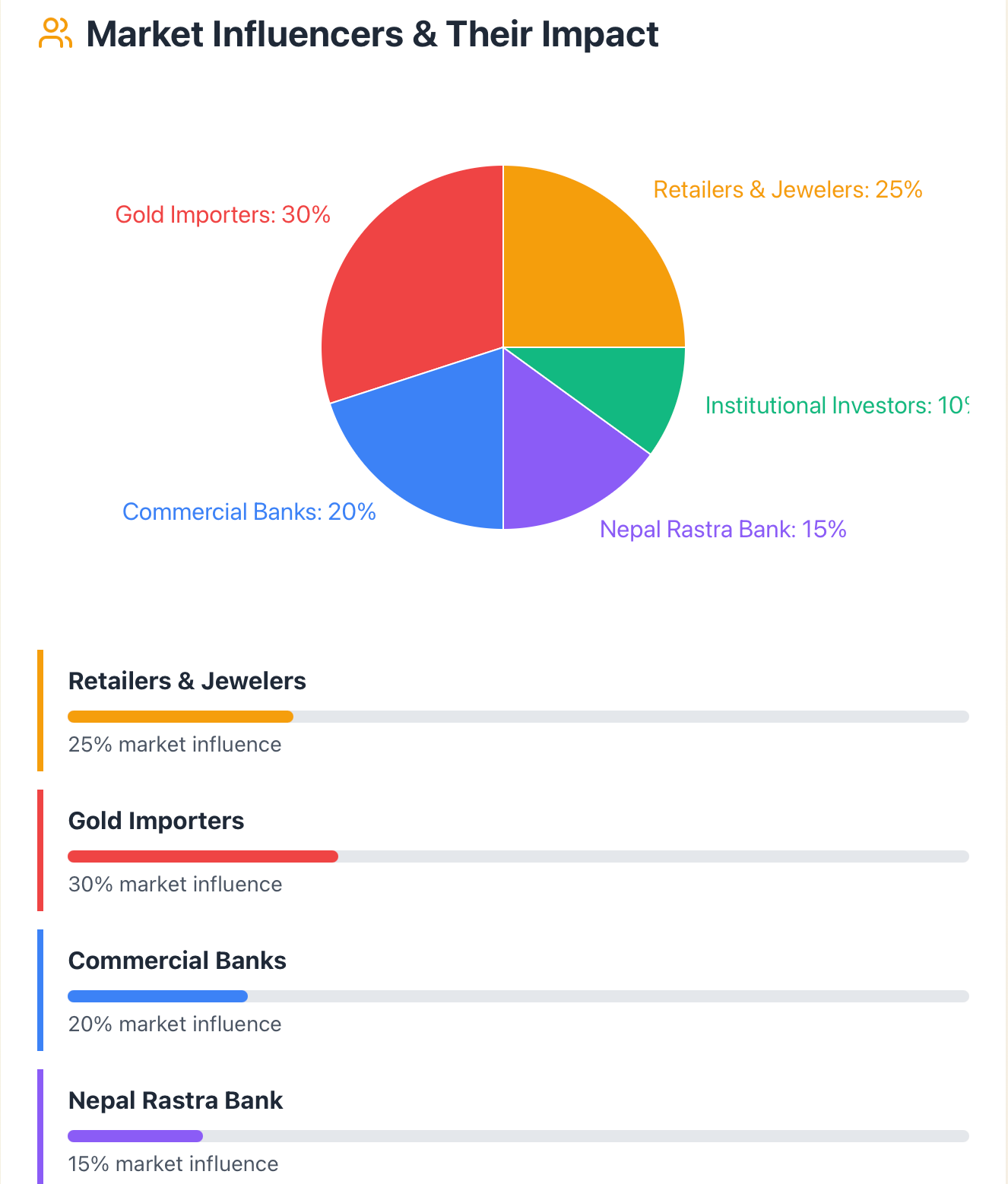
Commercial banks have begun to offer gold backed products. Some commercial banks will provide gold-based savings accounts, where the depositor's holdings are transformed into physical or financial holdings of gold. Some guaranteed loans are backed by gold. These commercial banks are making gold a lot more accessible as an investment tool compared to the previous investments based on just storing gold in your cupboard away from anybody's eyes.
Nepal Rastra Bank does not actually trade in gold, but as the primary regulators of a banking sector, their views on importing regulations, foreign exchange policies and other banking sector regulations influence pricing indirectly in the market. Regulatory changes like import duty changes can immediately change the pricing of gold.
Institutional investors and insurance companies in Nepal's gold space are still relatively new players. Still, this aspect of the gold market is growing. For example, when a large institution decides to allocate a nominal allocation to gold in their portfolio, their allocation can change pricing decisions locally, even as little as 0.5% or 1% of their total portfolio can influence local and regional prices.
This could also be thought of similar to a school cafeteria where everybody wants the same popular snack to the point that they cannot keep up with the demand. Given spikes in demand, prices get adjusted around this increased demand. Essentially, this is similar to prices in the gold market, just more zeros on the numbers and bigger players.
What Can You Actually Buy?
Physical gold is still the most common method in Nepal. A gold bar comes in many weights, which are generally 10 grams and up to a kilogram or more. There are coins available too, which frequently display religious symbols, or national emblems in Nepal. The benefits of a physical gold is individual convenience: you can hold, keep or sell it at any time. The disadvantage is equally obvious: security and management costs, and the wide-bid offer spread you see in buying and selling.
Gold futures haven't found their way into practice in Nepal in the same way they have in the more developed markets. Futures are worth understanding, though. A futures contract allows you to contract for a price today for gold you will not receive until some time in the future. If the price of gold rises, you will benefit. If it declines, you have effectively locked in your higher-priced investment. It is similar to pre-ordering something you know will have a higher price. However, in futures, there is a risk, and that risk is involved if the price moves against you.
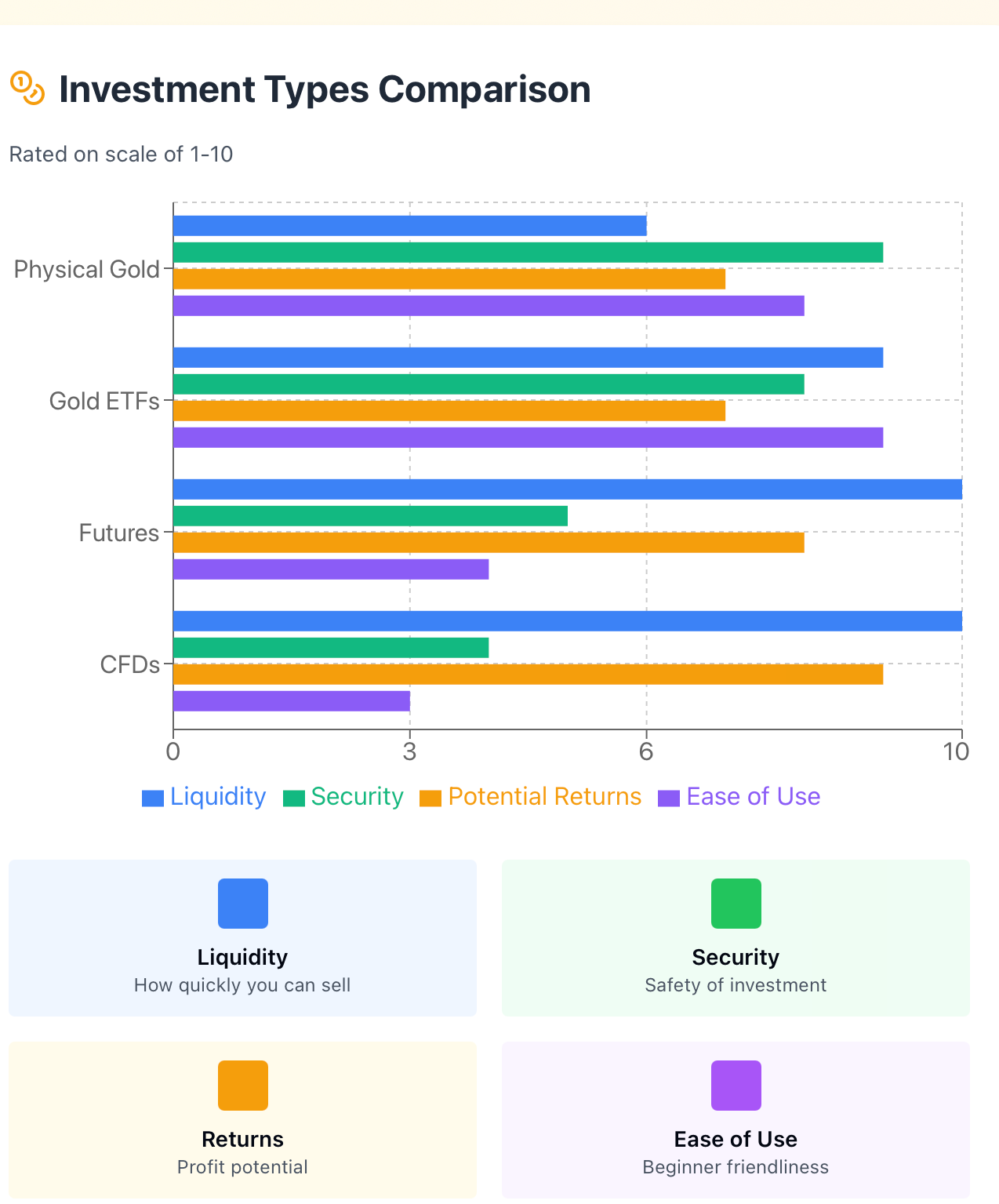
Gold ETFs, or Exchange Traded Funds, represent a share in a pool of assets that hold gold. You do not, technically, own the physical gold. Instead, you own a share of a fund and the fund owns gold. This option is not widely available in Nepal, but international ETFs are available through various brokers. The advantage of ETFs is ease of trading and no storage. The downside is you are at the whim of fund managers, and fees.
Gold CFDs, or contracts for differentiating, and other derivatives are high-risk securities that most retail investors should move cautiously into. CFDs allow you to speculate on the positive or negative movement of the price of gold, without ever holding or owning the actual gold.You are able to use leverage to control more gold value than you invested. This also amplifies gains and losses, making it most useful for experienced traders who understand the risks involved and how to manage their capital.
Each option fits the different needs of people. A person that is buying gold for their daughter's wedding in five years most likely wants physical gold. A trader looking to profit on swings in the price of gold in the short-term may opt for either futures contracts or CFDS. An investor who simply wants to gain price exposure to gold without the complications of storage may want to buy an ETF.
What Actually Drives Gold Prices in Nepal?
Gold prices do not move for no reason. Gold has multiple factors constantly pushing and pulling prices.
Interest rates in developed countries set by major central banks, especially the US Federal Reserve, have an inverse relationship with gold prices. As interest rates rise, bonds and savings become more attractive compared to gold that pays no interest. Conversely, when interest rates fall, gold becomes more attractive. The economy of Nepal sees the effects of this through capital flows and investor behavior, even if you feel removed from the global banking system.
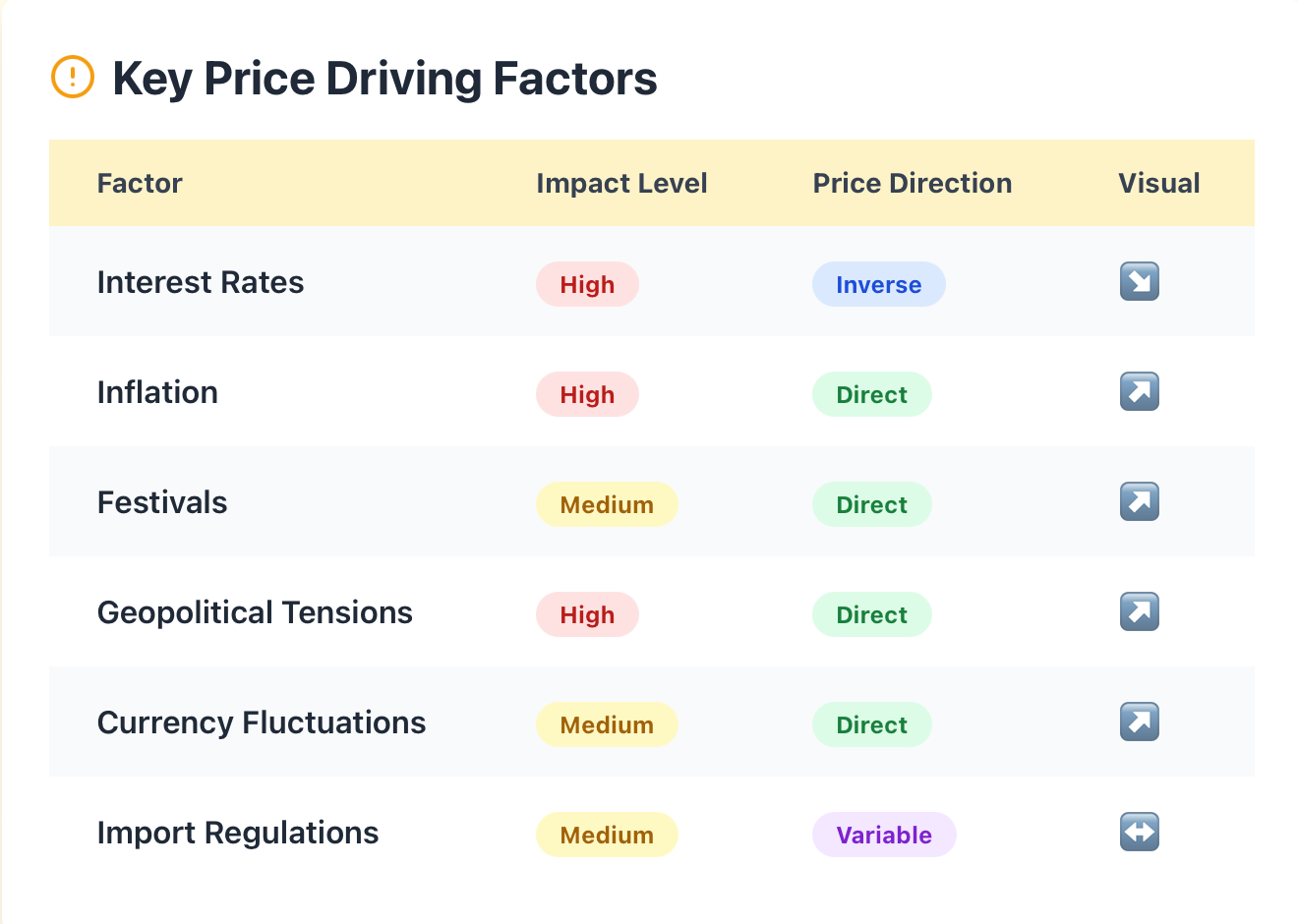
Inflation causes gold to be an attractive way to hold price value. When currency is losing purchasing power, gold usually retains it. Nepali investors often buy gold in greater volume during times of high inflation or currency instability. During the rise of inflation on a global basis from 2020 to 2022, demand for gold rose in Nepal.
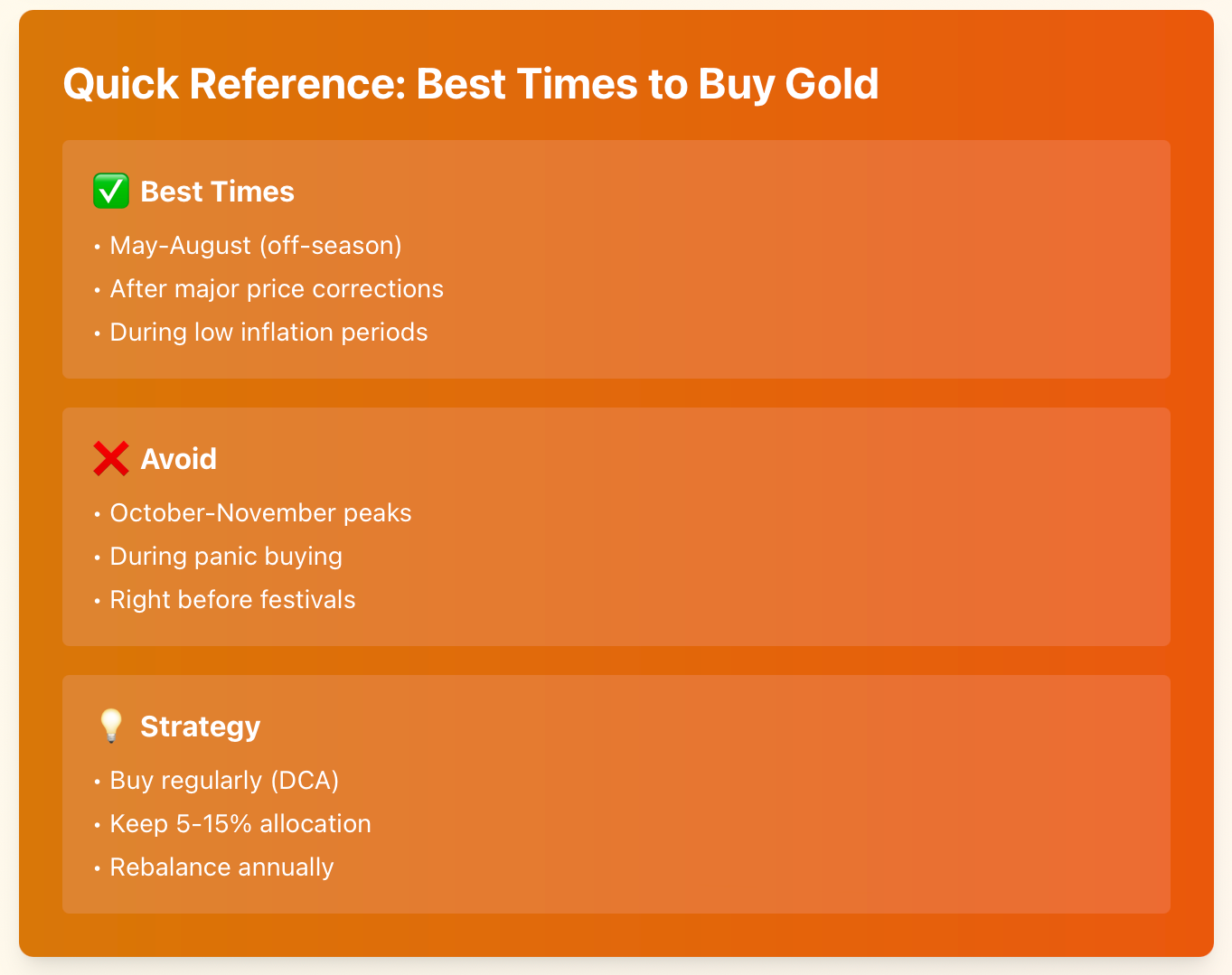
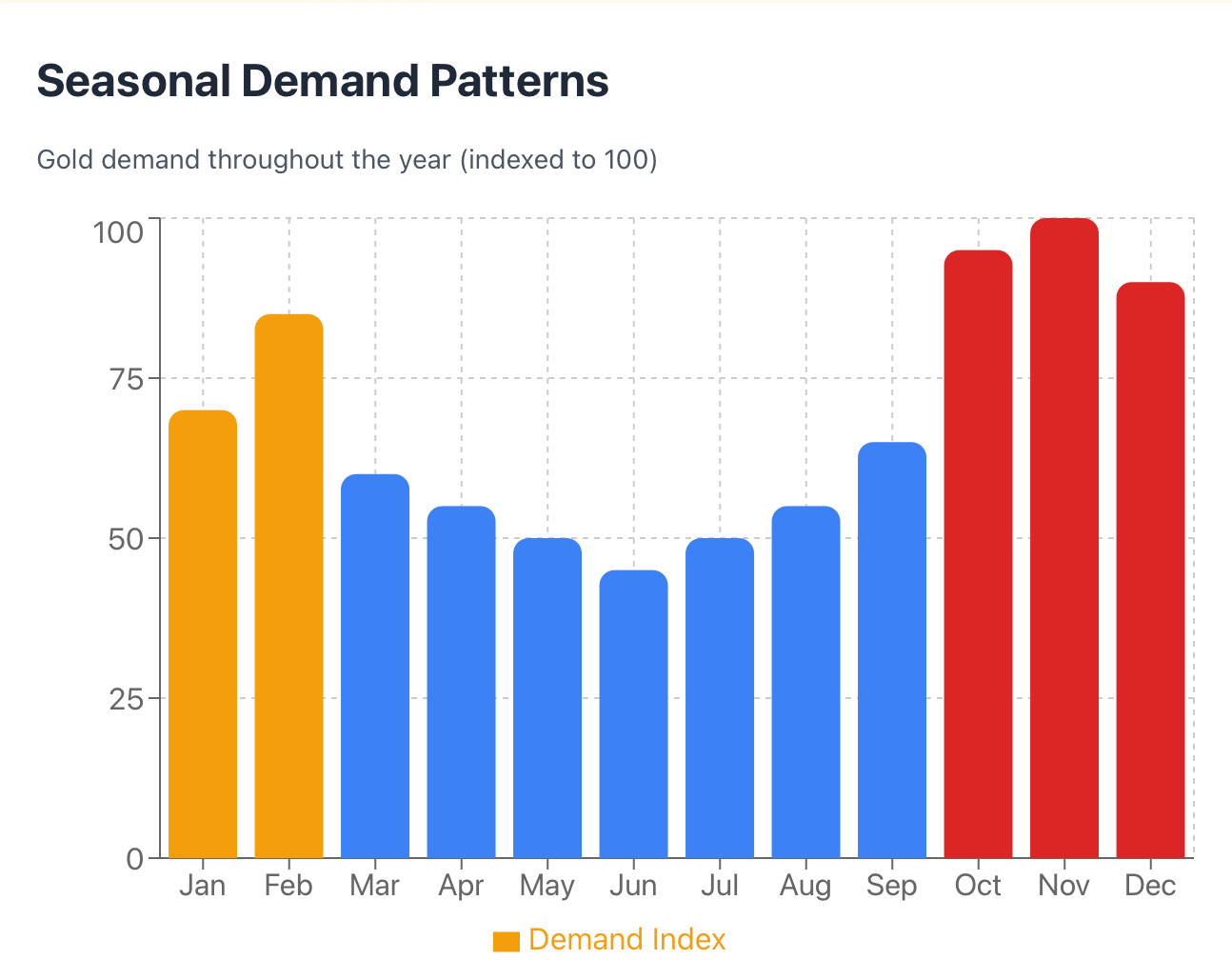
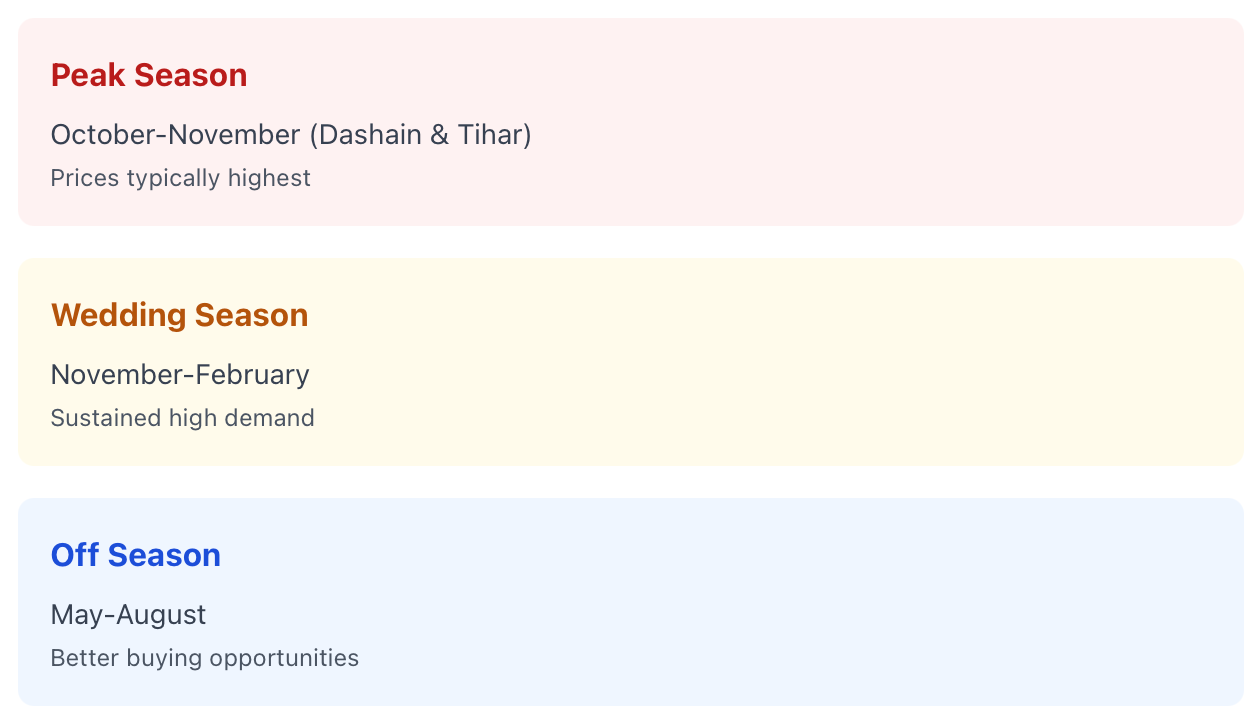
Festivals in Nepal create patterns that are predictable with the demands creating seasonal patterns. Dashain and Tihar, and weddings from November through February, are holidays that create significant gold buying. Additionally, jewelry stores prepare for holidays months in advance. Stores will have inventory acquired for the holidays months before the holiday is realized.If you are an individual looking to buy gold, thinking about these times can save you a considerable amount of money or cost you time.
When there are geopolitical tensions, there will be a demand for treasure in safe havens. When there is global news that is negative to the point of being terrible, whether that be violent conflicts, pandemic concerns or economic crises, investors all over the globe will be moving money into gold. This trend will instantly find its way into Nepal's market on the import price.
Currency fluctuations matter for more than most Nepali investors think. Gold is an international commodity that is priced in US dollars, so if the value of the Nepali Rupee decreases with relation to the US dollar, gold will cost more for the consumer, even if the price of gold in US dollars is flat. The opposite would also be true, although it is somewhat of an anomaly to see the Rupee strengthen.
Import taxes, rules and regulations will lead to variations in the final price you pay. Any decision the government could change definite aspects relating to gold imports will show up at retail within days. The government can relatively quickly change some policies based on the trade balance or revenue needs.
During the time of COVID-19, gold prices hit record highs in the global market. The Nepali market followed suit. The price of gold in 2020 reached levels that no one has seen before. However, the price is driven by more than one simple reality: low interest rates globally, the threat of economic uncertainty, volatility in currency values, and supply chain interruptions were all happening at the same time.
Gold Trading Strategies That Work
Making money trading gold requires more than luck. Here are strategies that traders take advantage of, from simple to more complicated.
Trend following is just that.One begins by determining whether gold prices are generally rising, falling, or moving sideways and proceed to trade in that direction. If you’ve measured gold prices rallying for months, a trend follower would buy and hold gold in anticipation of the trend continuing. This works well during times of strong and sustained trends but can be ineffective during choppy and directionless markets.
Levels of support and resistance refer to price levels of gold where it seems to bounce repeatedly. Support is a price level where buying interest tends to materialize which prevents the price from moving lower, and resistance is a price level where selling pressure seems to consistently develop that stops upward movement. Identifying support and resistance levels takes practice, as it involves analyzing the charts of prices. Support and resistance levels do give traders clear and concrete entry and exit points for trades.
Technical indicators can assist traders with making more informed trade decisions about buy and sell positions. Moving averages can be used to smooth out price data so that established trends can be determined clearly. A common moving average trading strategy will take two moving averages - a fast one and a slow moving average. If and when the fast moving average crosses and is located above the slow moving average that will typically indicate a potential buying opportunity, and when the fast moving average crosses under (and remains under) the slow moving average indicates a potential sell opportunity.
RSI, or Relative Strength Index, is used to determine whether gold is oversold or overbought. Values over a 70 reading provided by the RSI typically indicate that gold has gone up enough to warrant a pullback and become less overvalued, while values below a 30 reading on the RSI indicate that gold may be oversold and could bounce upwards. These values are not always accurate indicators, but do provide useful context to trade.
MACD, or Moving Average Convergence Divergence, can be used in conjunction with moving averages to determine periods when momentum is shifting. Strong traders look to identify encounters, and/or divergences that may signal points where price is ready to shift to the upside or downside before the price charts have indicated a shift.
Risk management strategies are more important than any outcome from single trade. Professional traders utilize stop-losses which allow the trader to automatically earn out of losing positions. Professional traders will size orders based on the size of their accounts, and will usually risk a percentage of their account. The common threshold is two percent of your account (the 2% rule), which means that the trade risk cannot exceed 2 % of the trading account on any one position.
Position sizing tells you the amount of gold you should buy or sell based on where your stop-loss is relative to your trade and how much you are willing to risk. If your account is 100,000 rupees, and you are using the 2% rule, then you should only risk 2000 rupees on a trade. If your stop-loss would fall into place at a 5% move against your position you would be able to place an order up to 40,000 rupees in order to limit your loss to 2000 rupees (5%, of 40,000 = 2000 rupees potential loss).
Most beginners do not use risk management strategies and simply chase profit, this will work for a period of time until it doesn't. It only takes one trade to lose an entire month's worth of gains if there is no stop-loss involved.
Legal and Regulatory Requirements You Can't Ignore
Engaging in gold trading poses legal risk requirements in Nepal. Furthermore, ignoring said legal risk would impose penalties and could disrupt your entire investment plan.
The import regulations to the baggage rules require evidence and documentation and payment of taxes. To bring gold into Nepal via other means would be illegal, with repercussions, since the government tracked the movement of gold imports for both revenue, and the trade balance.
Anti-money laundering (AML) laws currently require dealers to KYC (Know your Customer) whenever clients make transactions over a certain limit. If you are purchasing significant every gold, do not be surprised if they ask for evidence. This is not harassment, but standard procedure designed to illicit illegal flows of money.
You would have to pay taxes on profit generated from trading gold, although enforcement or knowledge varies. Technically, but if you were to buy gold, in for and sell the gold and made profit then that profit would need to be declared. Most individuals engaged in significant, private transactions are not noticed, whereas institutional investors and traders who trade on a regular basis are not able to run away from an obligation
.
Engagement in compliant trading means you deal with registered dealers, keep your receipts, and use the proper procedure for buying and selling. The Federation of Nepal Gold and Silver Dealers' Association (FNGSDA) will have an up-to-date listing of registered dealers. Although you may have spent the time and effort to get one deal for a gold price from an unregistered seller, you might save money in the short-term, but creates additional risk if there were a dispute or even if you required proof of ownership down the road.
Lastly, there have been instances where an investor wanted to sell gold they bought from a non-registered dealer, and they could provide documented proof, and ultimately the investor/user wereOthers have discovered their "pure gold" was actually alloyed when they sold it or used it as collateral in loans. While following the said policies may seem inconvenient, they are there to protect your investment and allow you to liquidate when necessary.
What History Reveals About the Gold Market in Nepal
Analyzing the price of gold in Nepal over the last decade certainly reveals some trends.
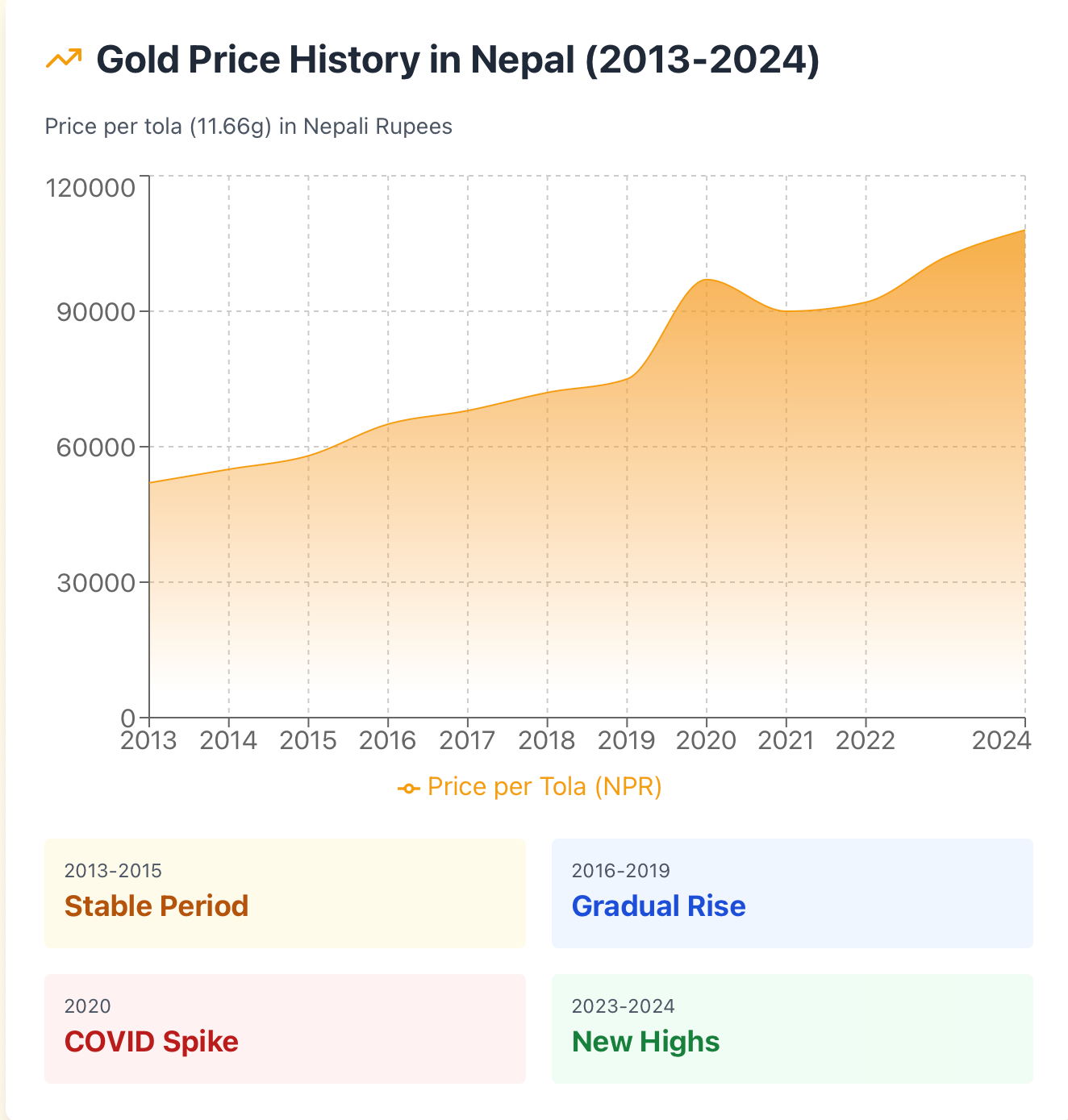
From 2013 to 2015, prices were quite stable, mostly fluctuating between 50,000 and 60,000 rupees per tola (11.66g). You will note that the global gold market was going through a consolidation period after it peaked in 2011, which was reflected in the Nepal market.
From 2016 - 2019, we saw a gradual uptick in gold prices, hitting approximately 65,000-75,000 per tola. Global growth was solid and steady, inflation was moderate, and gold was just keeping pace with adequate economic growth.
But then 2020 came along and everything changed. The onset of COVID-19 caused incredible global uncertainty. Central banks lowered their interest rates to 0% or even negative rates. Governments around the world printed money to support the economy. As the panic ensued, the global price of gold spiked, as did the price of gold in Nepal. Prices breached 95,000 per tola and on a few occasions, rose to almost 100,000.
In 2021 and 2022, there was a retracement and volatility. Gold retreated, forming highs as the world reopened and vaccines were distributed, but inflation in the global economy was still in a relatively higher range - providing support. The price continued to fluctuate between 85,000-95,000. The gold pricing reflected uncertainty in the global economy about whether inflation would quickly stabilize, or be persistent.
Now, 2023 onward has seen a resurgence. Stresses in the US banking markets in the early 2023, continued inflation in the global economy, and geopolitical concerns raised prices. Prices broke above the 100,000 mark in the Nepal gold market, and continued to climb further.
The lesson here on the history of gold is quite simple. Gold responds to crisis and uncertainty in a stable manner. When things are calm and stable, the price of gold almost always seems to lag behind equities and other growth assets. However, when times become uncertain and panic arises, the gold provides great shock absorbing returns - often outperforming all other investments.
An investor who bought gold back in 2013, and held it until 2024, would have earned approximately a 100% return in Rupees. (Approximately 6.5% annual return). This is a reasonable return versus other asset classes, but certainly not spectacular.
An investor who bought gold at the height of panic in 2020 and sold in proximity of the 2024 gold highs would have done much better however, potentially earning 30-40% in just a few years.
Like all investments, timing with gold is very important. Unlike some other investments, gold generally reserves its best returns for when things feel most awful. To capitalize on gold as an investment, you must make emotional and intellectual decisions.
Building a Gold Portfolio Without Losing Sleep
Investing in gold should be a part of your portfolio, but not the whole portfolio. The question is how much and in what form.
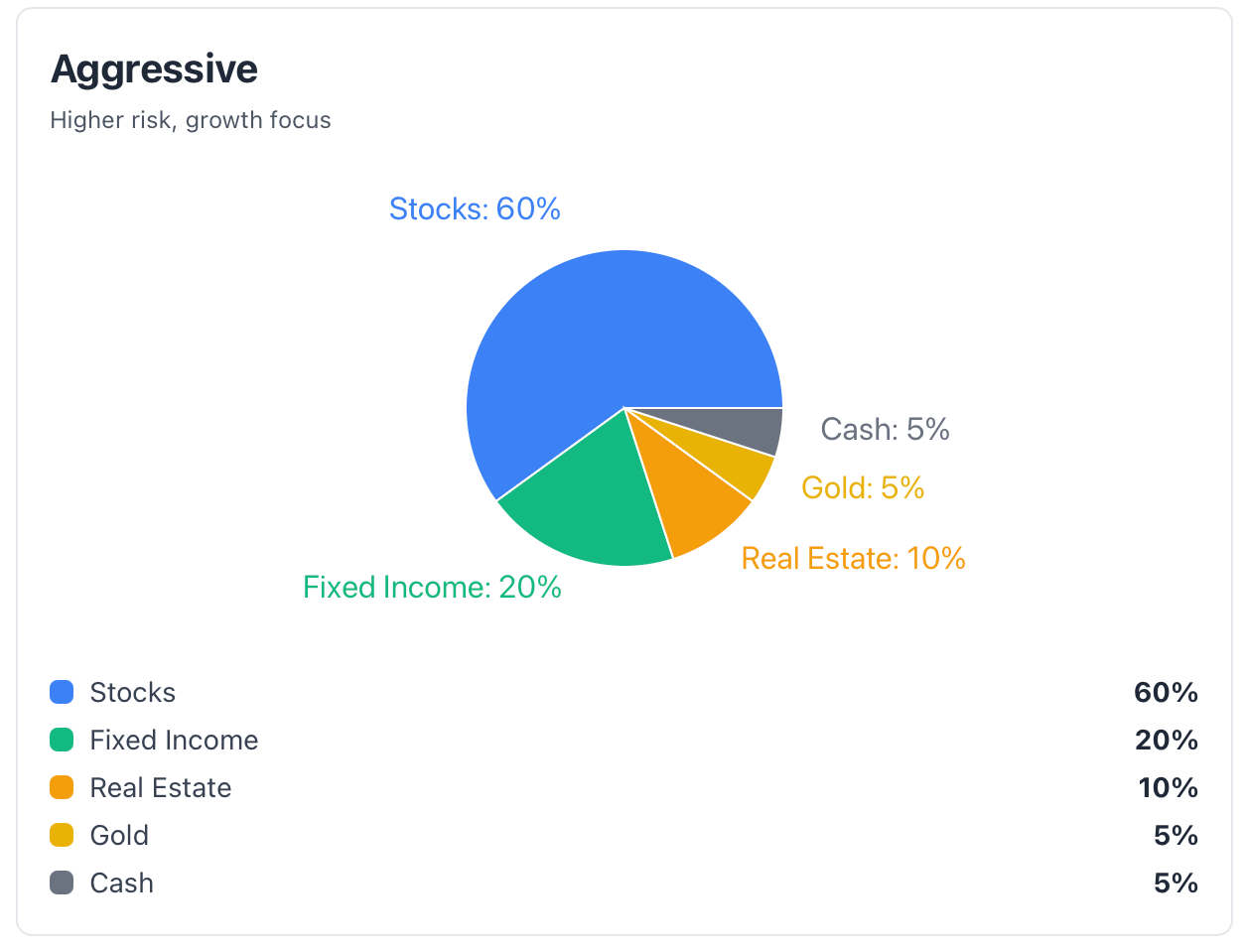
Traditional guidelines for diversification suggest putting five to 15% of an investment portfolio into gold. That level of allocation is enough to provide some level of meaningful protection during times of market dislocations, without becoming over-concentrated and invested in an asset that does generate income. A conservative investor may allocate 10%. An aggressive investor, who is mainly looking for compounding growth, may choose 5%. A very conservative type of investor who is worried about economic uncertainty may want to go to 15% or a tad bit higher.
The rest of the portfolio will include some combination of other types of assets based on personal goals, time horizon, and risk tolerance. Stocks, bonds, real estate, and cash all serve fundamentally different purposes. Gold serves a mainly defensive purpose, simply providing ballast to the portfolio while other assets are struggling.
Your allocation to physical gold in the gold allocation depends on your specific preferences. Some investors, who like the security of owning pieces of gold, may want 100% of their gold allocation to be in physical gold, whereas other investors may prefer 50% in physical and 50% in financial instruments for liquidity. There is not one correct answer.
The concept of rebalancing means periodically moving your portfolio back to your target allocation. If gold is up considerably and you have a 10% allocation that grows to 15% of the portfolio, you may sell some gold to buy other assets that have underperformed. Rebalancing puts you in the position to sell high and buy low, which is the opposite of what your emotions will typically drive you to do.
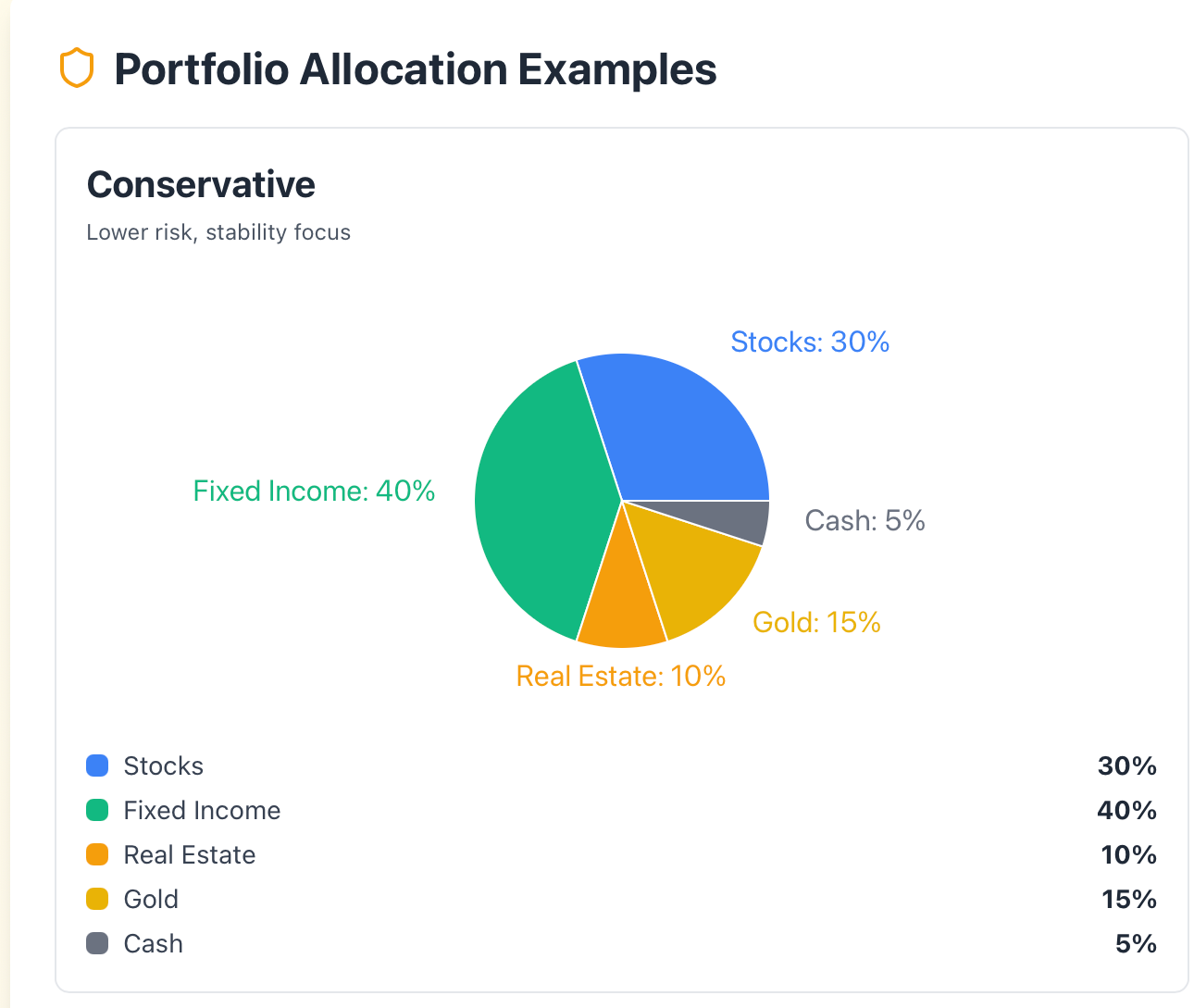
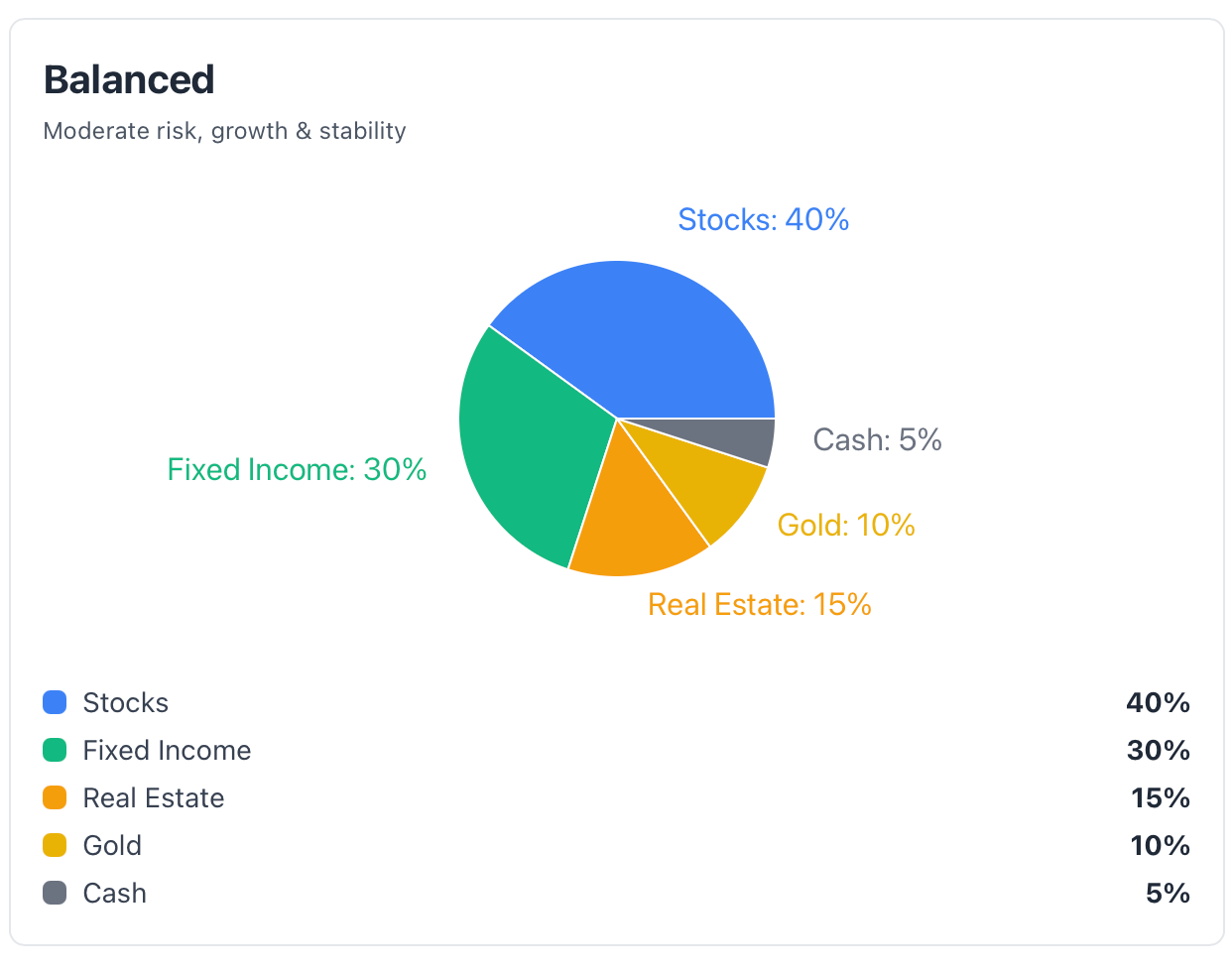
Here is an example of a balanced portfolio for a Nepali investor:
-
40% stocks (ideally, a mix of domestic and international)
-
30% fixed income (bonds/fixed deposits)
-
15% real estate (property or REITs if available)
-
10% gold
-
5% cash
A more conservative portfolio may have a higher percentage of fixed income and gold while lowering stock allocation. A younger, aggressive investor may have a larger percentage of stocks, reducing the other allocations.
Hedging using derivatives is advanced, but it is worthwhile to understand. If you own physical gold, and are reluctant to sell the physical gold to hedge against a short-term price drop, then theoretically you could sell futures contracts and lock in a price. If the gold were to drop, your physical position would lose value, but the futures position would make money to offset the loss. Obviously, this requires access to futures markets and understanding how to trade the contracts, therefore putting it outside the reach of most retail investors in Nepal at the moment.
The main principle of risk management is simple: Don't bet your life savings on one outcome. Remember, gold is valuable exactly because it tends to move differently than other asset classes. Gold really can only help a person if there are different assets.
Ready to confidently start the process of investing into gold? The Nepal gold markets do offer genuinely good opportunities, but profitability comes with an understanding of what drives prices and an investment framework that suits your own investing style and goals. Don't simply follow the herd during times of festivals or the panic of falling markets. Take the time to learn, think about your investing approach, and make a plan to invest regularly instead of emotionally.