




What Is Cryptocurrency Mining?
The act of cryptocurrency mining employs computer power to solve complex mathematical problems that verify transactions, establish new blocks, and acquire crypto rewards. Mining supports blockchain technology without mining, there is no way to secure the network or add a new transaction to the ledger.
Mining can be broken down into two core features. First, it secures the blockchain from censorship and state actor deception by making it incredibly expensive to tamper with transaction history. Second, it allows anybody with the right equipment to participate in the validation of the network, thereby establishing decentralization. This is very different from legacy banking systems that rely on central authorities for validation.
There are two primary consensus mechanisms used in the blockchain. Proof of Work (PoW) means that miners need to expend some computational energy to validate a block. Proof of Stake (PoS) sets validators based on the number of coins they hold and therefore "stake" as collateral. Bitcoin and many other cryptocurrencies use PoW. Ethereum switched from PoW to PoS in September 2022.
For traders, understanding mining is critical. Mining has a direct impact on supply creation. When a miner acquires a block reward, they typically sell some or all of those coins to pay for electricity and new equipment. This is an additional action that adds supply to the market from which traders need to consider price movements. There is also a security implication for market confidence based on network hashrate. A higher hashrate suggests that the network is more secure, and should attract more investors.
Bitcoin miners are working to solve SHA-256 cryptographic puzzles. The miner who finds a valid solution first will earn the current block reward (3.125 BTC after the 2024 halving). Think of it as a classroom running a very difficult math problem. The first student who figures it out correctly wins a prize. This is how mining works just at an industrial scale (millions of calculations per second).
The Evolution of Mining
Since Bitcoin's inception in 2009, cryptocurrency mining has changed dramatically. This history is helpful in understanding today's industry mining space and market dynamics.
During the early period of mining (2009-2012), it was possible to mine Bitcoin fairly easily using a common home computer. The CPU mining period quickly transitioned to GPU mining, when people figured out that GPUs were substantially cheaper, easier to set up and had much lower operating costs. The early miners were more like hobbyists, generally running a few GPUs at home, in their bedroom, low barrier to entry.
Then everything changed with the ASIC period (2013-2017). As the name implies, ASIC (Application-Specific Integrated Circuits) chips were designed specifically for one and only one purpose: mining designated cryptocurrencies. As everyone knows, Bitmain's Antminer series changed the entire sector and dethroned CPU and GPU mining Bitcoin altogether. ASICs are thousands of times more effective than general-purpose computing hardware but also very expensive and a single-use item.
With the advent of ASIC dominance came the emergence of mining pools. Mining solo became impossible for sensible players because the chance of discovering a block solo dropped to nothing. Mining pools allow groups of miners to aggregate their combined hashrate to find and solve a block collectively, then share the rewards proportionally. Mining pools created a more reliable and predictable source of income however, also represented some issues of centralization.
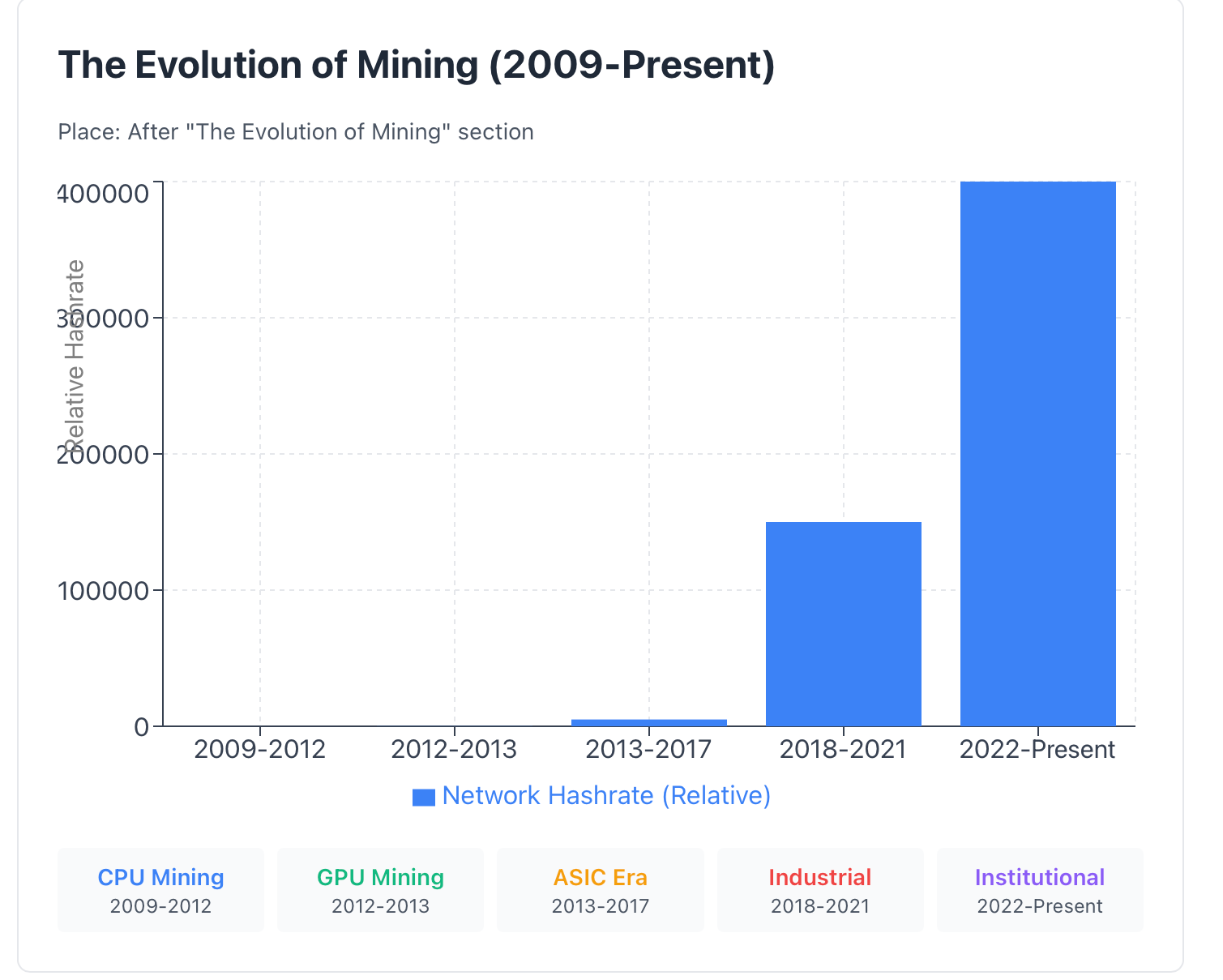
From 2018 to 2021, the mining industry became fully institutionalized and moved into major cheaper electricity regions. China dominated the global hashrate until regulatory crackdowns occurred in 2021. Professional mining companies launched their operations at the warehouse scale, utilizing tens of thousands of machines together in their operations. Companies like Riot Blockchain and Marathon Digital even went public, and mining became a corporate endeavor.
The transition period (2022-present) saw major structural changes take place. In September 2022 with Ethereum's merge from proof of work (PoW) to proof of stake (PoS), it displaced millions of GPU miners, who now all have to seek new coins to mine or leave the space entirely. At the same time, Bitcoin miners began to focus their operations increasingly on renewable energy, in which there are now multiple operations operating on solar, wind, or even hydroelectric power.
To think of this the evolution is best analogous to hobbyist gardening instead of becoming large-scale agriculture. What began as individual hobbyists growing small vegetables in their backyards has become very large-scale commercial farms with specialized equipment and an economy of scale. The overall trend shifts who can now profitably participate.
How Mining Actually Works: The Technical Mechanism
Grasping the technical elements of mining clarifies how blockchains actually vet transactions and maintain security. Let's take this from the top and walk through it step by step.
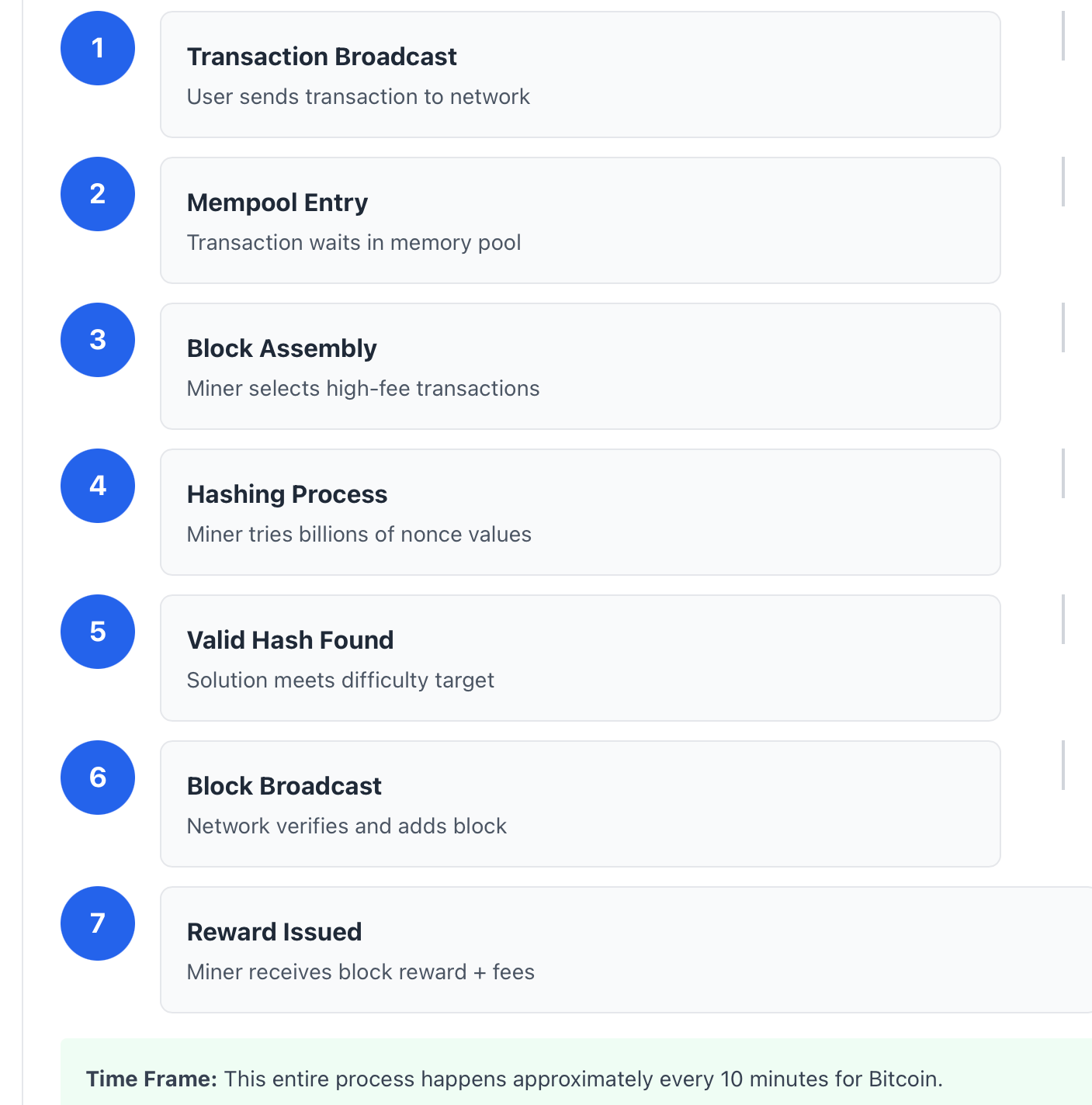
Mining begins when you send a Bitcoin transaction; first, it gets broadcasted to the network and enters a memory pool (mempool) waiting for validation. Miners pick from the available transactions residing in the mempool. It is common for miners to pick transactions with the highest fees first. The miner will pull these transactions from the mempool and form them, or cluster them, authentically into what is known as a candidate block.
The next step is the assembly of the block. The miner generates the block header which holds the adjusted and mandatory or protocol required pieces of information including: the previous block hash, a timestamp, the merkle root of all transactions grouped, and some nonce (a number that can be altered or modified numerous times). All this information is the header itself, the information above constitutes the header input in the hashing process.
This is where the work really begins. The hashing is at the heart of the mining process. A hashing function is a function that takes as input a variable amount of input data and outputs a fixed amount of output data, i.e. the hash. SHA-256 is getting used, and it is used twice for Bitcoin. A hashing function has three essential properties:
-
"One-Way" - It is mathematically impossible to reverse-engineer the input from the output
-
"Deterministic" - The same input data, i.e. the block, will always generate the same output hash
-
"Avalanche" - An output totally differs even with the slightest change in input data
A number set by the network is the target. To "solve" the block, miners find a hash that's numerically lower than this target. The only way to achieve this is by trial and error. Miners increment the nonce, trying billions of different values, hashing each combination, until they find a hash that works.
When a miner finds a valid hash, they broadcast the solution to the network. Each other node verifies in a quick manner (it's easy to verify, hard to find!) that the solution is indeed valid. If valid, the block is added to the chain, and the miner is rewarded with the block reward plus transaction fees. This process happens roughly every 10 minutes for Bitcoin.
The difficulty adjustment is very important. Bitcoin has a target of a 10-minute block time. If the network collectively finds blocks faster (because hashrate went up), the network will automatically adjust and increase the difficulty level, by lowering the target. If the blocks were found less often (hashrate went down), the difficulty would lower as well. This happens every 2,016 blocks, which amounts to roughly every two weeks.
Proof of Work (PoW) is safe because of its computational expense. An attacker would have to redo all of the mining work to change the history of the blockchain for previous blocks and then still maintain an advantage on the rest of the honest network. Given Bitcoin's hashrate, the computing and energy costs are prohibitively expensive. The network is secure if the costs for an attacker exceeds anything they hope to gain from the attack.
Hashrate is directly related to the security of the network. The more hashrate, the greater the computation power is securing the network, and the more difficult it is to mount an attack (exponentially so). You can think of hashrate like a vault door, the thicker the door, the greater the protection for your valuable items inside.
Proof of Stake (PoS) works differently. Validators are not selected based on computation power but instead based on their stake in the network. The validators are required to lock coins as collateral and if they validate something that is not true, they lose their stake (this is called slashing). PoS uses much less energy but works off of different trust assumptions compared to PoW.
Types of Mining Operations
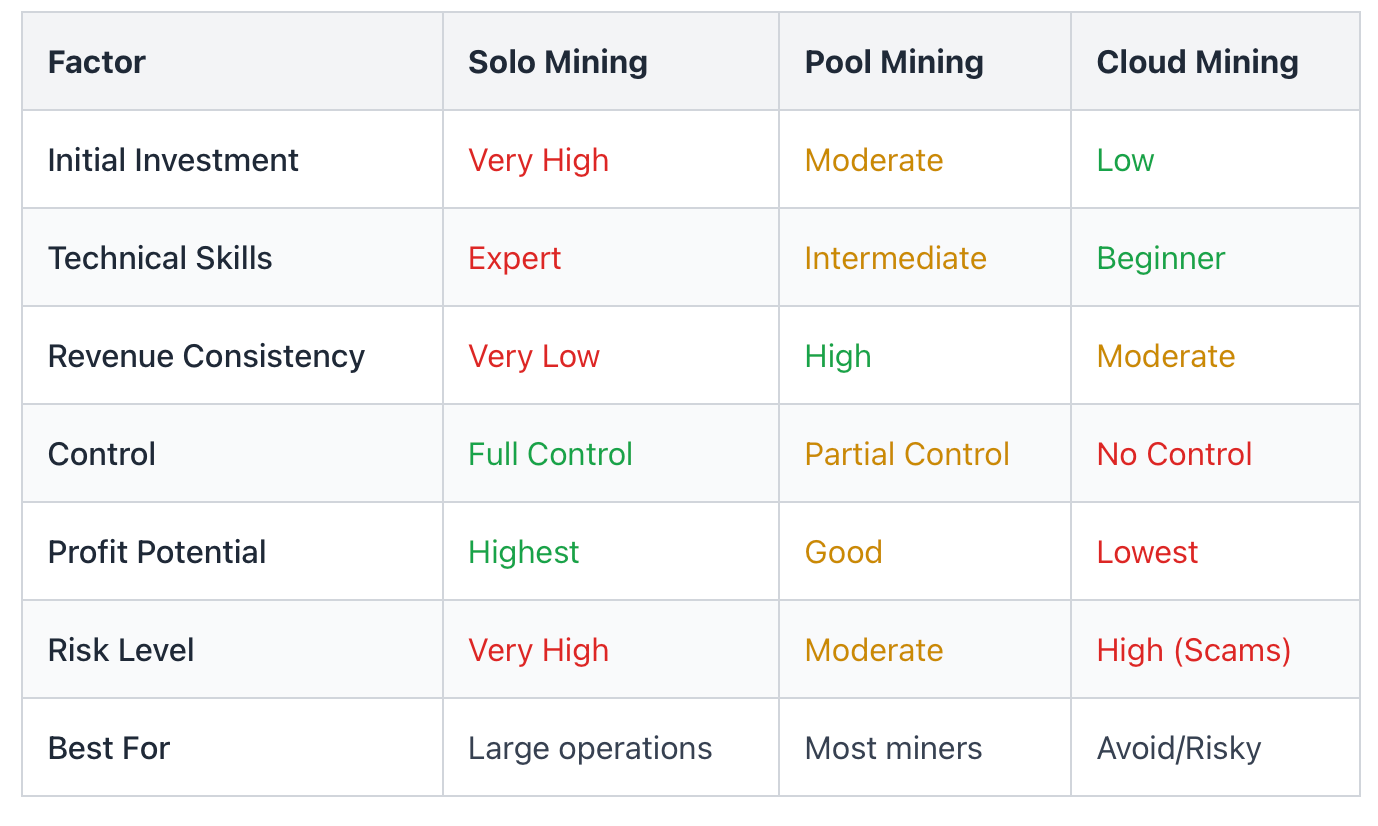
There are a number of ways miners can be involved, all with their own advantages and disadvantages, as well as varying amounts of capital required. Solo mining consists of running your own full node and a mining operation to find blocks independently. If you find a block, you keep the full block reward plus the transaction fees.
This may sound appealing, but it comes with an extremely high variance. Given Bitcoin's current difficulty, one ASIC miner can take years, or even decades to solve for a block. You need to have significant hashrate to have a reasonable chance of succeeding. Solo mining requires a great deal of technical experience just to set up and maintain the nodes, configure the mining software and troubleshoot any problems in the future.
Pool mining solves the variance issue by combining many miners' hashrate together. After the pool has discovered a block, it pays out rewards to each miner proportionately based on their contributed work. Payout methods include:
- Proportional (PROP): the mining pool divides rewards based on the shares submitted in a round.
- Pay Per Share (PPS): the mining pool pays miners based on the share submitted, regardless of whether the pool finds a block. In this case, the pool operator has the risk of finding a block.
- Pay Per Last N Shares (PPLNS): the mining pool rewards miners based on their shares within the last N shares discovered before finding a block.
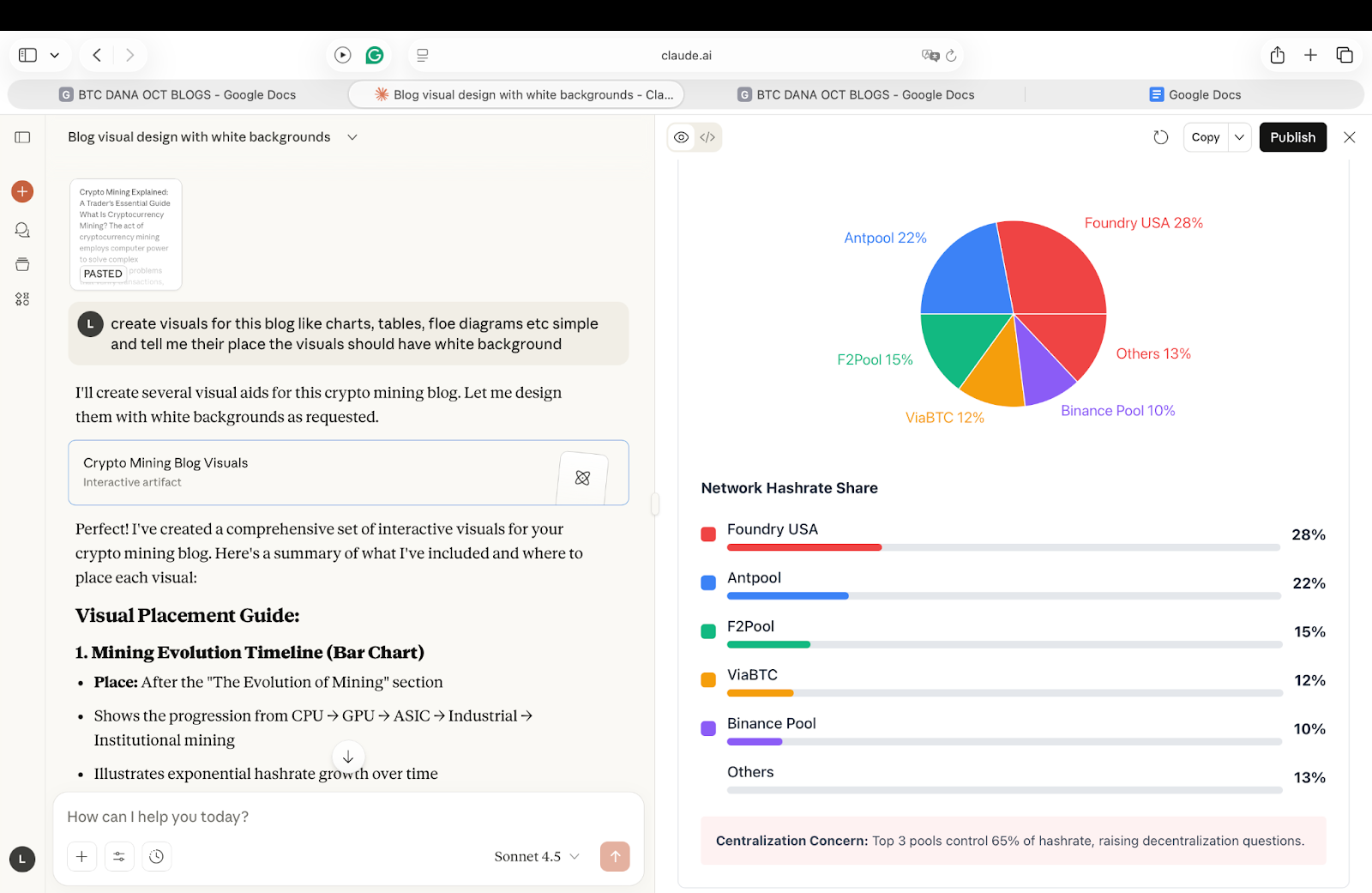
Mining pools impose fees on earnings, generally between 1-3%. In addition, larger mining pools such as F2Pool, Antpool, or Foundry USA have accumulated a large proportion of the total network hashrate. This creates questions regarding the decentralization of the pool. However, if it becomes too centralized, miners can always switch to a different mining pool. For the majority of miners who mine individually, a pool usually provides the best balance of consistent income and technical difficulty.
Cloud mining, on the other hand, allows consumers to rent hashrate from a remote data center. You may either may an upfront fee, or sign a contract for the service. The cloud mining company will process the mining, and you will receive your share of the rewards. There is no doubt, the appeal of cloud mining is clear: You are not required to purchase and operate hardware, you are not required to pay the electricity bill, there is no technical setup required, and you do not need to maintain a cooling system.
However, there are major disadvantages of cloud mining. Many clouds mining businesses are scams (i.e., they are simply a ponzi scheme), and those that are not scams still come with significant risks. For example, if the service provides unclear information regarding its fees, you risk not getting your money back. Additionally, cloud mining contracts often have very long payback periods (if you ever break-even), and can be terminated by the pool once mining becomes unprofitable. While services like NiceHash offer possible pool style rental contracts, it is important to remember that the returns may be low or very low.
Solo mining is akin to farming alone on your property; you reap all the harvest and if the crops fail, you get nothing. Pool mining is essentially joining a cooperatively farm where everyone shares in the yield of the harvest. Cloud mining is leasing farmland from another farmer, while hoping they simply know what they are doing and manage the crops properly. All three models reshape where risk and reward lies.
For new farmers with limited working capital, pool mining is almost always the best entrance for new farmers. Also, for those who lack the technical skills or low-cost electricity, cloud mining may appear tempting, but should be only considered with careful thoughts and research.
Mining Economics: Understanding Costs and Profitability
Mining profitability is predicated on an extremely fine line between cost and revenue. Understanding the economics will help you assess if mining makes sense, and how miners affect the larger market environment.
The largest upfront cost is hardware. ASIC miners, such as the Antminer S19 Pro, can cost thousands of dollars each. Prices can change quickly in terms of the crypto market; they will be higher during a bull market, and lower during a bear market. Hardware depreciates quickly as new units are released. For example, a top tier ASIC may become unprofitable in two to three years.
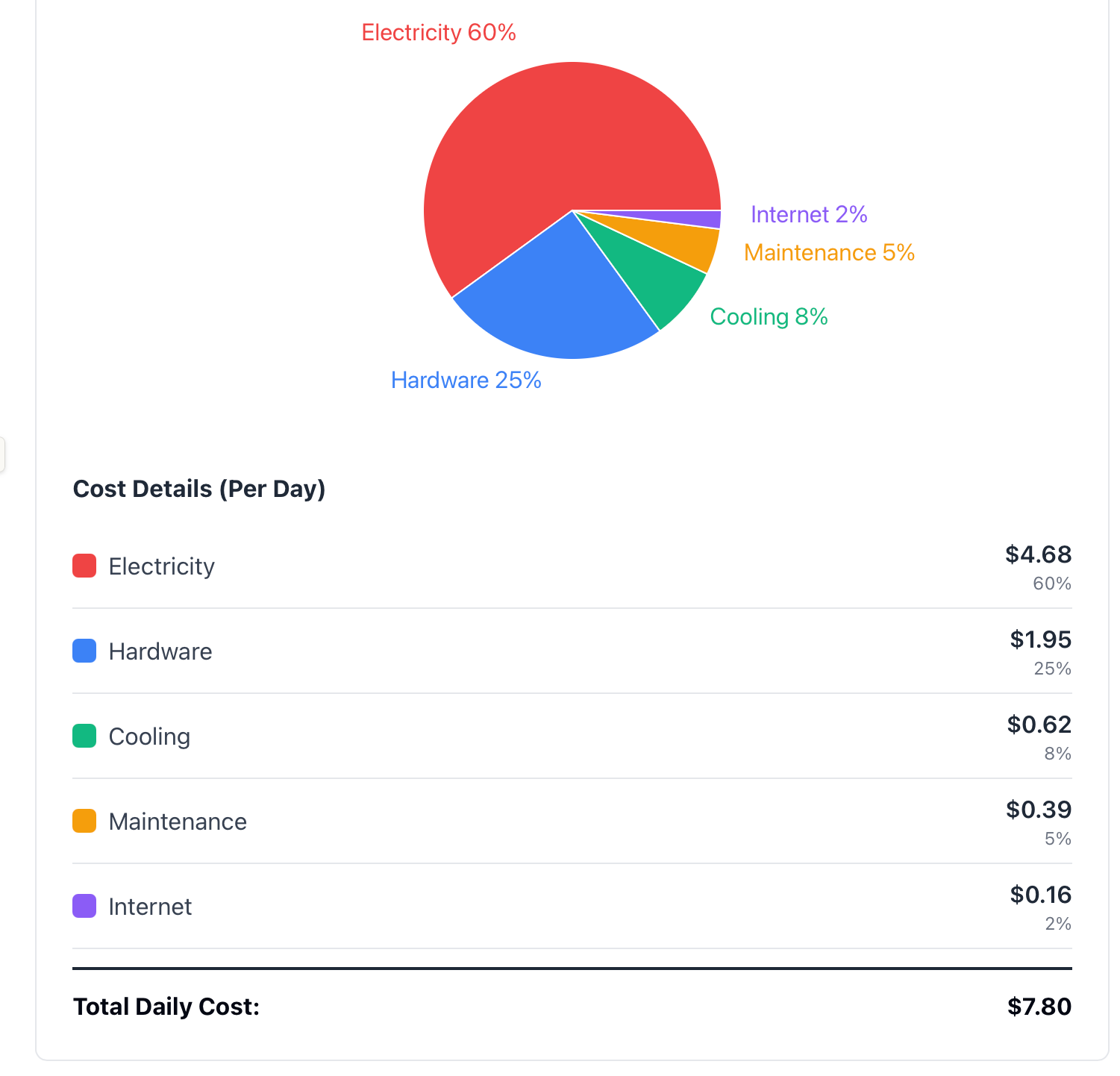
Electricity is the largest ongoing cost. Mining hardware runs continuously, consuming huge amounts of electricity. An Antminer S19 pulls about 3,250 watts while running (or approximately 3.250kw a day). At $0.10 per kwh, that's about $7.80 a day for electricity. With some regions producing power at $0.05, that daily cost may only be $3.90. It's these costs that causes mining to migrate to energy cost effective areas.
Other costs may include cooling systems. Mining hardware produces tremendous heat. Commercial environments will sometimes use very expensive HVAC type systems or immersion cooling systems to control the heat from the processors in mining rigs. You will also need reliable internet service - its not much bandwidth in downtime with rigs running cards at various rates - but you will need it. Other maintenance might include replacing broken fans, breaking the unit down to repair it, periodically updating firmware updates, etc.
There are two sources of revenue. There is the block subsidy, which is the fixed reward for mining a block - currently 3.125 BTC for Bitcoin. There are the transaction fees which users pay to have their transactions included in blocks. When there are congestion issues in the network, transaction fees can increase dramatically, providing additional revenue for miners. When the network is not congested, transaction fees may be negligible.
To provide an oversimplified estimate of profitability, daily revenue is determined by multiplying the hashrate share into blocks mined in a day multiplied by the block reward, adding transaction fees if there are any. Daily profit is determined from the daily revenue minus daily expenses. The payback period is the hardware cost divided by daily profit. This quickly becomes complicated as the price of Bitcoin, network difficulty, and hashrate fluctuate continuously.
Now let’s use a real-world example. Suppose an Antminer S19 Pro runs at 110 TH/s, costs $2500, and it’s being mined at current Bitcoin difficulty (hypothetically, let's set the price of Bitcoin at $45,000). If electricity costs $0.08 per kWh, then the daily revenue that the miner could generate would be $8 and, after covering $3 for the power consumed ($5 profit) (not accounting for other expenses).
That is a payback period of 500 days on hardware cost assuming everything stays constant. In this example, what is evident is that difficulty does indeed increase over time and therefore reduces profit.
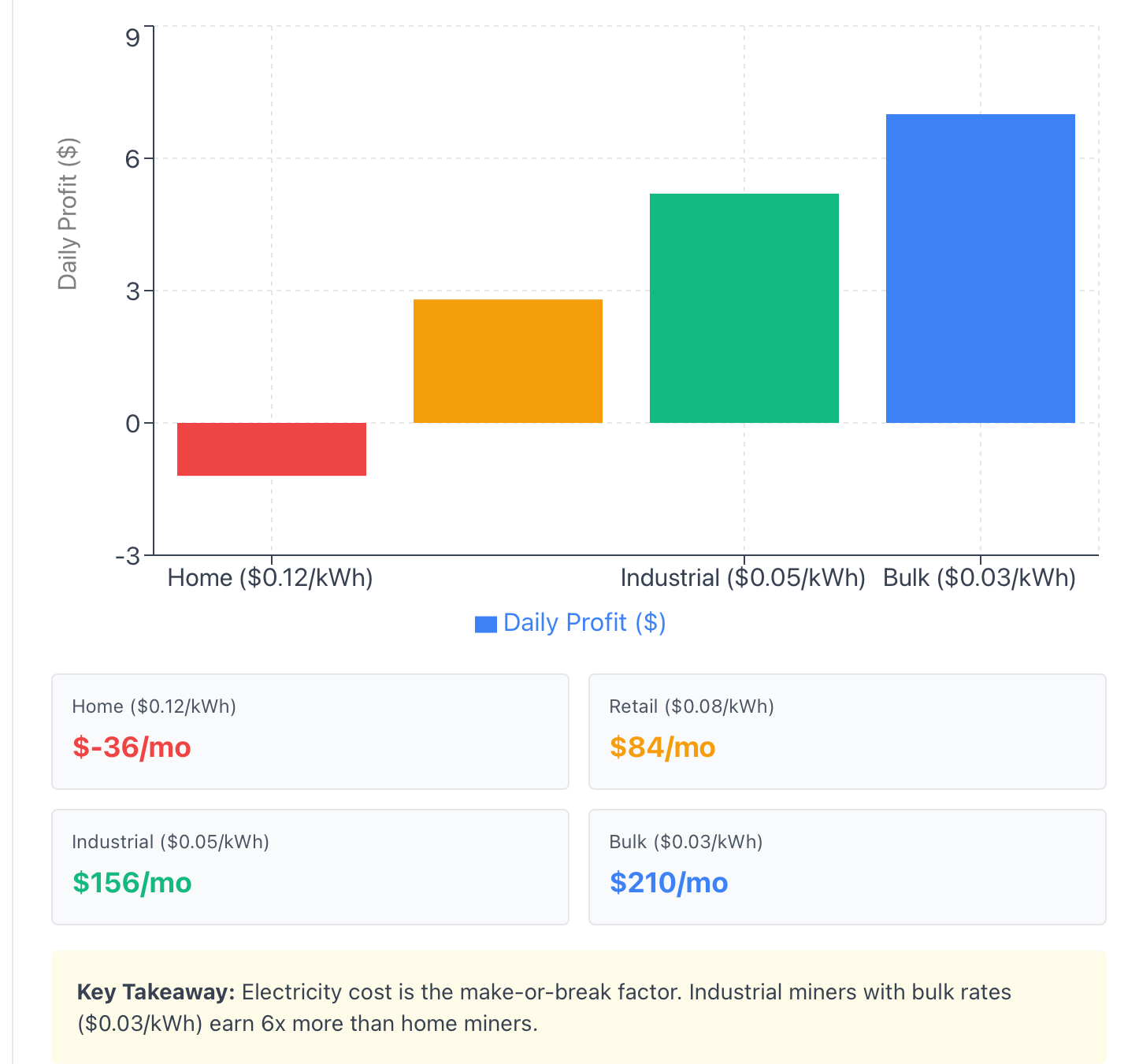
Economies of scale have huge ramifications. Large mining companies may negotiate bulk hardware discounts (if they buy enough), have access to competitively priced long-term power contracts (sometimes under $0.03 per kWh), spread fixed costs across more hardware, and be more efficient at running and operating the hardware it does have. It is difficult for a home miner relying on retail/prosumer prices for electricity to compete with this scale.
Difficulty and hashrate growth are also constant, but comparatively slowly, eroding unit returns. Simply, if more miners join the network then each miner's share will be reduced. Furthermore, bull markets will see extreme price action that will attract new miners to the network, resulting in sustained upward difficulty and further reducing everyone's margins. This is a natural self-corrective mechanism that tends to average out to keep mining marginally profitable.
Mining profitability is extremely sensitive to energy costs and the price of Bitcoin. It is always important to run complete plausible scenario-based ROI on hardware. The most successful miners are those that historically have found good and cheap power long term and have continued to reduce operational costs.
Mining and Market Dynamics
Mining creates new coins and consequently affects market dynamics and price cycles. Understanding these variables can provide traders with useful perspectives for pricing and positioning.
Sell pressure from miners is a consistent aspect of the market. Once mining creates Bitcoin, the miner's expenses are in fiat currencies: electricity costs and bills, hardware purchases and costs, facility leases and rent, along with their own payrolls. For miners to pay these expenses, they need to convert Bitcoin to fiat continually. This continual need for mining to sell constantly applies pressure to the sell-side of the market.
The extent of this pressure can change based on Bitcoin's price. When prices are elevated, miners can afford to hold a larger percentage of Bitcoins since even selling a small amount would offset their expenses. When prices drop significantly, miners have to sell a larger percentage of their mining rewards to cover the same expenses, thereby creating more downward pressure.
One way to frame this miner activity is referencing on-chain information. Outflow metrics (also call miner outflow metrics) show the flow of Bitcoin from miner wallets to exchanges, which usually indicates selling. Also, higher miner outflows during price rallies can indicate the miners have been distributing Bitcoin. Likewise, low miner outflows during a bear market can either be signs of the miner holding their Bitcoin, or that they have completely capitulated, and relinquished their operations and to sell their coins.
Bitcoin becomes scarcer with each halving process, which is a major supply-side event. Approximately every four years (or every 210,000 blocks), the block reward is halved. In 2009, Bitcoin had a block reward of 50 BTC, which was reduced to 25 BTC in 2012, then halved to 12.5 BTC in 2016. Until 2020, it dropped to 6.25 BTC and again halved to 3.125 BTC in 2024. The next halving will drop the number to about 1.5625 BTC around 2028.
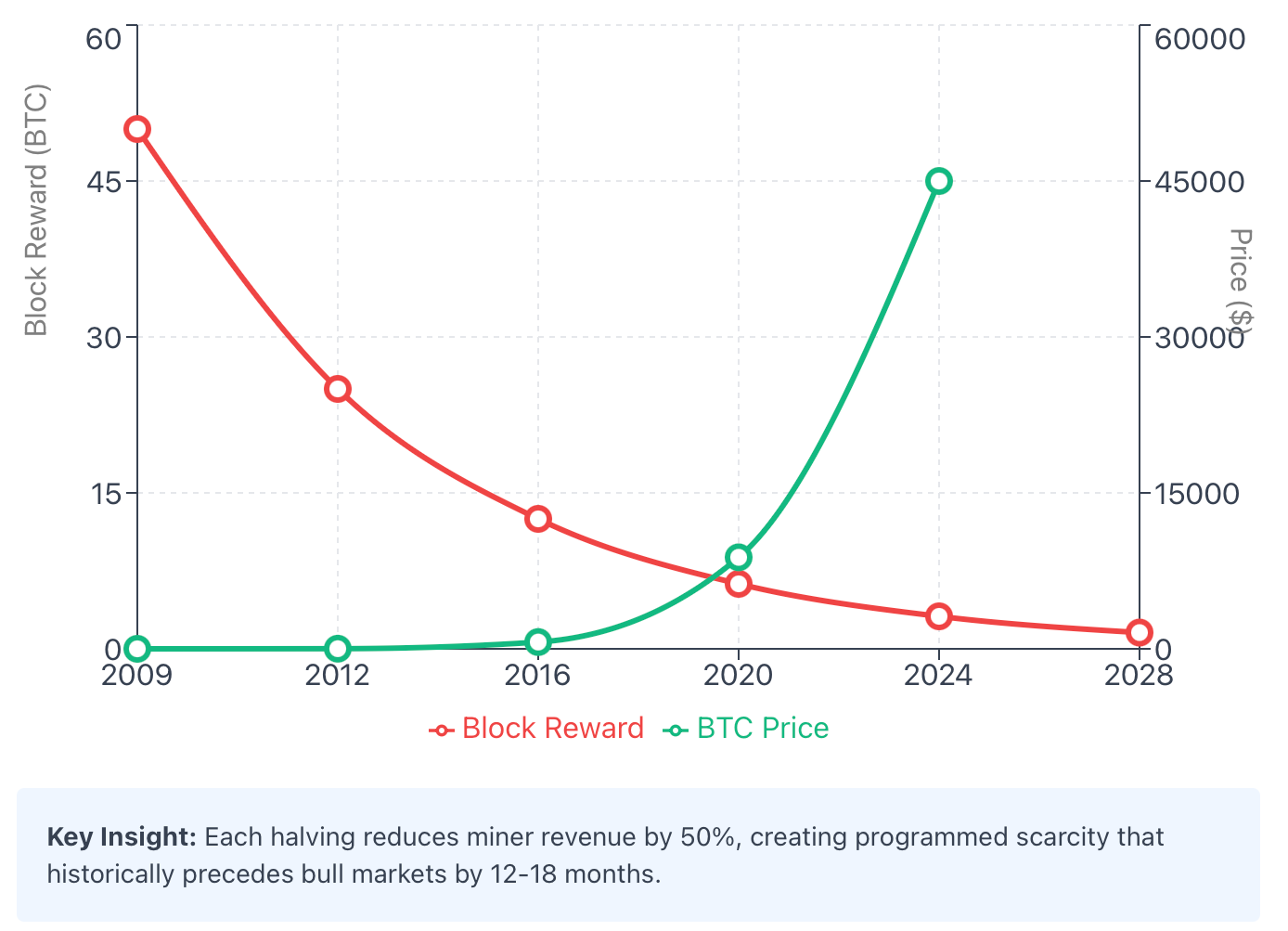
Halvings quickly reduce miner revenue (assuming transaction fees remain constant), forcing out marginal miners, and then hashrate reductions as well. Aside from the reduced issuance of supply, the market tends to experience bullish price pressure. It is typically not immediate, but comes over time.
From its history, the pattern is that major bull markets generally do occur about 12-18 months after halving. The 2012 halving occurred shortly before the rally to $1,000 in 2013. The 2016 halving occurred shortly before the bubble to $20,000 in 2017. The 2020 halving occurred prior to the run to $69,000 in 2021.
Correlation alone does not prove causation, however when a supply shock is created due to the halving, it does create an economic incentive to consider. Less issuance means less new supply hitting the market. If demand is constant - or increases - prices will rise. Halvings are public knowledge and are priced in to some degree; however the actual effects all happen over daylight hours and longer.
Changes in a network's hashrate measure both its health and market sentiment for that network. A rapidly dropping hashrate can indicate miner capitulation. Miner capitulation often happens at the bottom of a bear market, which results in only the most efficient miners continuing to mine. Increasing hashrate indicates more network security, and miners are likely becoming optimistic in terms of expected future profitability.
Major hashrate drops can mean more than miner capitulation. For example, when China banned mining in 2021, the hashrate dropped drastically before it increased again, as miners picked up and moved to other regions of the world.
For traders, mining metrics can influence your strategy:
-
Track changes in miner reserves (are miners accumulating reserves or distributing reserves?)
-
Look for increasing hashrate / upward trends in hashrate (is the network becoming more secure?)
-
Mark your calendar for the halving event (and track historical price behavior)
-
Look for difficulty adjustments to confirm price changes in line with trends.
Mining can be viewed as a resource and consumption. For example, when gold mines are producing less metal for its processing due to depletion, gold becomes scarcer and thus increases in price. The halving of Bitcoin is creating programmed scarcity. Unlike gold where miners will continue to extract from other locations, Bitcoin has more of a programmable supply schedule that is both fixed and transparent.
Some traders also consider mining profitability as a leading indicator. A lower security on a network and the associated loss in profitability, followed by a drop in hashrate will indicate that price is close to its bottom.
Conversely, if miners are highly incentivized to continue, and new capacity is coming online, this would lead to dwindling miner profitability which would indicate that the price is likely approaching its high, although we can never know this with certainty. Again, just like hashrate, these are not perfect signals but they definitely add value in consideration of the respective market condition by technical and fundamental analysis.
Key Mining Risks
Mining is a capital-intensive activity exposed to different risk categories. If it is your intention to mine or invest into a mining company, understanding these risks is important.
Technical risks begin with hardware obsolescence. Mining equipment becomes antiquated very quickly. You might have the most efficient ASIC today, but there is a chance it will be unprofitable in two years when the next generation of mining hardware is released. Unlike general-purpose computers, ASICs have no alternative uses; when they become obsolete as miners, they will be essentially worthless.
Market risk is significant with mining. When Bitcoin prices drop, revenue drops alongside fixed costs. Suddenly a 50% drop in Bitcoin price can turn profitable mining operations into operations that incur losses in money. Difficulty increases are also a risk, and they correspond to increases in network hashrate. Even assuming your hardware does not change, your reward will be lower as your share of any reward diminishes due to increased competition.
Regulatory risks can be detrimental, and even catastrophic. There are jurisdictions that explicitly ban crypto mining. In 2021, China cracked down on crypto miners, which forced mining companies to cease operations in that jurisdiction, or to shut down completely and set up elsewhere. In doing this, mining companies lost millions of dollars in capital investment on their facilities and power services, while other companies just disappeared.
Other jurisdictions have expensive, limited licensing regimes or special taxes on mining activity or facilities. Regulatory risk is also volatile and everchanging; companies that are relatively legal today may find themselves in legal violation in the near future, meaning they would lose whatever capital investments made in fixed infrastructure.
Risks to energy supply bode challenges for continuity of operations. Grid instability in some regions leads to frequent outages that can halt mining operations, resulting in lost revenues. The volatility of power costs leads to uncertainty around budgets for miners. Some miners have faced utility price hikes that consistently render operations unprofitable. In de-regulated power markets, extreme weather can also contribute to skyrocketing price increases.
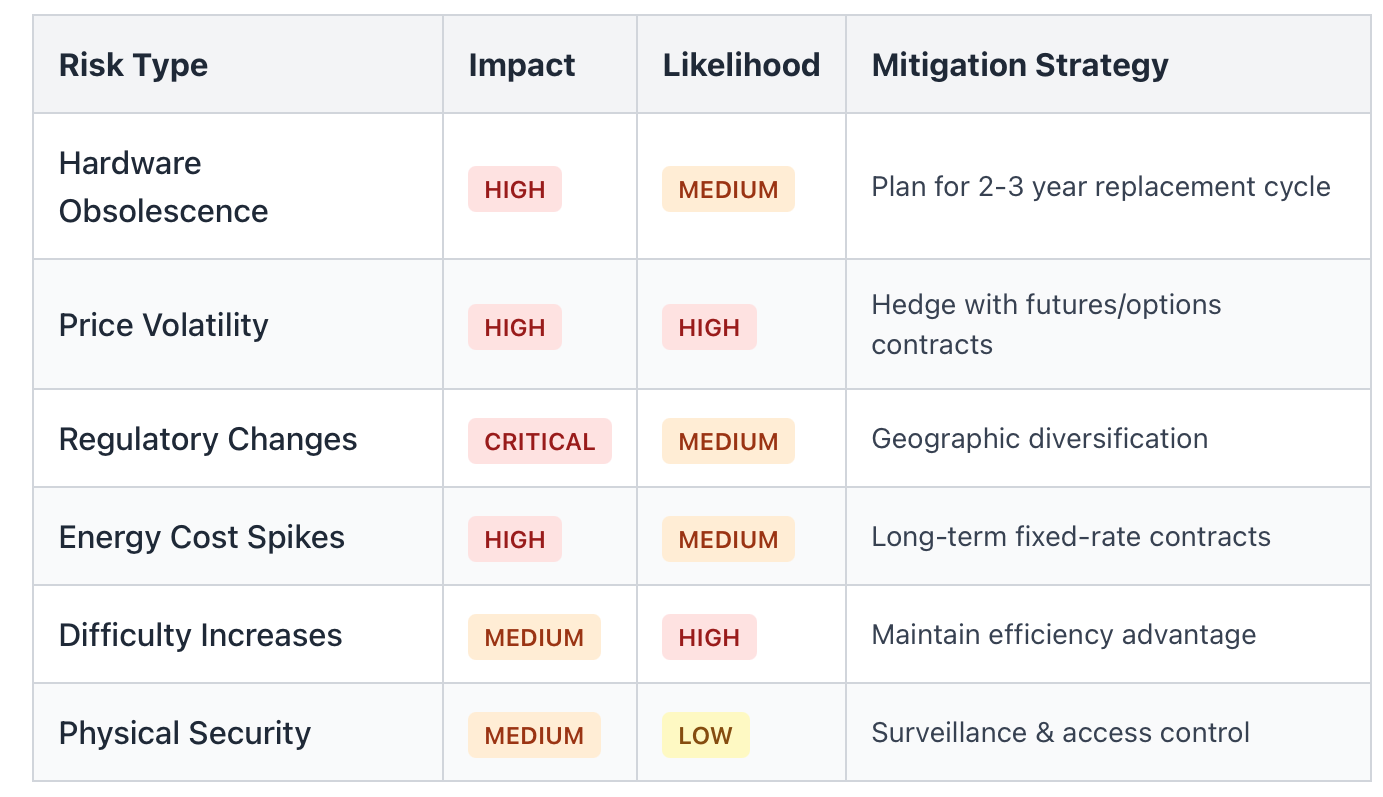
For example, the freeze in Texas in February 2021 led to extreme spikes in the cost of electricity; hundreds of times the normal price, devastating miners that had not hedged their contracts.
Security risks can also be either digital or physical in nature. Because hardware and cryptocurrency can have a significant resale value, mining facilities tend to be targets for theft. Hacking attacks are also a risk to mining operations, pool accounts, and wallets. Ensuring physical site security can involve investment in surveillance, access control, and even armed security in some cases.
There are ways to alleviate risks, although there are significant considerations including:
-
Geographic diversification to reduce your exposure to regulatory risk
-
Hedging some degree of exposure through forward contracts or options
-
Securing low-priced long-term power contracts that will lock in costs
-
Investing in strong operational practices; redundant power supply, fire suppression, or cybersecurity
-
Having cash reserves to manage downturns without the need to sell under duress
-
Pool diversification to lower the risk of having one pool compromised
Mining is sensitive to capital and regulation. Risk management is not optional; it is essential for survival. Many miners underestimate risk and face devastating losses. Miners who survive the next downturn will be the ones who plan conservatively, keep a financial cushion, diversify risk, and watch regulation changes.
Investment Strategies Related to Mining
When you have an understanding of mining, there are many different ways to invest without directly mining on hardware yourself. These strategies allow traders and investors to gain exposure to mining economics.
Publicly traded mining companies provide indirect exposure to the price of Bitcoin with a leveraged play because the value of mining stocks often moves more dramatically than Bitcoin itself. Companies like Riot Platforms, Marathon Digital, CleanSpark, and Core Scientific are examples of publicly traded mining companies with stock listed on major exchanges.
When the market for Bitcoin rallies, you will see mining stocks rally; when Bitcoin crashes, the mining stocks often drop harder than Bitcoin itself. This is largely in part to the fact that there is often negative leverage because of the cost of the mining operations.
Mining stocks often correlate with Bitcoin to a degree but may not provide a direct proxy. Mining company-related factors matter: operational management, cost structure, energy sources, hydraulic power (the amount of hash the company controls), liquidation debt, acquisition debt, and stock dividend decisions all relate to the stock value of the mining company. It is important to to your own due diligence on whatever company you are engaged with.
ETFs and funds can also provide indirect exposure to mining as a whole. There are many ETFs that are basketed together mining stocks of interest to you, thus reducing risk of a company-specific stock when compared to an investment in a specific company. Funds do allow for easy entry and exit from today's trading capabilities, but include management costs and can also include several other companies that dilute the pure-play aspect.
Investors can integrate metrics from the mining industry into their trading strategies:
-
Increasing hashrate can act as leading or confirming indicators of bull markets that support a long position.
-
The capitulation of miners (hashrate drops along with spikes in miner selling) can often signify a bear market bottom that supports a contrarian long entry point.
-
Measuring miner outflows to exchanges can signal miner selling pressure.
-
Halvings are events that can play a role in calendar-based trading strategies with expected outcomes.
-
Historically, buying Bitcoin in the 12-18 month lead up to an expected halving and holding until the price event through the following rally has been a profitable strategy. We cannot guarantee this pattern will repeat itself and through each cycle there are constructs that may differ from significant price correction to another cycle, but the supply shock caused by the halving event creates structural bullish supply side pressure that traders can play for.
-
It's always prudent to create risk-managed strategies for your crypto miner portfolio investments. Position sizing and capital should reflect the volatility associated with mining assets. These assets are high-beta investments that can experience violent price swings.
-
Never invest more capital than what you can afford to lose on mining speculative assets. Possible risk mitigated strategies could include taking long positions in mining stocks but pairing long mining stock positions with short Bitcoin positions or options that reduce volatility and/or correlation risk.
-
Diversifying across investment types helps spread and reduce risk. Rather than just holding mining stocks, consider a portfolio that may include outright Bitcoin ownership, mining stocks, companies involved in Blockchain infrastructure, and traditional assets. These options constantly reduce concentration risk while maintaining crypto exposure.
For those who trade on platforms such as btcdana.com, knowledge of the mining process will improve the trader's decision-making. Use mining data (hashrate, miner flow, difficulty) as data points to assist in timing entry and exit points. Keep in mind that mining creates predictable supply dynamics (halvings) and miner behaviors (miner capitulation, miner distribution) that can influence trading outcomes.
Why Understanding Mining Matters for Traders
Cryptocurrency mining represents more than a technological curiosity. It is an essential underpinning of blockchain security, a force in the marketplace, and a source of data for tradeable intelligence. For anyone serious about trading or investing in crypto, mining knowledge offers relevant context and a competitive edge.
Mining is how blockchains are secured, utilizing computational work to validate transactions without a trusted third party. Mining generates the new supply in a predictable manner, but the issuance occurs in a manner that has an impact on long-term dynamics. Halvings are the scheduled cuts to issuance, creating a conditional supply shock present just before major bull runs. Miners also have to regularly sell the coins they mine to fund their operations and maintain a cash flow, providing ongoing selling pressure analyzable by traders through on-chain data.
A significant number of the economic implications of mining also provide insight into mining costs and profitability. When the price of Bitcoin begins to flow below mining costs for a number of miners, capitulation takes place, the hashrate drops, and markets create what is functionally a bottom. When it becomes exceedingly profitable to mine, we see a lot of new capacity enter the market and an increase in the difficulty, which sequentially compresses margins. These cycles cause regular tradeable patterns.
Mining data can provide a material advantage for traders:
-
Hashrate trends to predict declines in network security as well as miner confidence
-
Miner outflow to exchanges to provide real time evidence of selling
-
Difficulty adjustment
-
Halvings give precise calendar dates that can signify added supply
Mining knowledge goes beyond just its role in trading. Would you like to leverage your bitcoin exposure by buying mining stock? Would this mining ETF provide value worth the fee? Could this cloud miner provide the returns advertised? Having a working knowledge of mining economics will allow you to analyze those opportunities rather than succumb to those pitches that you may have previously imagined were unrealistic.
Moreover, the wider context is still important. The regulatory climate can impact miners, and that can later impact the entire crypto market. Debates about energy sources can alter the public's perception and, ultimately, the public's policy decisions. Changes to capital costs for miners can impact financial behavior across the entire crypto space, if not the financial markets as a whole. Technological shifts, like the recent merge of ethereum into a proof-of-stake chain, lead to extreme shifts in capital allocation. Having a working understanding of mining will help connect you to the true drivers of these market changes.
More practically though, you can integrate micro-intelligence around mining in your trading process. For example, making a plan to set up alerts for large hashrate swings in the markets can be very valuable. Track the halving calendar. Use miner reserve info from on-chain data and analytics sources. Track earnings announcements of large mining firms to gage general health around the mining space. Use this information along with the technical data, sentiment, and macro items.
Mining-related opportunities carry a high degree of risks. Whether it's mining, investing in mining stocks, or trading off of mining signals, there is risk involved and you should prioritize informed risk management. As usual, identify your own due diligence, understand the fee structure, and manage the appropriate size as you're thinking about trading into volatile assets.
The most accomplished traders and investors in the cryptocurrency market are those who have a full understanding of the intricate ecosystem. Mining is an important and crucial link in that ecosystem. It explains why Bitcoin has value, how the supply enters the market place, what may cause miners to act and behave, and the long-term structural forces that affect the market. This understanding elevates you from the basic participant to one who glances beneath the surface to see the deeper machines that drive crypto markets.
Simply put, understanding mining will enable you to make better informed trading decisions and help you think more longer term. You will have the ability to identify opportunities that others do not see and avoid the traps and pitfalls that others will fall into. You will understand why prices move around halvings. You will even know what miner capitulation may mean. You will appreciate how energy costs affect breakdown of market structure. This nuanced understanding is what makes the difference between sophisticated traders and those who react to headlines or news without consideration of broader events in the market.
When you learn the fundamentals of mining you will understand supply dynamics, security protocols, and the economic incentives that miner participants face to stay connected to the network. You will be able to detect when miners reach peak pains, sewing divergences, accumulating holdings for upward movements in price and when halving events will create supply shocks with buying opportunities for investors post event.
This knowledge stack gives you a significant edge in timing trades, evaluating crypto assets, and understanding the fundamental forces that shape long-term price trends in the cryptocurrency markets. Open your BTCDANA today!