



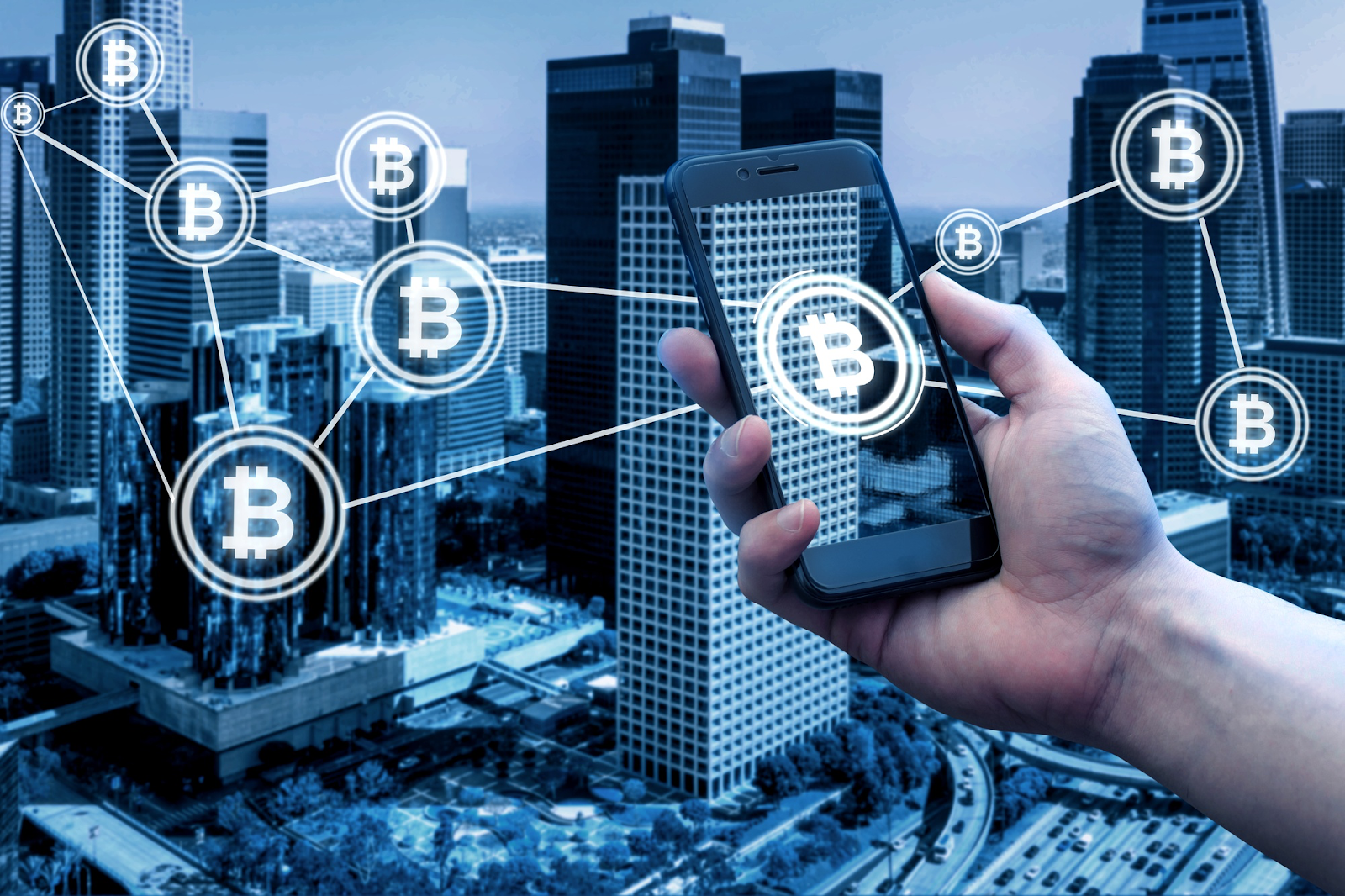
When AI Meets Blockchain: The Financial World Is Being Rewritten
At this moment, two of the most disruptive technologies on Earth are colliding, sending ripples throughout society and changing how we think about money, trust, and automation.
Artificial intelligence is about machines that think. AI learns from data, sees patterns humans might miss, and makes predictions that improve over time. Blockchain, on the other hand, allows data to be trustworthy. Blockchain creates permanent records that cannot be changed, and it does so without a centralised entity having to make decisions.
So, here's the real question - what happens when the two forces are combined?
OpenAI is making a concerted effort with decentralised AI projects like SingularityNET to discover what is possible at the intersection of intelligence and decentralisation. If you are new to this concept, you can think about it this way - a teacher (AI) collaborates with a public ledger (blockchain) to provide more real-time grading transparency (e.g. fairer, less biased, harder to game or change grades).
This is not a sci-fi scenario view of AI and blockchain working together. AI and blockchain are already powering smarter trading models, creating new data markets, as well as a change in how people invest. The crypto world is leading these developments, and in reality, we are just starting.
Understanding the Core Technologies: AI and Blockchain Explained
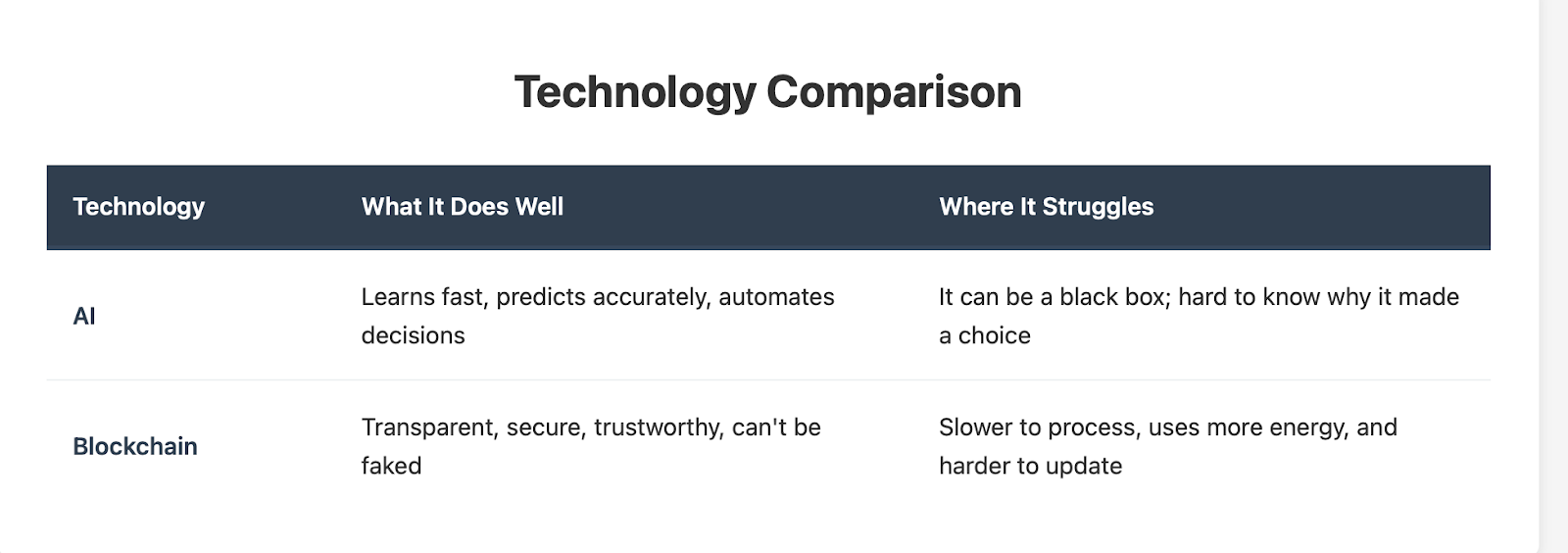
Artificial intelligence works by taking in large amounts of data and finding patterns in the data. The more machine learning algorithms are allowed to do their jobs, the better they get at them. Natural language processing allows machines to understand human language. Computer vision allows AI to "see" and interpret images.This means that AI systems can predict results, automate decisions, and solve different problems without actually being programmed to perform those tasks.
Blockchain does something different. Blockchain creates a chain of records that everyone can see, but nobody can change in secret. Each transaction is validated by multiple computers in the network (this is called the consensus mechanism). Once something is written to the blockchain, it is there forever (this is called immutability). Additionally, there is no single entity in control of the blockchain, so there is no single point of failure (this is called decentralisation).

Here is a simple way to think of it: AI is the intelligent brain, while blockchain is the undisputed ledger.
IBM Watson exemplifies this capability. It is an AI that grasps complicated information and makes intelligent recommendations. Ethereum is a blockchain that powers smart contracts and decentralised applications. Google DeepMind has developed an AI that solves conceptual problems that were felt to be impossible only a few years ago.
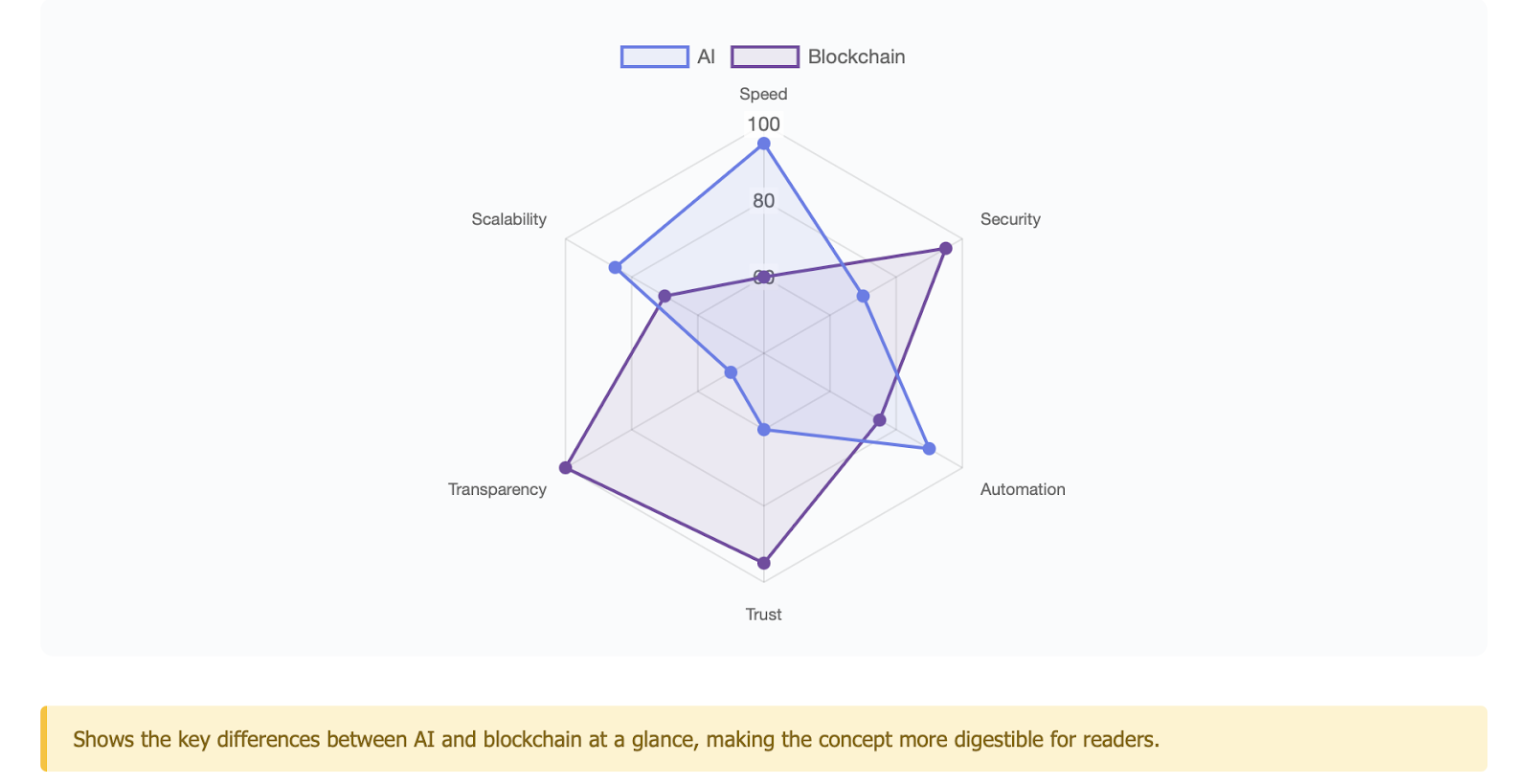
At a more basic level, AI identifies your face in your camera, while the blockchain signifies your Bitcoin transaction is verified and permanent.
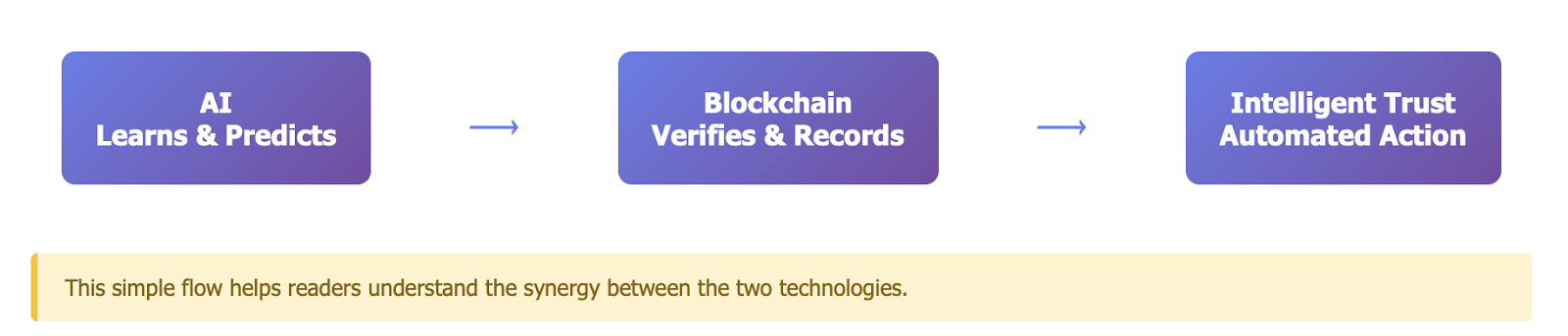
The real beauty here is this: You have AI that enables analysis and thinking, you have blockchain that enables verification and trust, and you put them together, and you have intelligent trust. That's a game-changer.
How AI and Blockchain Work Together
AI relies on having good data. The better the data is, the better the predictions are. The blockchain provides just that: trusted data that has not been manipulated. When AI trains on blockchain-verified data, it is more reliable. It is not a guess from potentially corrupted sources. It is much easier to define what is trustworthy. A favourable trend is that it works both ways. Blockchains are getting smarter through AI.
Machine learning algorithms can aid in validating transactions more quickly, predict which transactions may pose a risk, and identify patterns of fraud more quickly than a human auditor can. There are a multitude of ways in which these technologies can be engaged in practice. For example, with decentralised AI networks such as Bittensor, AI models can exchange "value" programmatically on a blockchain system. Some projects programmatically use blockchain data specifically to train AI models. Others use AI to automate decisions, like voting, governance, and risk management, circumventing delays caused by human involvement.
Ocean Protocol illustrates a real-world use case. It is a marketplace between people who would like to use AI models to share their data and the AI models themselves, where everyone is compensated fairly through blockchain transactions. Singularity NET builds upon this idea, building a marketplace for AI services. These AI services are sold in exchange for cryptocurrency in lieu of money.
For someone new to the space, imagine an AI robot that will only "trade" your trade after the blockchain confirms your identity and checks that you have the funds in an account. The value is trust in automation. Sounds simple, but it works so well because you are not relying on any one company or person.
Real-World Use Cases of AI and Blockchain in Crypto
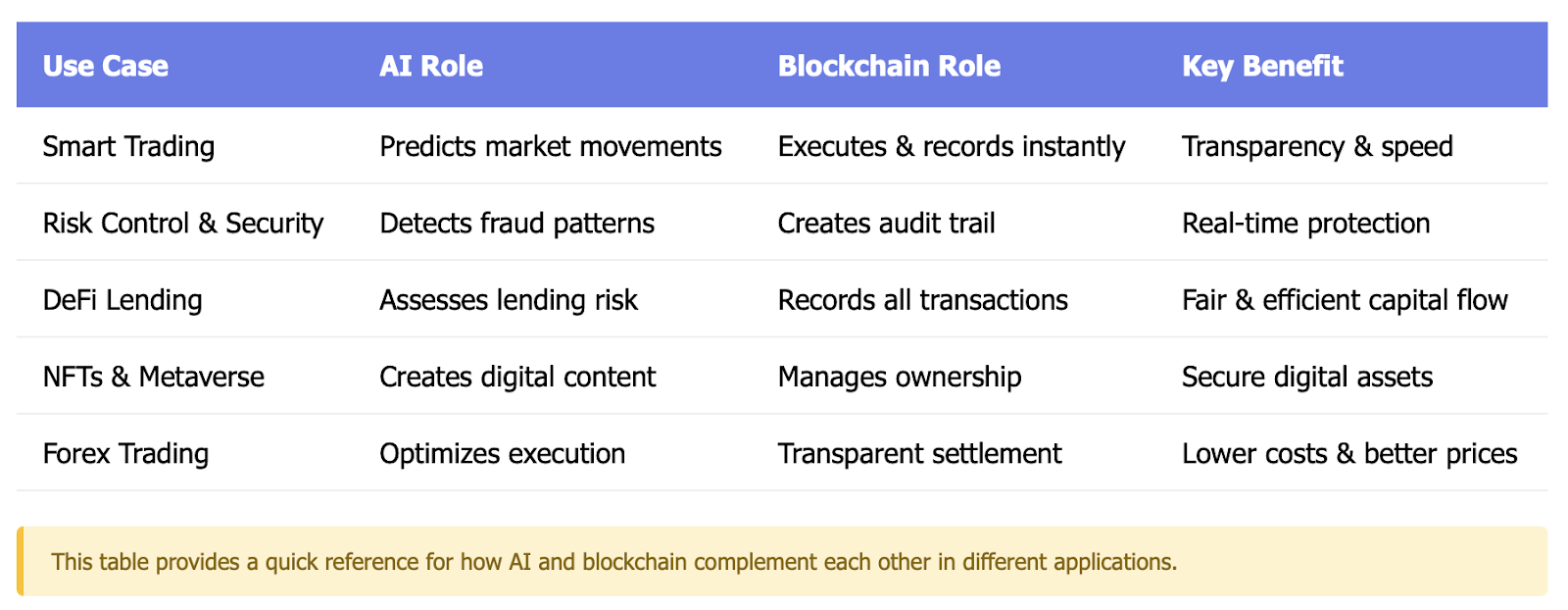
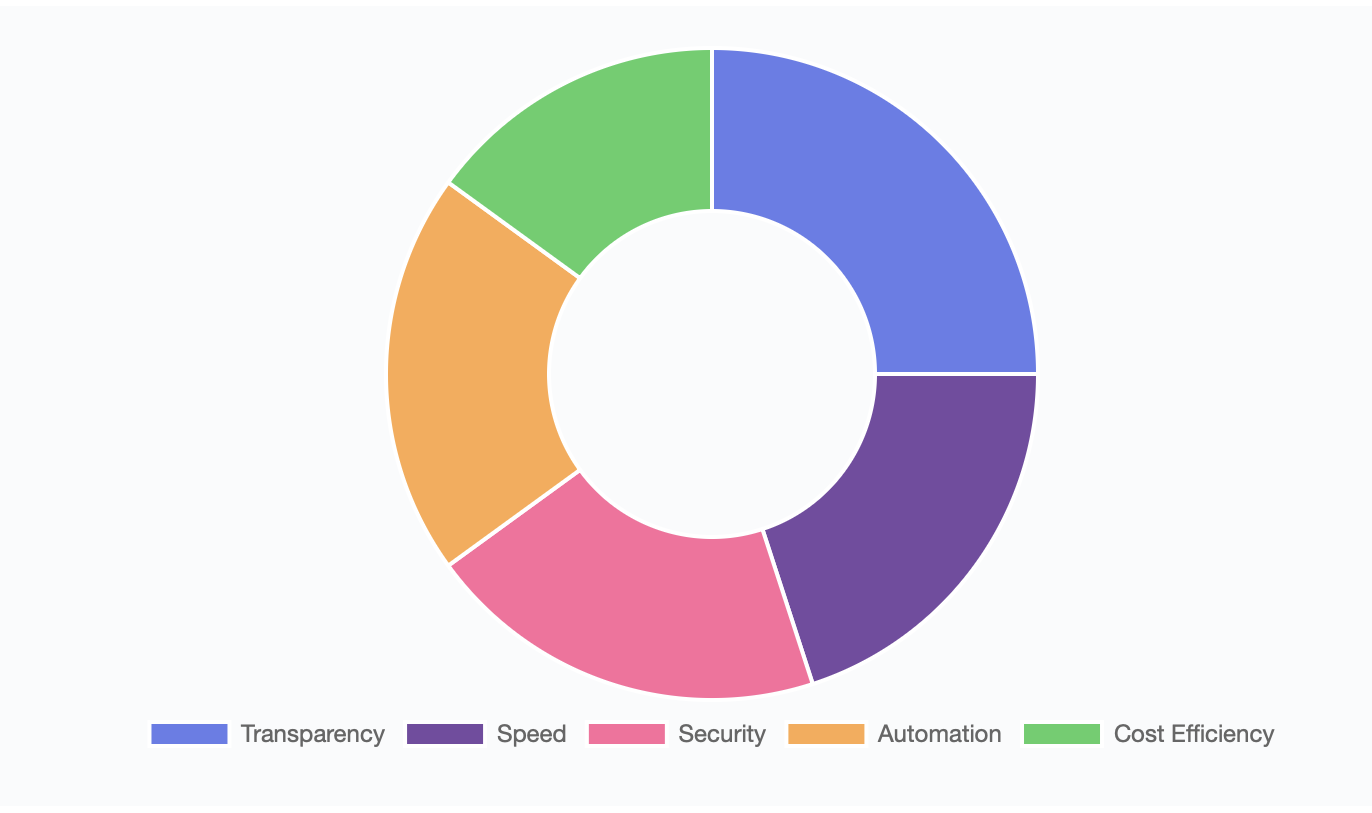
Smart Trading is perhaps the most well-known example. AI algorithms are analysing market data and predicting where prices are likely to go. Blockchain-based automation allows trades to be executed instantly and records every transaction with complete transparency. No hidden fees, no mysterious delays. You can audit the complete history of each trade, forever.
Risk Control and Security have also been transformed through the combination of AI and blockchain. AI-based systems can detect scams and unusual behaviour patterns in real time and can catch fraudulent activity sooner than any human team can. Blockchain technology can permanently record these security events and create an inviolable audit trail. If things go badly, you have an unalterable timestamp of when and what happened during the security breach.
DeFi (Decentralised Finance) platforms are using AI to underwrite loans more accurately and to best assess lending risk. Instead of having bank officers make gut decisions behind closed doors, machines are looking at thousands of data points instantaneously. That means capital can flow to people who need it and will pay it back, without needless gatekeeping. The blockchain allows for every loan to be recorded and every payment to be followed.
NFTs and the Metaverse are also evolving. AI is making creative content - artwork and music, digital objects, etc. - and blockchain manages ownership and guarantees that these digital assets can be securely bought, sold and traded. Essentially, you own whatever you purchase instead of just renting access.
Fetch.ai is creating a platform for fully autonomous AI agents to negotiate and trade autonomously with each other. Numerai allows data scientists to train AI models to predict future stock prices, and the Best model predictions are rewarded with cryptocurrency. A major player in the DeFi space, Aave, is looking at credit scoring via AI to increase the safety and efficiency of lending.
AI predicts Bitcoin will rise, the blockchain automatically buys it at the right time, locks it in to ownership forever. No intermediaries, no hidden truth, no errors.
Challenges and Limitations of Blockchain–AI Integration
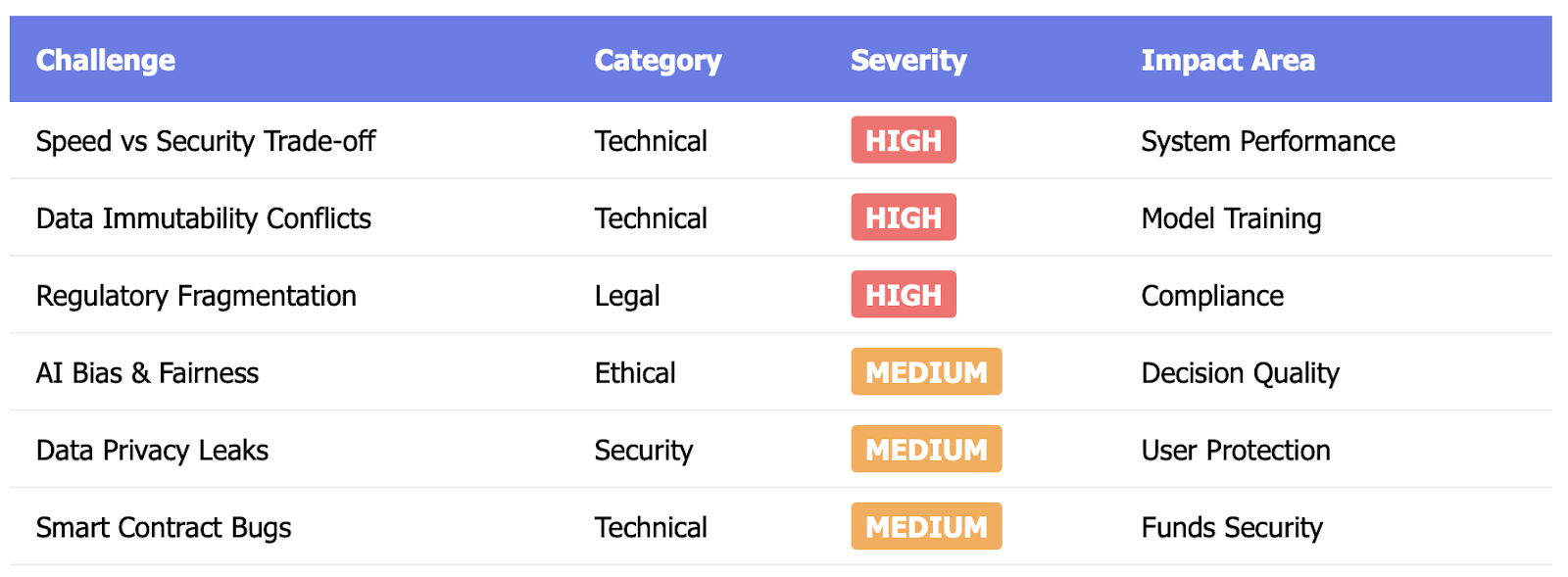
Technical challenges are tangible. Blockchain networks prioritise security and decentralised nature, which can significantly slow down the transactions compared to centralised AI systems. However, at the same time, AI also requires a great deal of computing power to operate at speed. Therefore, these two competing demands are often opposed. You want your AI to think quickly, but you also want some measure of verification from a network of computers, which can be a tall order.
There are also data-based difficulties. AI models require a constant stream of updates and retraining in order to remain accurate. Blockchain protocols remain immutable once the data is written on the chain. If an AI needs to "forget" previous knowledge or update previously incorrect information, blockchain transaction types don't permit this. Herein lies a real tension in trying to build autonomous systems that are knowable and trustworthy.
The EU has strict AI Act specifications. The U.S. SEC has its own stipulations for crypto and trading regulation. China has established regulations that differ from both. Furthermore, many AI projects and blockchain iterations will cross many, if not all, of these boundaries and consistently be held in arbitrage of an untenable number of rulebooks from governments.
Indeed, most initiatives that combine AI with blockchain are still at the concept stage and not yet at the business model stage. Some will work, and some will not. That's the reality of innovation.
There are real risks. AI can inherit biases from its training data and make unfair decisions as a result. Data privacy leaks can expose sensitive information on "secure" blockchains. There can be bugs in smart contracts, which control money, and if you've ever heard the phrase, "bugs equal stolen", you know what that means.
To be clear, none of this is evidence that integrating AI into blockchain is a bad idea; it means that with every innovation, there are frictions. Rationality is more important than hype. The companies that will ultimately be successful are the ones that recognise those issues exist and are interested in solving them.
AI in Forex and CFD Trading: The Next Frontier
Artificial Intelligence is transforming the ways traders trade against forex volatility. Instead of watching charts all day waiting for signals, algorithms can run millions of scenarios in seconds. They optimise order execution by getting the best prices. They identify opportunities that would be overlooked by human traders.
Moreover, every time you send down money, which is tracked, and then used to trade, the settlement becomes transparent and audited with blockchain. You would be able to affirm that the outcome of your initial capital was worth sending down. Traditional forex markets create a lot of ambiguity around an institution’s thinking, which is not open to view. Thus, Blockchain exposes it.
AI algorithms are able to detect high-frequency trading patterns, tell you about flows of liquidity, etc. They will spot abnormal activity, which is usually predictive of a major price move in the near future. For the case of JP Morgan and LOXM, there is an AI system that is able to meet execution response time far superior to than of a human trader, and at a lower cost. In another space, Binance also built AI-based risk controls to observe users’ suspicious behaviour before a manipulation on their platform happens.
So, for traders at BTCDana, this means three concrete and meaningful additions: smarter trade recommendations, improved risk management controls, and offered transparency concerning trade execution.
Just think of an automated financial advisor that never sleeps, that will never panic, and always plays by the rules.
The Next Decade: How AI and Blockchain Will Reshape Global Finance
Decentralised AI (DeAI) represents the next frontier. Rather than building AI systems owned by single corporations, we will move toward AI operating on decentralised networks. No company owns the AI, owns your data, or decides what the AI does. You interact with the intelligence directly.
AI models themselves are being tokenised. You will be able to buy and sell AI services like any other asset. A good AI at predicting forex trends will become an on-chain asset that people can directly invest in. Each time someone uses the model, the AI creator is paid.
Automated investment portfolios will run on DeFi platforms to manage your money better than most people can. You articulate your risk tolerance, and the AI learns your preferences. Everything the AI does (or doesn't decide to do) is auditable on the blockchain. The better the AI, the more money will go into those systems; it will create a meritocracy of only the good AI surviving.
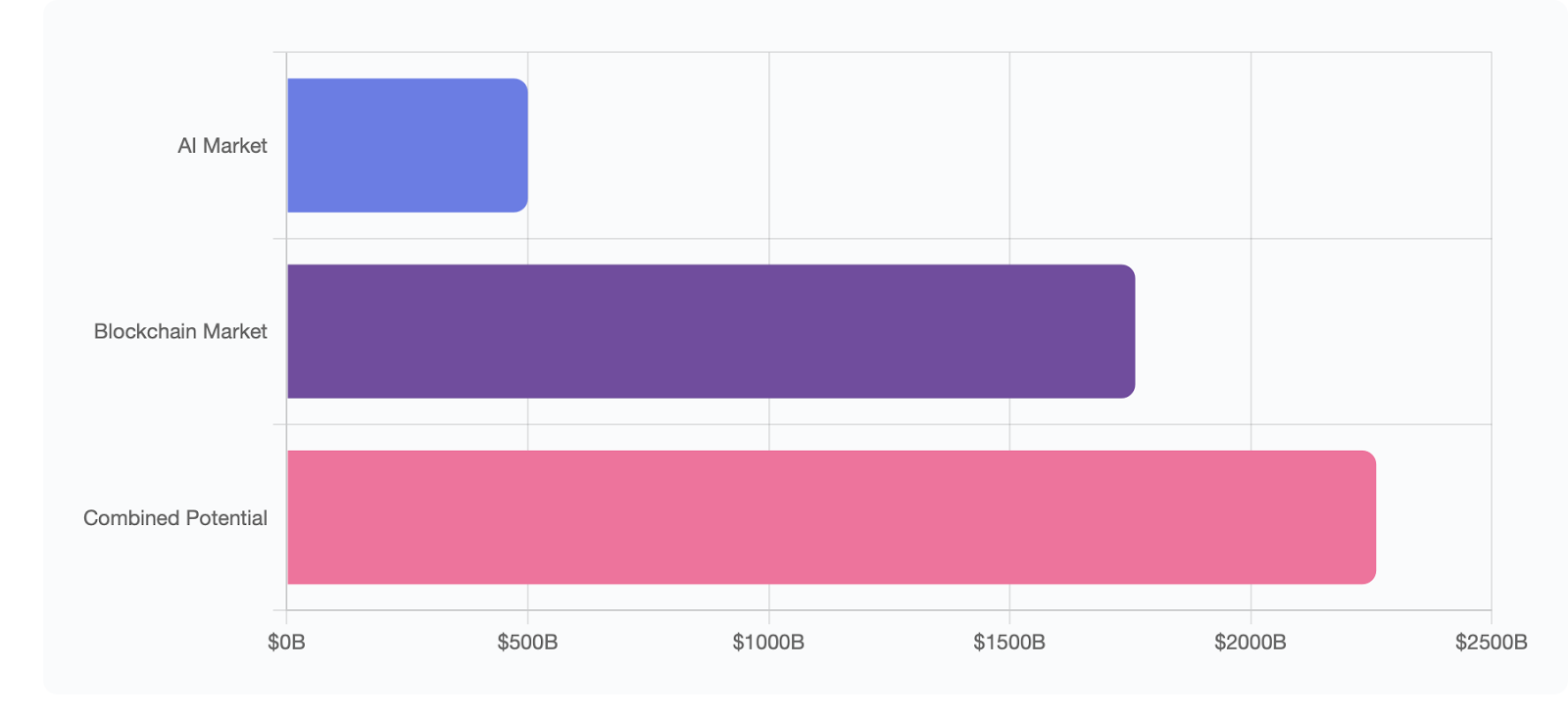
Gartner anticipates the AI market is going to cross $500 billion by 2030. PwC expects blockchain technology to create $1.76 trillion in value by 2030 as well. Deloitte expects these technologies to work together more and more, and the combination will create entirely new categories of financial services that don't currently exist.
The convergence between traditional finance and crypto is inevitable. Wall Street firms are already dabbling in both. The distinction will blur until "traditional" and "crypto" finance are just one system, powered by AI and verified by blockchain.
How to Stay Ahead in the AI–Blockchain Era
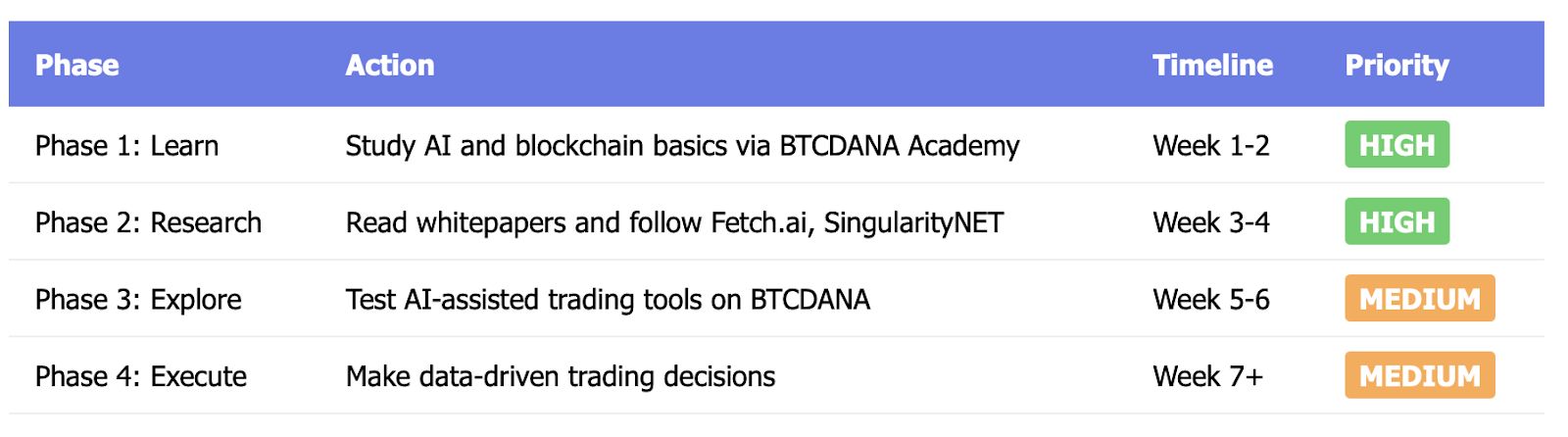
If you want some actual analysis instead of hype, you should read CoinDesk and Cointelegraph. They report on new projects, track market trends, and explain the difference between what works and what is noise. The BTCDANA Academy has a structured learning program for traders who are trying to make sense of these technologies and use them.
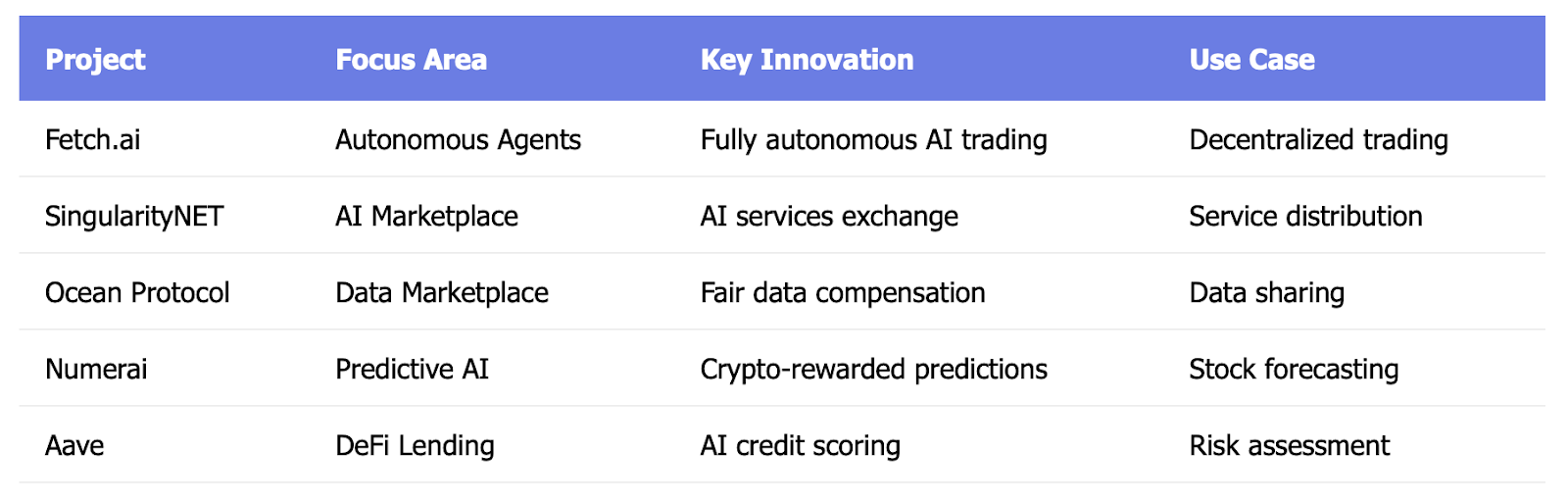
There are projects to keep an eye on. Fetch.ai, SingularityNET, Ocean Protocol, and Numerai are doing interesting things in the AI and blockchain space. Follow their trajectory, read the whitepapers, and understand the problem they are solving. Regularly check the metrics. Are they growing? Are they being used, or is the an accrual of theoretical value?
Risk awareness is more important now than ever. This space draws brilliant minds and scammers who are mostly opportunistic. Do your own research. Don't put anything into something you don't understand. In this space, the long game is a better bet than quick wins. The technology is real, but the projects, not as much.
Ready to trade smarter? Explore btcdana's AI-assisted trading tools and start making data-driven decisions instead of gut calls. Your future self will thank you for learning this now rather than five years from now.