



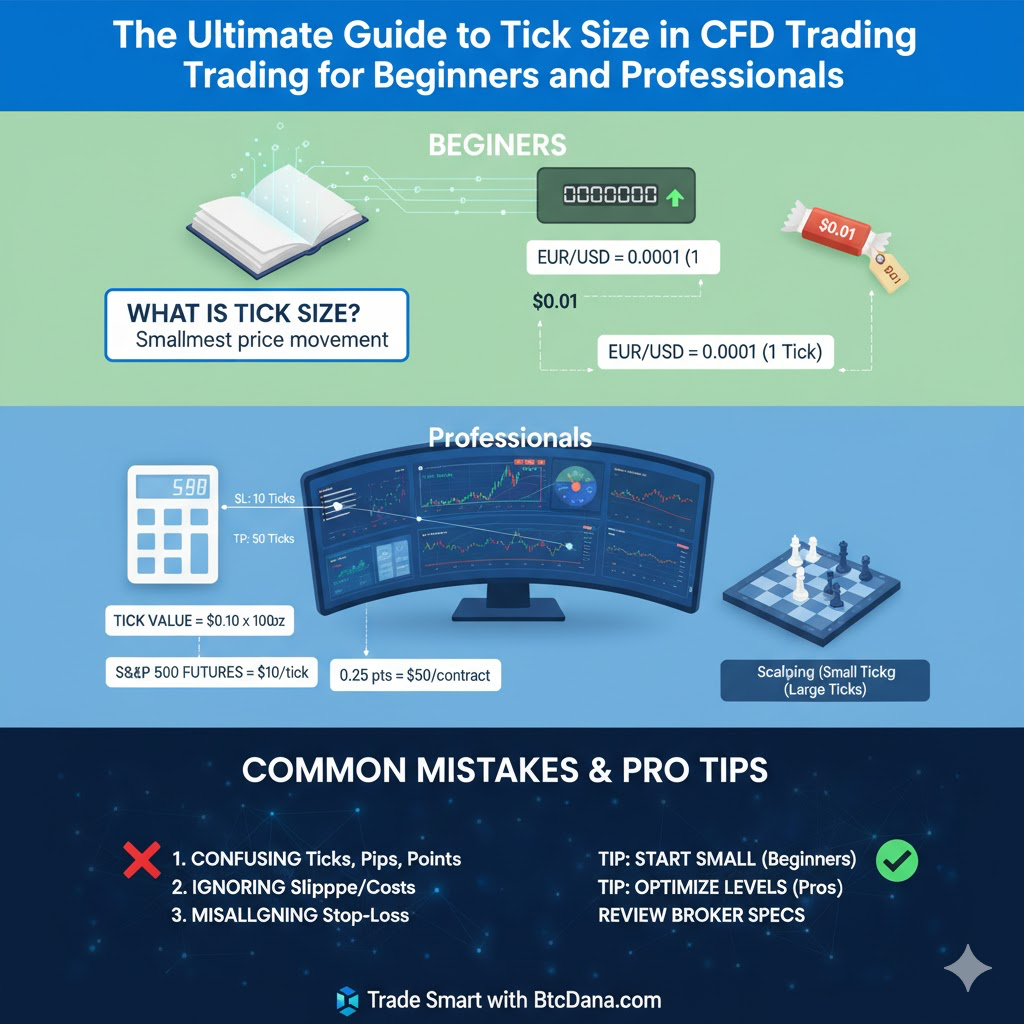
Introduction to Tick Size in CFD Trading
Every second in CFD trading sees price changing. These changes are measured in small increments. These increments are called Tick Size.
What is Tick size? Tick Size is how much a price can actually move in the smallest amount possible. This matters for a few reasons. First, Tick Size affects how much your trading costs. Second, Tick Size has a direct effect on how you manage your profits. Third, Tick Size is an important indicator for your overall risk management.
Think about it in terms of a score in a video game. Each point is the minimum incremental unit you can earn. The same goes for Tick Size in the markets. For example, a commonly traded currency pair is EUR/USD. The Tick Size for EUR/USD is 0.0001, which is the smallest possible change in price. Therefore, a move of 0.0001 is simply 1 Tick.
Tick Size is a foundational element of trading. Understanding Tick Size creates a supportive foundation for trading. Understanding Tick Size helps you develop better day trading decisions. Knowledge of Tick Size helps to manage and protect your money from unnecessary losses.
What is Tick Size? Definition and Market Variations
The Tick Size is the smallest price movement an asset can make in a given trading market. It is not to be confused with points, or pips. This is a misconception many new traders confuse.
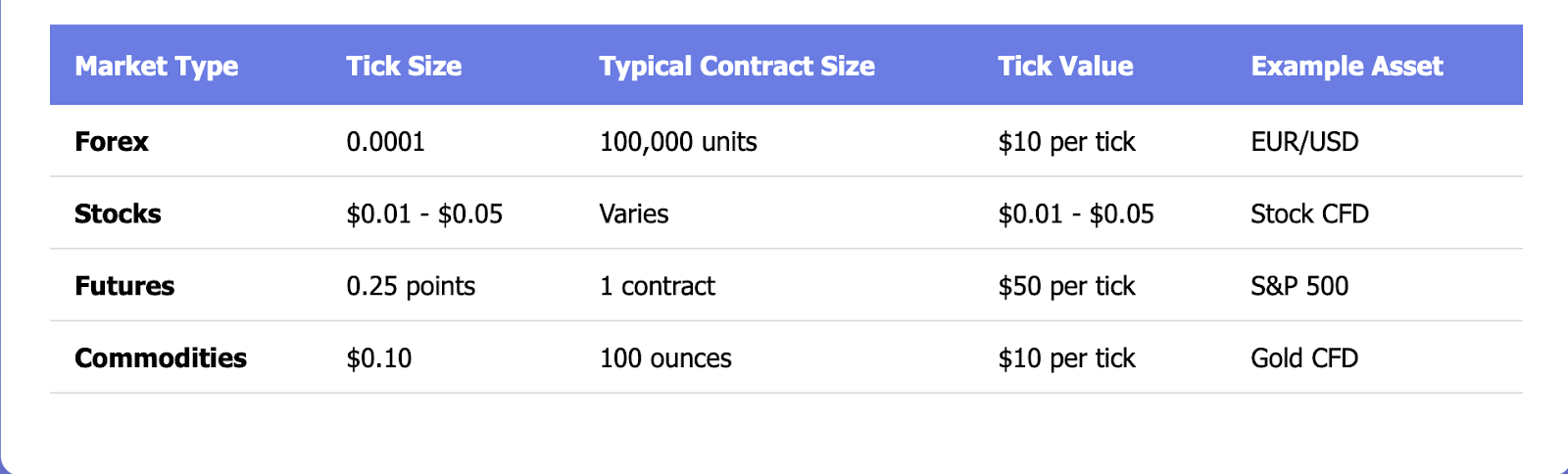
Different markets have different tick sizes. For stocks, the tick size is usually between $0.01 and $0.05. The forex market (for example, the EUR/USD) typically has a tick size of 0.0001. Futures contracts vary per contract (for example the S&P 500 futures tick size is 0.25 points).
Stock Markets: The smallest price movement for stocks will be either 0.01ca or .05 points. There are larger stocks that will actually trade at tick sizes of .05 points or greater; this plays an important role when placing buy and sell orders.
Forex Markets: Currencies pairs such as the EUR/USD will trade primarily on a 0.0001 tick size basis. This is the standard for the global forex market. Each movement or tick represents one tick in price.
Futures Markets: The S&P 500 futures contract has a tick size of .25 points. Each tick is equivalent to $50 per contract traded. This highlights the significance of tick size and the differences between it.
CFD Markets: CFDs have the same Tick Size rules as the underlying investment. For example, a gold CFD may have a Tick of $0.10. A stock CFD will follow the stock markets' Tick Size.
Beginner Example: If the price of candy goes up in increments of $0.01 each time, the Tick is $0.01. Every little change eventually adds up to something substantial.
Professional Example: The S&P 500 Futures have a minimum Tick of 0.25 points. You will, of course, have to assign a dollar value to each point, but now you understand the minimum Tick Size, which will allow you to figure out your risk very precisely
Tick Size quantifies all upward or downward price changes in the marketplace, including CFD Markets, and it will have a direct impact on your trading strategy.
Good risk management relates directly to the Tick Size. You must know the Tick Size. Be aware of the Tick Size in every market you trade.
How to Calculate Tick Value and Its Impact on Trading
The tick value indicates how much money is worth each tick movement. The formula is quite easy: Tick Value = Tick Size × Contract Size.
For example, a gold CFD has a tick size of $0.10 and a contract size of 100 ounces. Tick Value = $0.10 × 100 = $10 per tick. Therefore, each price movement will cost or gain $10;
For EUR/USD the contract trades for lots of 100,000 units, and the tick size is 0.0001. Tick Value = 0.0001 × 100,000 = $10 per tick.
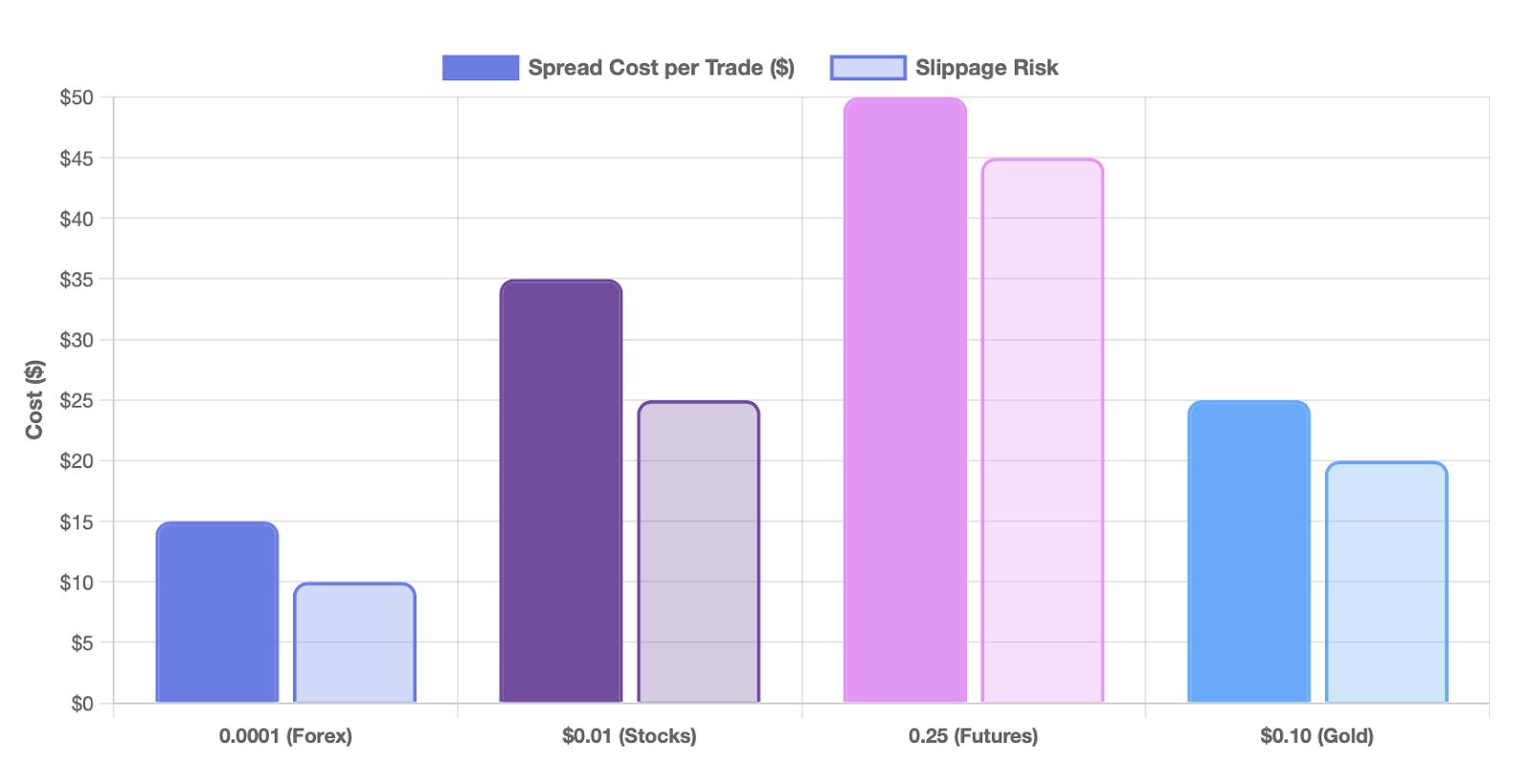
Impact on trading costs: Tick Size will have an impact on slippage; slippage occurs if your order is filled at a different price. Generally, larger tick sizes will create larger slippage in the spread and cost you more money.
Stop-loss orders and take-profit orders must measure tick size. You cannot put your stop loss or take profit in-between a tick. This restricts where you may place your orders.
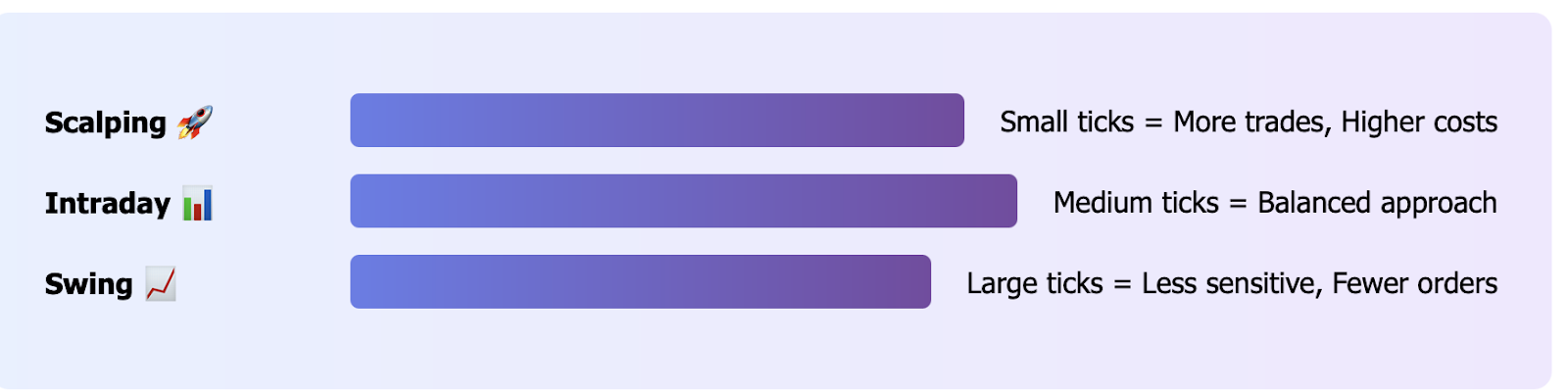
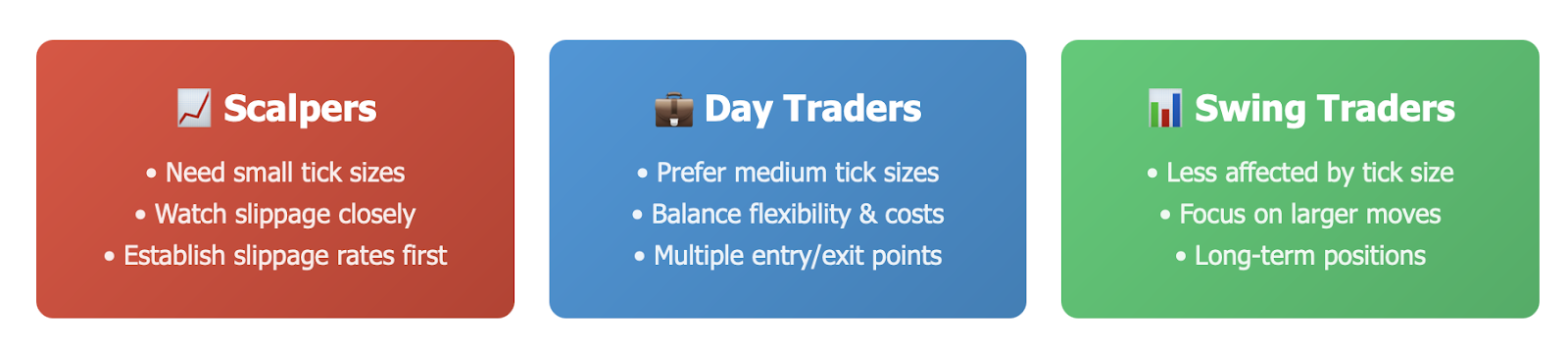
Different strategies will require different trade sizes. Scalpers will look for smaller tick sizes because they make many trades, attempting to garner small profit amounts through price fluctuations. Larger tick sizes will make this process difficult. Swing type traders acquire profit through more significant price movement over time and are less affected by tick size.
Being familiar with Tick Value enables risk management as well as helps with position sizing and setting take profit levels. The first step to trading smart is calculating Tick Value, at which point you can understand Tick Value in relation to risk management.
Tick Size and Its Effect on trading strategies
Tick size influences the effectiveness of your strategy in real, live markets. Each strategy has a unique size sensitivity.
Scalping strategy: Scalpers attempt to open multiple trades quickly. Scalpers attempt to profit from small price movements. Scalp trading works best with small Tick Size. Large Tick sizes will make it difficult to scalp. With a larger tick size, your transaction costs will outweigh your small price movement profit.
Intraday trading: Intraday traders will buy and sell a position within hours or minutes. They are banking profit by getting multiple ticks out of price movement. Medium Not even tick size, rather mean tick size is good for small intraday traders as a tick size gives it enough space to take a profit.
Swing traders: Swing traders will hold positions for days or weeks with the expectation that they can capitalize on larger swings in price. They are less reliant on Tick Size, waiting for larger profit targets.
Imagine playing a board game where you move one step forward varying the length of your tick size. Your larger step length limits your strategy options. The smaller step length seems to give you more control over your strategy. Tick size applies the same way to trading.
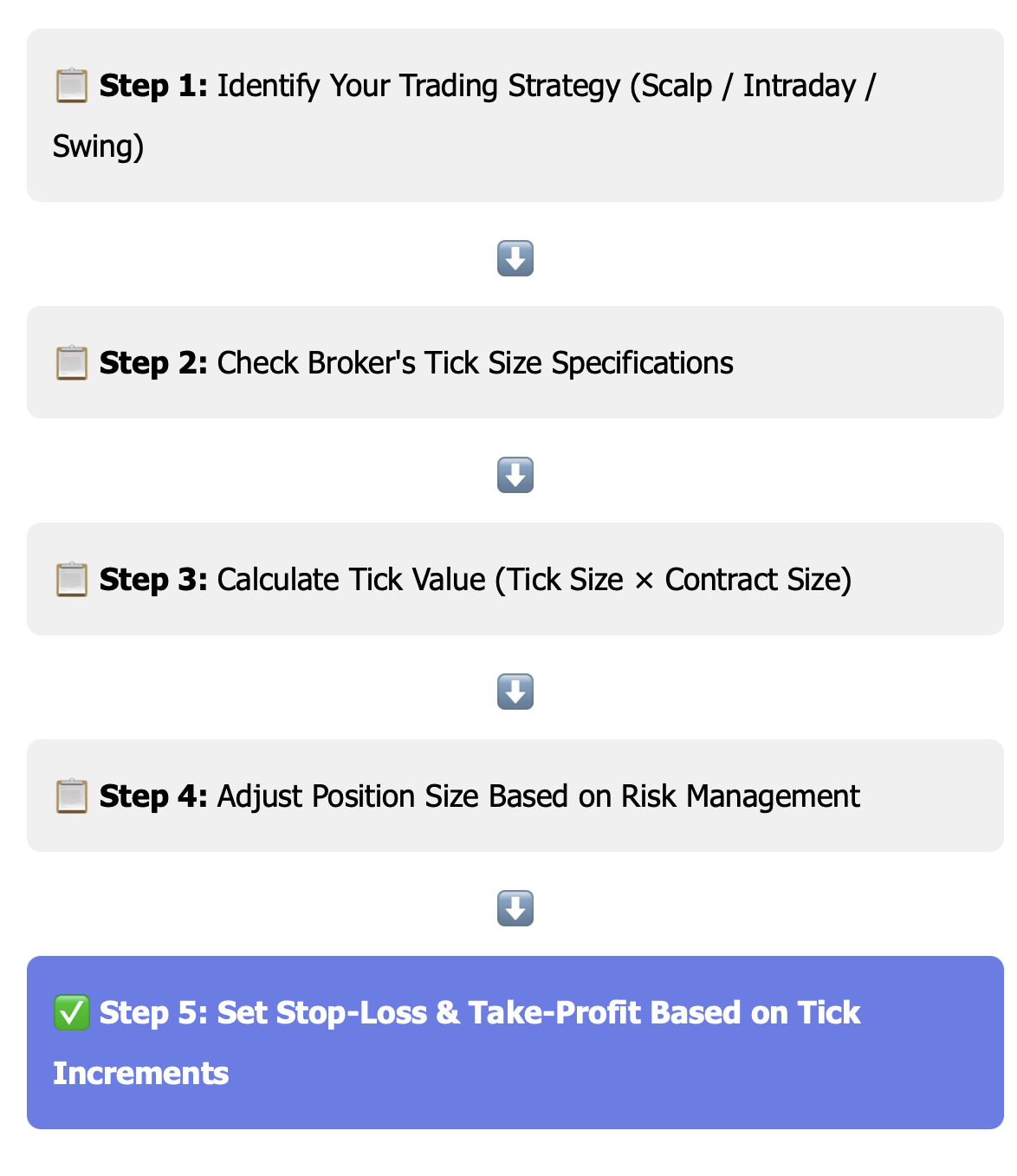
Professional Application: Optimize your stop-loss according to Tick Size. Your take-profit strategy should be in ticks. Your position sizing is determined by Tick Value. These three aspects are your trading plan.
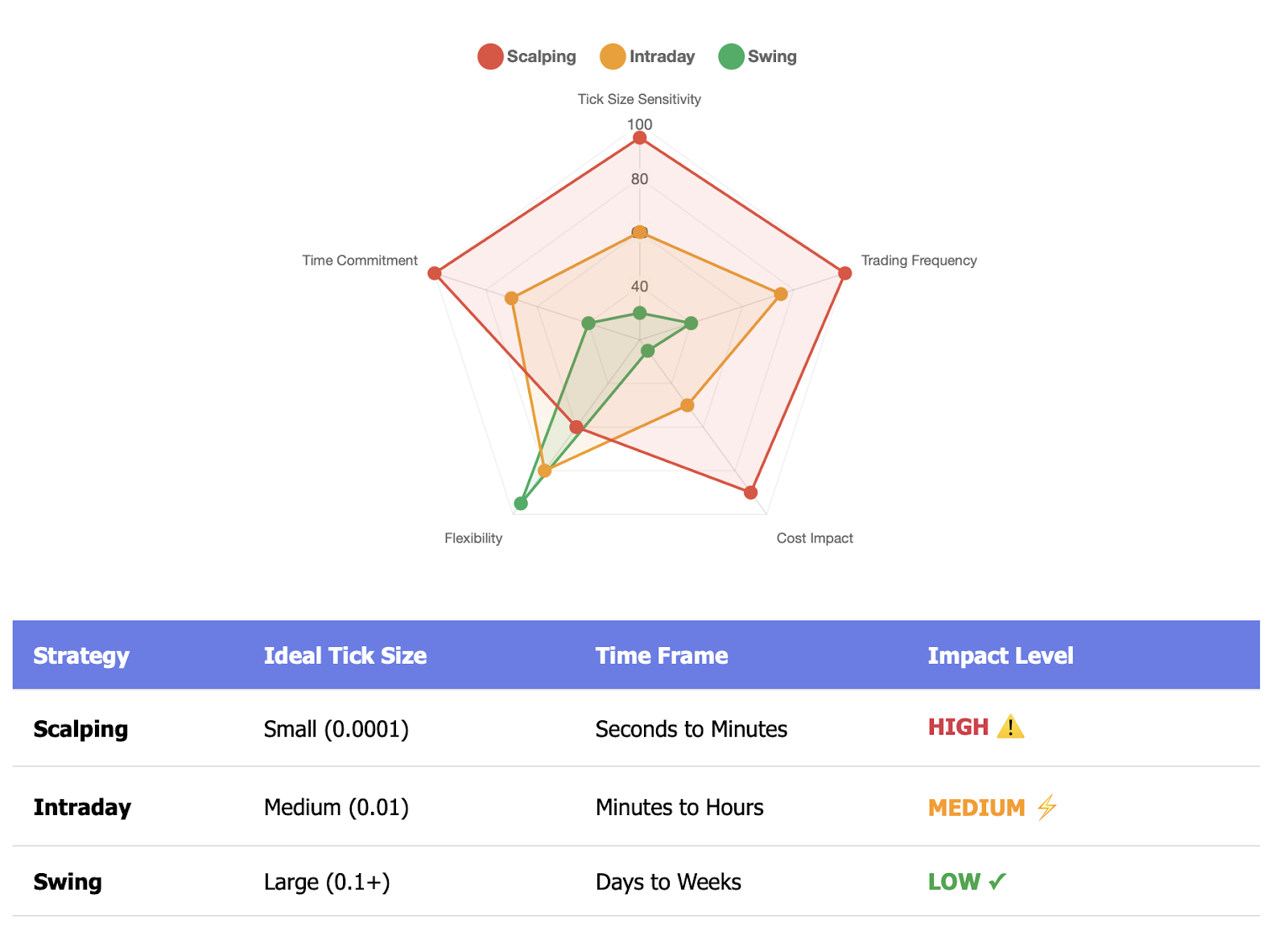
Flexibility Vs. Costs Trade-off: Tick size is too large and you lose flexibility. You cannot get the fill you want. Tick size is too small and trading costs increase. Each trade will cost you more in fees or the spread.
EUR/USD Intraday Example: EUR/USD has a small Tick Size of 0.0001. This is perfect for intraday traders. You will easily enter and exit on precise levels. This precision allows you to create profitable strategies.
Tick Size establishes whether your strategy is efficiently executed. Your risk-reward confusion. It is important to choose the right market with Tick Size to meet your criteria for success.
Choose markets that have tick sizes appropriate for your trading strategy.
Common Mistakes and Important Considerations with Tick Size
Tick Size basics are often misinterpreted by traders, and these mistakes can incur real financial losses.
1st mistake: Confusing Tick Size with Points or Pips. Tick size is the smallest price change. Pips are a unit of price change. Points are used for indices and futures contracts. These terms carry different meanings. Confusing them can lead to a critical miscalculation.
2nd mistake: Taking Tick Size into Account. Many traders do not consider tick size in their impact. Larger tick sizes create a wider spread. Wider spreads create more costs in a trade. Your trade loses money before it even moves.
3rd Mistake: Not Being Properly Aligned on Your Stop-Loss. Your stop-loss must be aligned with the tick size. You cannot create a stop-loss between price increments. Failure to consider this will create issues with execution. Your trade will not execute correctly as planned.
Beginner example: confusion on EUR/USD. A new trader does not understand tick and pip value. EUR/USD moves in price increments of 0.0001. The trader incorrectly presumes that each price increment movement is one pip. 10 tick movements is one pip of currency. This confusion extends to profit and loss calculation.
Important Consideration 1: Tick Size Differs by Market. Do not presume that all markets have the same Tick Size. Always check the specifications for each market, as each exchange is different.
Important Consideration 2: Scalpers Need to Be Aware of Tick Size. Scalpers rely heavily on little ticks. They also pay particular attention to slippage. High slippage can make the scalping process unprofitable. Slippage rates from your broker should be established before you trade.
Important Consideration 3: Tick Value Varies by Contract Size. A larger contract size will carry more Tick Value. A smaller contract will carry less Tick Value. Know your actual Tick Value at all times.
Understanding Tick Size will prevent your strategies from failing. Understanding your Tick Size will save you from losing money from unnecessary costs. Take the time needed to learn the specifications for your market.
Review the Tick Size specifications your broker provides before your first trade.
Conclusion and Actionable Tips for Tick Size
A Tick Size is the fundamental unit of price movement you will experience in CFD trading. Tick Size specifies the least amount of price movement in difference. Tick Size affects the costs you incur, where you can place your stop-loss, and your potential profit.
Review the Core. The Tick Size is the minimum price movement in the markets. Tick Value is equal to Tick Size times the size of the contract. Your plan must match the Tick Size of the market. Proper risk management requires you to be able to understand Tick Size.
Tip for Beginners: Start Small. Start with small trades to grasp how a Tick impacts your trading. Watch the price move in Ticks. Observe how Ticks impact the profits you gain. Doing this will provide you with a real understanding.
Tip for Professionals: Use Optimal Levels. Set your stop loss based on your calculations of Tick Value. Place your take-profit based on levels that make sense for Tick movement. Size your positions based on your calculations of Tick Value. Again, optimising will lead to a higher success rate.
Summary Examples.
EUR/USD: Tick Size 0.0001, Tick Value $10 (on standard lot). Gold CFD: Tick Size $0.10, Tick Value varies by contract size. S&P 500 Futures: Tick Size 0.25, Tick Value $50 per contract.
Tick Size is a critical device to help you develop your trading strategies. It leads you through your risk management decisions. It defines your entry and exit levels. If you understand Tick Size, you will be ahead of other traders.
You should start to put your Tick Size knowledge to work right now. Look at your positions and find their Tick Values. Change your stop-loss and take-profit levels based on Tick Size today with BtcDana.com