




Why Speculation is a Core Concept in CFD Trading
If you've ever heard someone mention "playing the markets" or making quick trades based solely on what they think stocks will do in price, they've been talking about speculation. Speculation really just means trading based on predicting price direction; it does not involve holding assets for years like traditional investing. By trading contracts for difference (CFDs), you are participating in pure speculation. You are not actually buying stock, gold, barrels of oil, etc. You are simply betting that prices will either go up or down.
Understanding speculation is important because it impacts every aspect of your approach to trading, what strategies you choose, how you manage risk, how much capital you put into trades, everything will depend on your understanding of speculation. To illustrate: a professional trader based in London observes upcoming economic data that are anticipated to impact EUR/USD, and takes a short position as they suspect the euro will decrease in value against the dollar. That is speculation; period.
To make it easier for the new traders, here's a more intuitive comparison. Do you remember making a bet with your friend about the outcome of a basketball game? You're not buying their jersey or buying the team. You're making a short-term prediction, using everything you know, but it's just for fun. Speculating on CFDs involves the same thinking. You take stock of what you know and all of the available information, you make your best determination, and you place your trade.
CFDs and speculation are tightly linked. CFDs exist for that express purpose - they allow a trader to speculate on short-term price movements, without the need to own the physical asset. In fact, there are global CFD brokers, like IG or eToro, which have developed their entire platform around introducing speculative products.
If you wanted to speculate on the price of gold, for example, you could use CFD accounts and do the trade in a matter of minutes. However, if you wanted to buy gold and store it in your home, you would have to have quite a bit of money to do so, and then the effort to store it as well.
Speculation is not a fringe aspect of CFD trading; it is at the heart of it. Everything you decide to speculate becomes the potential for profit, and, just as important, it is the probability of loss. Whether you are trading for small intraday profits or looking to hold a CFD for a few days, you are speculating. The sooner you grasp this main idea of speculation, the sooner you will grow a skillful repertoire of trading skills to help you achieve your trading goals and risk appetite.
What is Speculation? Definition and Core Principles
Speculation is short-term trading based on the assumption of future price movement. That is all it is! You are not investing for your retirement or building a dividend portfolio. You are looking at charts, looking for trends, and making informed guesses about where prices will go in the near future (potentially hours or days).
The distinction between speculation and investing boils down to a few things: purpose, risk tolerance, and holding period. An investor buys an asset expecting its price to move up over a long period of time, with an expectation of modest returns in exchange for lower risk. A speculator is trying to make profits faster, by speculating on the short-term price fluctuations, expecting higher risk. An investor may buy Apple and hold for ten years. A speculator may trade Apple CFDs on five occasions in a single day.
CFD speculation is further complicated by the use of leverage. Leverage is a feature of CFD trading that enables traders to borrow capital from their broker to open positions greater than they can afford utilizing their account balance. If they are correct in the price direction, they increase their returns utilizing leverage. If wrong, they also increase their losses. Leverage is what makes CFD speculation appealing and dangerous.
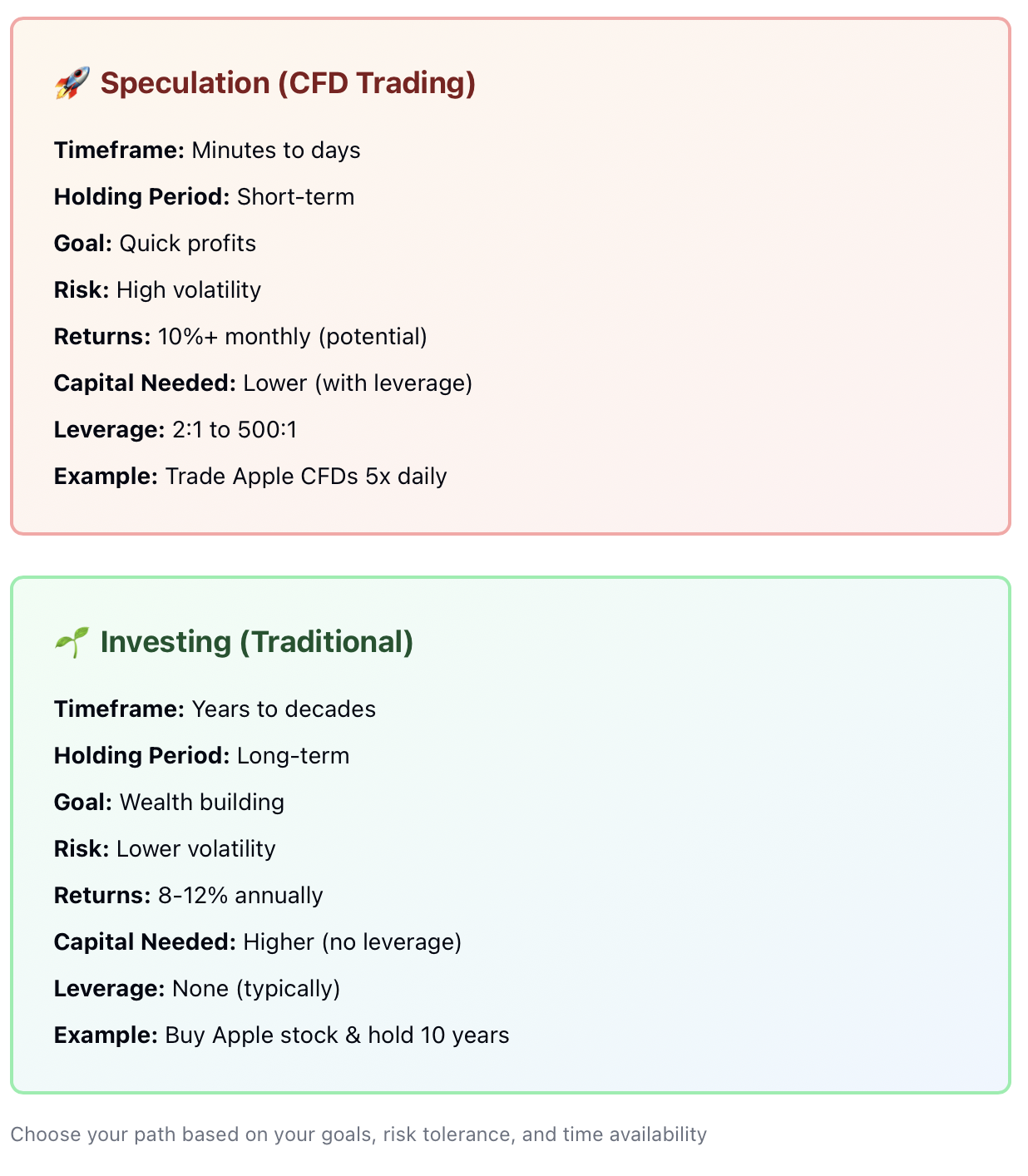
For those new to the trading world, you can think of speculative trading, in essence, like trying to guess how a cryptocurrency is going to move tomorrow while playing a video game. You would read news, look at recent price movement, and then choose to "buy" or "sell" the crypto. If your guess was right, you'd gain points, and if it was wrong, you'd lose points. The process is like "real" speculation, as long as you aren't risking any real money during the activity.
Profitable speculation isn't just random speculation. It is entirely organized, and based on the degree of strategy on component analysis, such as the use of trend analysis, technical indicators, or news analysis, among other techniques. You may have had a course in trend analysis, where you might use moving averages to indicate when to take a position in a trending market.
Or perhaps you've learned how to use the relative strength index (RSI) to show overbought or oversold conditions, or you've learned to follow an economic calendar, to estimate times of tremendous volatility in a given market. The most important lesson is to have a framework, instead of just guessing and hoping for the best.
Speculative trading is nothing like gambling, but it can certainly feel like it when a trade goes poorly. Gambling is based on pure chance. Speculating is based on some combination of objective phase or metaphysical/ subjective likelihood. The moment you learn to internalize the difference between chance-based decision making and informed speculative decision making, you'll be ready to build surge and speculative strategies that will give you a greater advantage in the markets.
Common Speculation Strategies in CFD Trading
Once you comprehend the nature of speculation, the next inquiry becomes: how do you go about it? Let's summarize the most commonly used strategies CFD traders use to speculate price movements
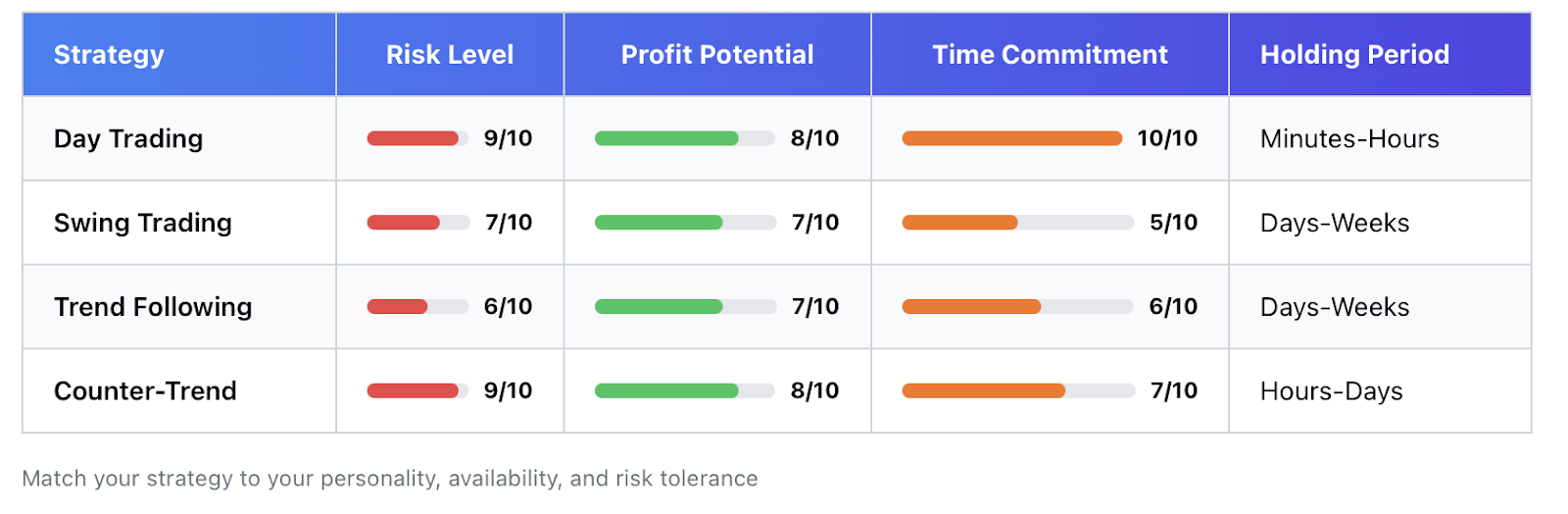
Day Trading is exactly what you would expect. You open and close a position on the same day, sometimes within the same minutes. Day traders are able to capitalize on small intraday price movements, often making multiple trades in one session. The goal is to accumulate relatively small gains that ultimately aggregate over a period of time.
A European trader may pay close attention to the EUR/USD currency pair when the London session is open, only entering trades when economic data is released and causes temporary price volatility. A day trader is not wondering where the price will be next week, rather they are focused on where the price will be from this moment until the end of today.
Trend Following is just figuring out which way the market is currently trending, and then riding that trend. An example would be if gold prices have been going up for the past several days. A trend follower then buys gold (long position) for the hope that the increase in prices continues upward.
They would use technical analysis tools to confirm and follow the direction it is trending such as moving averages or trendlines. As a trend begins to weaken or reverse, they would exit their positions. In Asia, professional traders may use MACD (Moving Average Convergence Divergence) to follow intraday EUR/USD trends, only entering once the MACD confirms momentum.
Counter-Trend Trading works in the opposite direction. Counter-trend traders see the trend has gone to extremes and is likely to turn. If a stock price jumps significantly, for instance, a counter-trend trader would short that stock in anticipation of a pullback. Counter-trend trading is riskier because you are fighting the direction, but when you time the shifts correctly it can pay off. It is like betting against the crowd as everyone is swarming in to purchase.
Swing Trading is a cross between day trading and long term investing. Swing traders will hold positions for days or weeks to capture medium term price swings. They aren't on the screen in front of the computer monitor for every second of the day like day traders, and they are not holding positions for months like long term investors. A swing trader could look at a commodity, such as crude oil, do some analysis on it and say that oil is likely to go higher based on suppliers in trouble, then hold the position for a week as the swing happens.
Technical Indicators like RSI (Relative Strength Index), Bollinger Bands, and MACD allow traders to assess entry and exit points. Students learning with a stock market simulation game, for example, may find benefit from basic charts that identify support and resistance lines for buying/selling decisions. More advanced traders use multiple indicators in conjunction to confirm signals before risk capital is deployed for that trade.
What ties all these strategies together is risk management. Without risk management, no strategy will work. Stop-Loss orders allow you to automatically close your position if the market price moves towards a negative position more than a predetermined amount.
Position sizing means that no amount of capital is placed on one position, which putatively means that you are only risking 1-2% of your account capital on that position. Capital allocation refers to how much of your total funds are being allocated to active speculation, or how much you are keeping in your account for cash reserves.
Different strategies work for different personalities and risk profiles. Day-trading requires a great deal of attention and focuses on rapid entry and exit from ideas. Swing trading provides some flexibility due to a longer investment horizon, and will require patience. Trend-following strategies tend to work best in a strong directional market, while counter-trend strategies tend to work best in reversal scenarios. Finding what activities match your availability/commitment, emotional profile, and risk profile is the secret sauce.
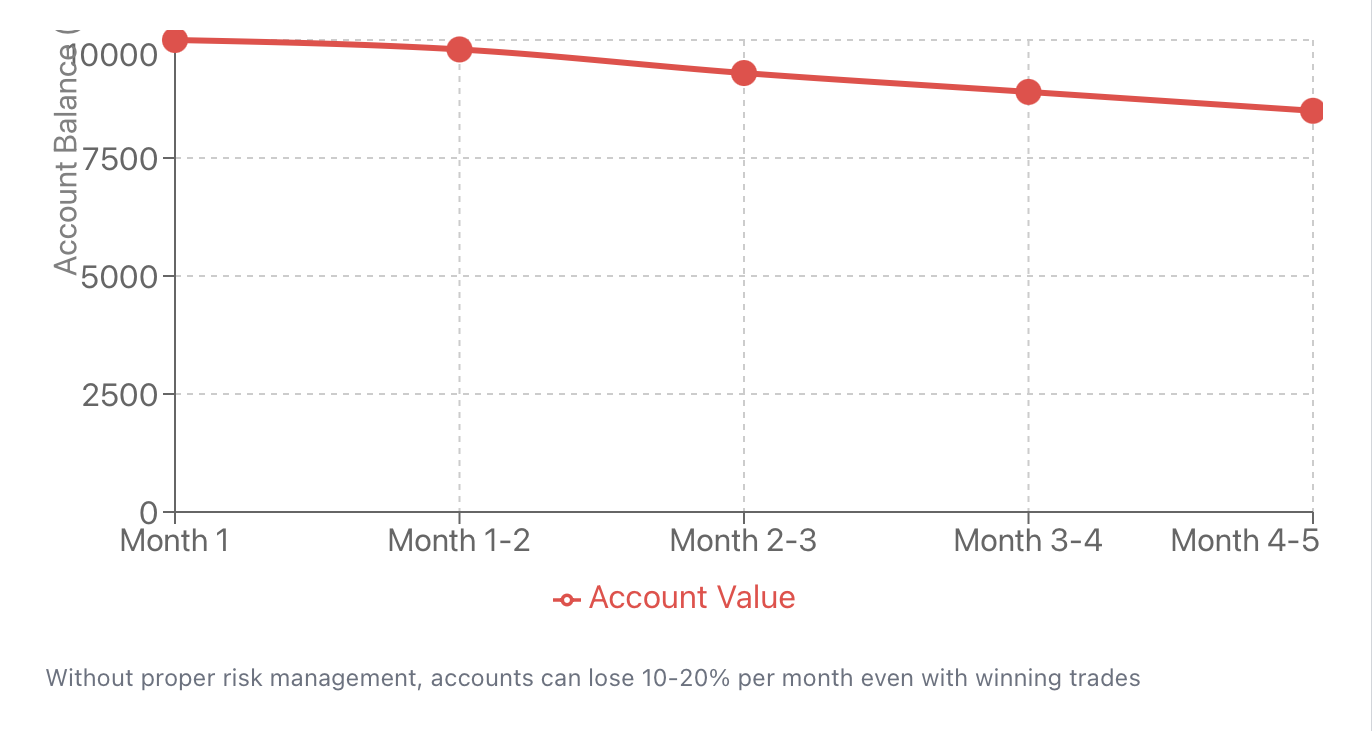
Risk management is not optional. It is the distinction between surviving long enough to profit and blowing an account in less than a month. Establish your stop-loss orders before you enter your trades and abide by your position sizing rules. No one likes to chase a loss. Again, a big deal when it comes to risk management - these practices are far more important than any sophisticated indicator or unique trading strategy.
The Benefits and Risks of Speculation
The Benefits:
The fact that there is high liquidity and opportunities to earn profits quickly makes CFD speculation attractive. CFD speculation can be very quick, unlike commercial real estate or private equity. You can buy and sell positions in seconds. Global markets trading nearly 24/7 present regular opportunities. For example, a trader in Australia can speculate on the US constituent stock indices in the evenings during Asian hours. The flexibility is powerful.
Another key benefit is leverage, which also can greatly enhance potential returns. With leverage of 10:1 on your original investment, for example, a movement of just 1% can provide for a potential return of 10% of your original invested capital. If you are right about the direction of EUR/USD with leveraged capital, you can turn $1,000 into $1,100 in hours or less. You are not going to get that speed from traditional investing.
When markets are diverse, you are never stuck in one asset class. Are you feeling bullish on oil? You can trade crude CFDs. Think tech stocks are overvalued? You can short the Nasdaq 100. Are cryptocurrencies lighting a fire? You can trade Bitcoin and Ethereum CFDs. The presence of all this variety lets you take advantage of global events and trends in specific sectors.
The Risks:
High volatility can move in either direction. Price fluctuations can create profits, or they can quickly wipe-out your entire account. An example is a day trader who predicted correctly the EUR/USD move value $500 and then lost $450 because they guessed incorrectly. Remember, the markets don’t care about your analysis or best intentions.
Leverage can increase your losses as well as your profits. That 10:1 leverage mentioned earlier? If the price moves against you 1%, you lose 10% of your capital. If you have several losing trades, it can deplete your account before you know what happened. Many novices do not believe that mistakes can occur so quickly due to leverage and do not consider it until major losses occur.
Markets are intrinsically unpredictable. You can possess the most accurate analysis, the most complex indicators, and all the experience in the world and still be wrong. Economic data surprises, geopolitical events, unexpected announcements from a corporation, or even just randomness can move prices in unpredictable ways. There is no fail-safe strategy.
Think of that as a simulation game. The prediction of a virtual token's movement will give you points when you are correct. The inclination to lose your points on a wrong prediction is no less profound, even though it's hypothetical play-money. Now assume it's real money.
Risk Management Strategies:
Your first line of defence are stop-loss orders. Set them automatically to sell out of trades unceremoniously when losses reach your predetermined parameters. A 2% stop loss, for instance, means that you are willing to lose a smaller amount of capital in exchange for avoiding losing a large amount of capital.
Your position sizing will prevent any one trade from wiping out your account too quickly. With any trade, you should only risk 1-2% of your capital. For example, with a $10,000 account, risking no more than $100-200 on any one position will afford you 10 consecutive losing trades to lose 20% of your account. That will definitely provide you breathing room for that scenario.
Diversifying your assets spreads risk across multiple markets. Don't just invest everything into EUR/USD or gold. You want a mix of forex, indices, commodities and some may say some cryptocurrencies. If one market moves against you, other markets may make up the loss.
The need to practice simulated account trading before actually trading live is crucial. Demo trading accounts are great for testing your strategy, understanding how the trading platform operates, and to get a feel for the high emotional aspects of trading without the issues of money loss. Most successful traders spend months and possibly years practicing their trading before they go live with real money.
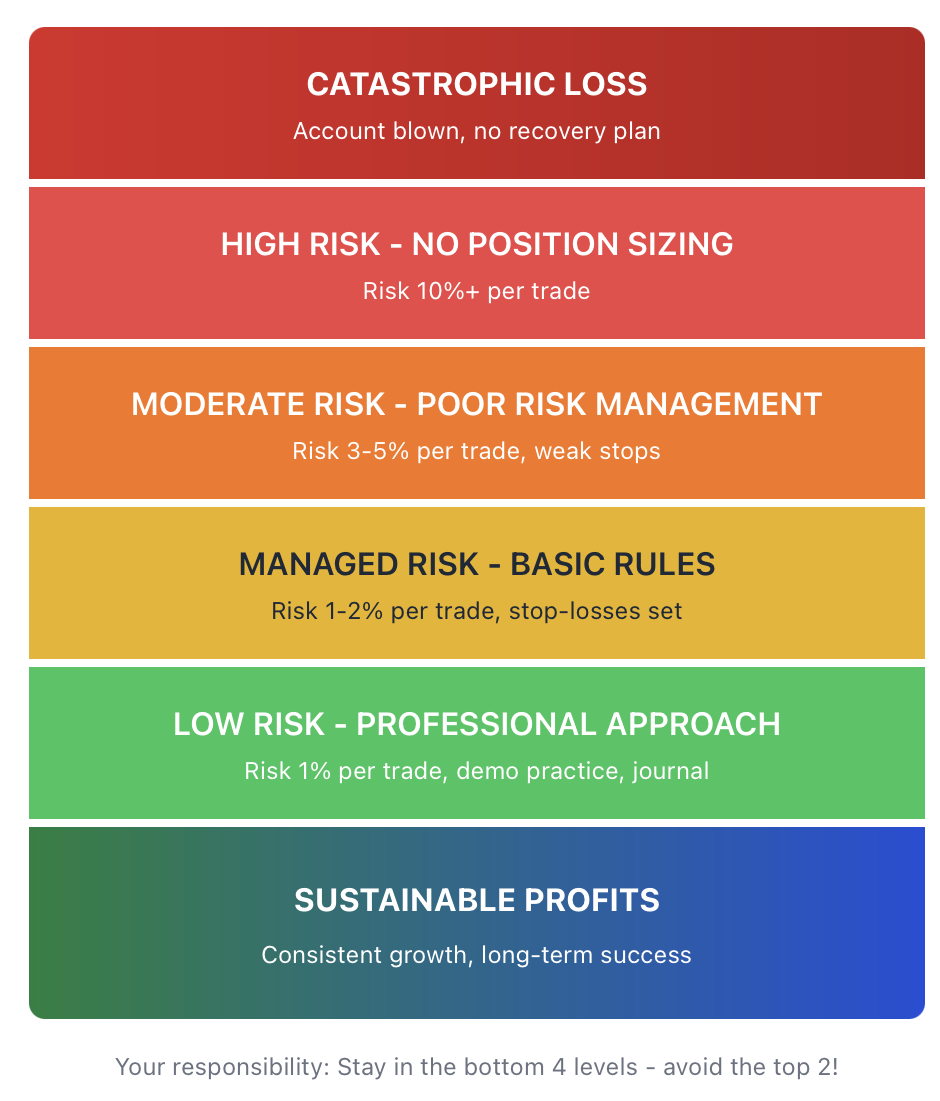
In simple terms, there are high potential rewards and also high risks. Speculating can and is a very generous process, but it will rely on having the discipline to manage risk and have realistic expectations. You must have both eyes open, understand losses will happen and understanding and managing losses is what will separate the successful speculator from an exhausted one that quickly loses interest.
How To Speculate on a CFD Platform
There is a big difference in knowing theory from executing speculation on a CFD Platform, but this is where the theory applies and in this case we have provided you with your practical guide.
Selecting a Platform
The first step is knowing that not all CFD platforms are the same. The first thing is regulation; your broker and platform must be a regulated broker with a guaranteed scheme such as FCA (UK), ASIC (Australia) or CySEC (Cyprus). Regulation is not perfect, however it will provide protection and accountability.
Leverage options are significant. Different brokers provide different maximum levels of leverage. European regulations allow retail leverage only up to 30:1 for major forex pairs, but regulations differ around the world. Select a broker who offers leverage levels which match your risk tolerance and strategy.
Spreads and commissions affect profitability from the outset. The spread is the difference between your buy and sell price, which is your broker's fee per trade. The Taylor’s store as narrow as spreads get you started to break-even on your first trade. Other brokers will charge commissions instead. Brokers utilizing commissions may be more beneficial for traders who make many trades.
Trading tools can distinguish between amateur trading platforms from professionals or better brokers. Examine and research platforms that offer more advanced charting, technical indicators, an economic calendar, or live news feed. If you plan to trade or monitor transactions away from a computer, mobile support is critical.
Operational Flow:
Opening an account is simple: Open an account, fund the account, select your instrument, submit your trade, observe the position, and close when your target or stop-loss has been reached.
Opening an account generally involves identifying verification and proof of address. A majority of brokers will have identification verification completed with a maximum 24-48 hour response time. Examples for funding methods include bank transfer, credit card, or e Monies such as PayPal or Skrill.
The instrument you choose is your decision of what you are going to speculate on, it could be EUR/USD, gold, S&P 500, Bitcoin or whatever jives with your analysis. Each instrument will have different spreads, leverage and trading times.
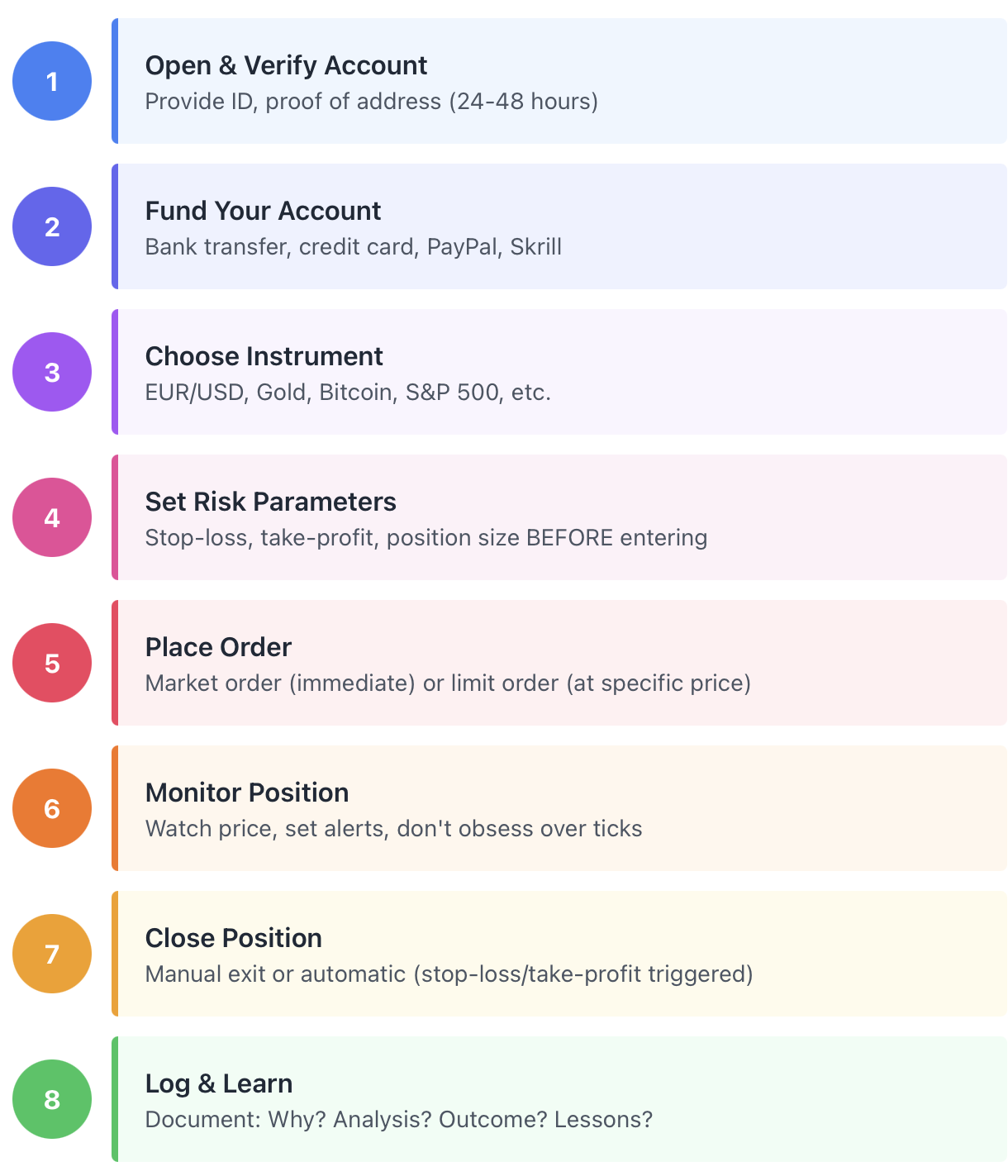
For the next step in the process, placing your orders you will need to make a decision on market (immediate execution at current price) or limit orders (execution at a specified level you designate). Before confirming your trade you will allocate your position size, leading to clicking the confirm order button.
Monitoring prices and open positions, you will want to be aware of your open positions while not becoming obsessed with every minute tick in price. Simply set alerts for critical price levels. Monitoring relevant news with potential influence would be advised. Further, in monitoring positions you would allow your stop loss and take profit to do their work.
Closing positions may either occur without your input (when your stop loss or take profit levels are triggered) or manually when you decide you would like to exit the position for some reason. At this juncture, emotion should not interfere with your plan if your analysis supports your exiting the position, simply execute.
Practical Tips:
Practice on demo accounts first. This cannot be emphasized enough. BtcDana has demo accounts that are free with virtual funds. Spend at least a few weeks becoming comfortable with the mechanics of the platform, strategy development and experiencing the psychological and emotional rollercoaster trading involved without risking any of your real capital.
Before taking any trades, you should set your stop-loss and take-profit levels first, not after. You should decide your risk and reward before you are emotionally involved with the trade. For example, you may risk $100 to try and make $200 with a 1:2 ratio. These levels need to come from technical analysis and not random amounts.
As a secondary rule, keep a trading journal and track each trade you take, documenting the importance of every trade you take (Why?, Analysis?, Outcome?, What did you learn?). This is a habit that separates casual speculators from serious traders. With time and consistency, you will start to notice trends in your journal and how this affects your decision quality. You will also notice what you did well when you were trading well, and, more importantly, notice what you did when you were not trading well.
For instance:
A professional trader could be on BtcDana trading platform for an intraday key level speculative trade for EUR/USD. The trader checks the economic calendar and notices a critical employment report will be available in two hours, and is poised to get limit orders in to take some advantage of volatility. The trader has done this setup thousands, if not tens of thousands of times in demo and has both an idea of where the key levels are for the position and where to place a stop-loss at the most recent support levels.
A beginner trader could be on a trading platform demo account practicing some last-minute short-term CFD trades in gold. The trader watches how gold reacts to news about if inflation is increasing or if geopolitical tension escalates, and places some small practice trades to watch this effect without the pressure of potential financial losses.
Key Considerations:
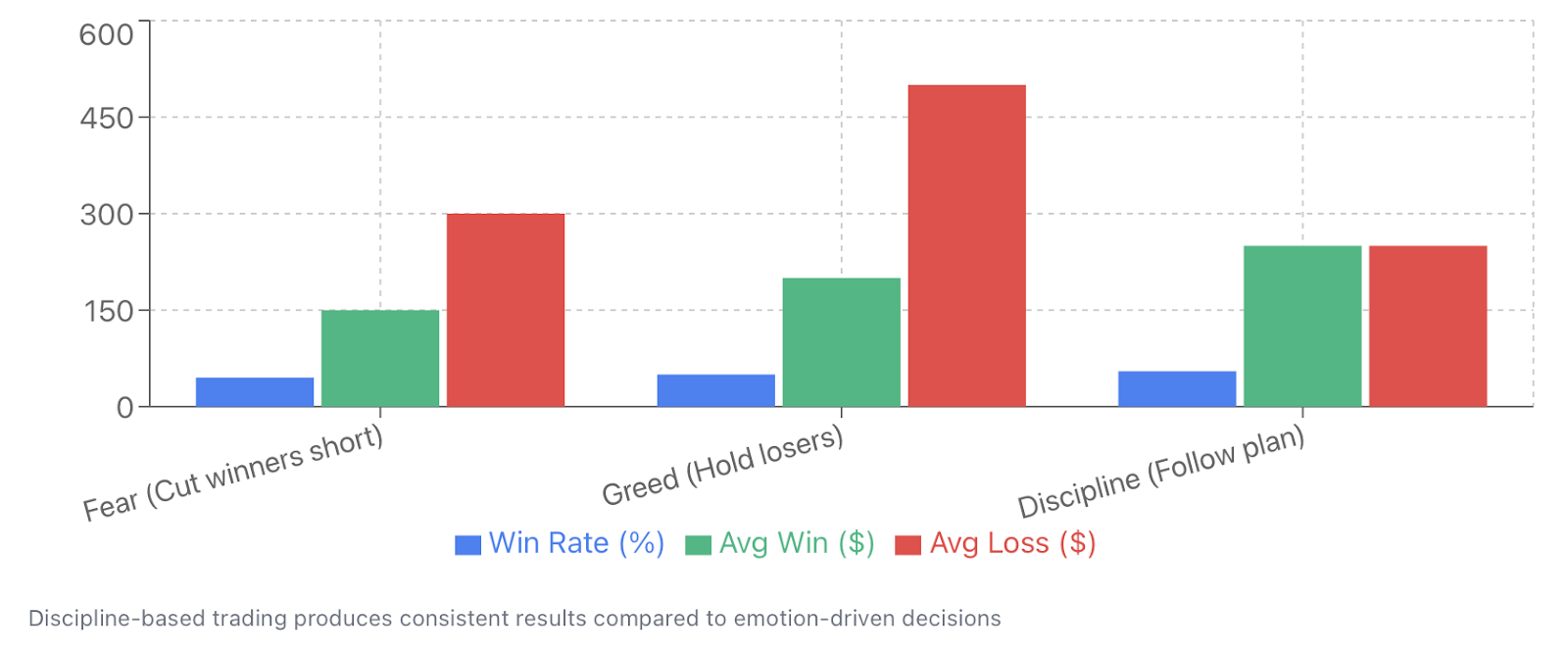
Psychology is more important than most beginner traders seem to acknowledge. Fear and greed are a very common motivator for bad trading decisions. For example, you may hold a losing trade, waiting for it to come back in your favor, or you may close a winning trade due to fear that it will return to a losing trade. Stay with your trading plan.
Capital management simply means never risking more than you can afford to lose. Avoid trading funds allocated to your rent or savings that you may need to fall back on in an emergency. Only trade with funds you can afford to lose - and - funds you're mentally able to afford to lose that won't affect your ability to live.
Avoid trying to chase a trend that has already moved dramatically. By the time something breaks headlines in the mainstream, that move is often over. The professionals often got involved early - you are showing up after the party has already been going on.
Make sure to have a well-defined strategy and define your risk parameters prior to your trade. You want to clearly understand why you are entering that trade, where you will exit if you are wrong, and what potential profit warrants the risk. If you don't understand, then you are gambling and not speculating.
It is vitally important for beginner traders to utilize and practice on a demo account. This provides the closest thing you'll get to a free education in trading. Be sure to take full advantage before going out and risking real money.
Global Practices and Regulations in Speculation
CFD trading occurs in a regulatory environment. Different areas have significantly different regulations, and knowing the rules allows you to trade in a legal and safe manner.
Europe:
In an effort to protect retail traders, the European Securities and Markets Authority (ESMA) instituted strict regulations on CFD trading in 2018. The regulation limits leverage to 30:1 for major forex pairs, 20:1 for minor pairs and gold, 10:1 for commodities, 5:1 for stocks, and 2:1 for cryptocurrencies. These regulations limit how much risk a trader can take on by leverage.
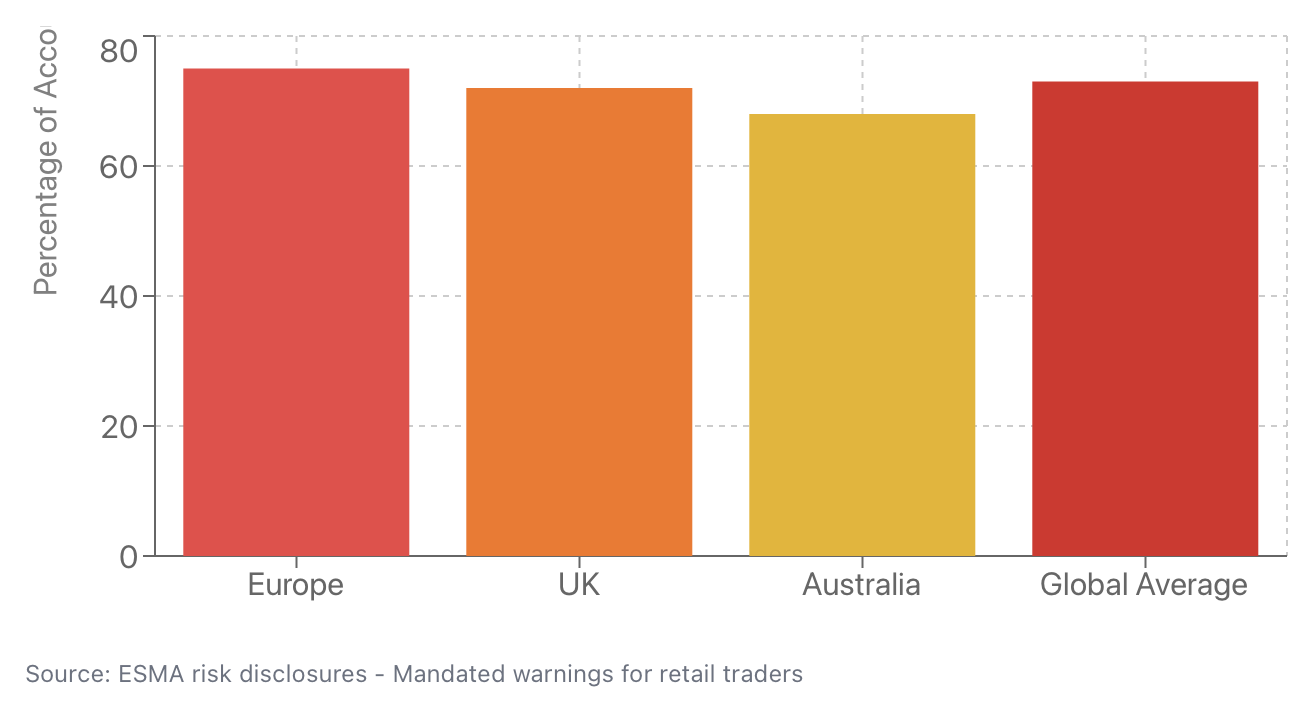
ESMA also mandates prominent risk warnings. You've probably seen statements such as "X% of retail investor accounts lose money when trading CFDs with this provider," plastered on marketing material. These are not simply promotional or marketing jargon, they are federally mandated disclosures based on data. The numbers, which are quite unsettling, range from 70-80% of all retail investor accounts losers.
Negative balance protection is a compulsory requirement, so you can never lose more than the balance in your account. Prior to these requirements being enforced, some traders lost more money than they had in their accounts when trades moved significantly against them. This possibility for losses has been eliminated for retail accounts in Europe.
So, a European trader taking a speculative trade on the DAX 40 index CFDs is speculating under the negative balance protection. They're probably okay with the lower leverage if it means they can sleep easier at night, even if it may potentially limit their returns.
USA:
CFDs are overwhelmingly restricted for US residents. Years ago, the Commodity Futures Trading Commission (CFTC) effectively banned CFD trading for retail traders. Accordingly, a US investor is illegally allowed to trade CFDs on any US-based broker or any other international brokerage.
Instead, US traders are left to speculate using options and futures contracts. Similar in purpose, yet different in mechanics, costs, risks, and regulations. The Turf wars are political, and the decision on the prohibition of CFD trading for retail traders is also based on protecting retail investors.
Australia:
Australia's Securities and Investments Commission (ASIC) is right in the middle. There are leverage restrictions, but they are not as strict as in Europe. ASIC's regulations insist that brokers have risk management tools, provide adequate disclosures, and maintain capital requirements to protect client money.
Australian traders are allowed to freely trade global CFD markets with strong regulator oversight. Brokers operating in Australia are required to comply with a local Australian Financial Services License and meet high standards of conduct.
Latin America, Middle East, Asia:
There is tremendous variation amongst these regions. Some countries have limited CFD regulations, allowing retail investors to trade through global platforms with very few restrictions; while other countries outright ban CFD trading or limit it to accredited (or minimal accreditation) investors.
Retail investors in Brazil, Mexico, South Africa, and UAE typically trade CFDs through international brokers that are more likely based in Cyprus, UK, or Australia; and are trading under the regulations of that jurisdiction rather than local regulations.
Impact on Trading:
Regulations have a direct impact on your leverage options. A trader based in Europe, for example, will be subject to a 30:1 cap on the EUR/USD, while a trader based in an unregulated area may be able to access 500:1 leverage. While higher leverage gives you a greater opportunity for returns, it also increases your risk, and can result in needing less capital to trade.
The same is true of stop-loss requirements and risk disclosures; both will vary in their application across the globe. Certain jurisdictions require a broker to impose stop-losses on a retail account. In others, that would solely depend on the trader’s wishes.
Risk disclosures are another standard developed to help traders understand the inherent dangers of trading, and if you have been trading for any length of time, you have seen the obligatory warnings about the percentages of potential loss and danger of loss when trading. They have to put those messages in writing; you may not get rich quick, and, more importantly, most retail speculators lose money.
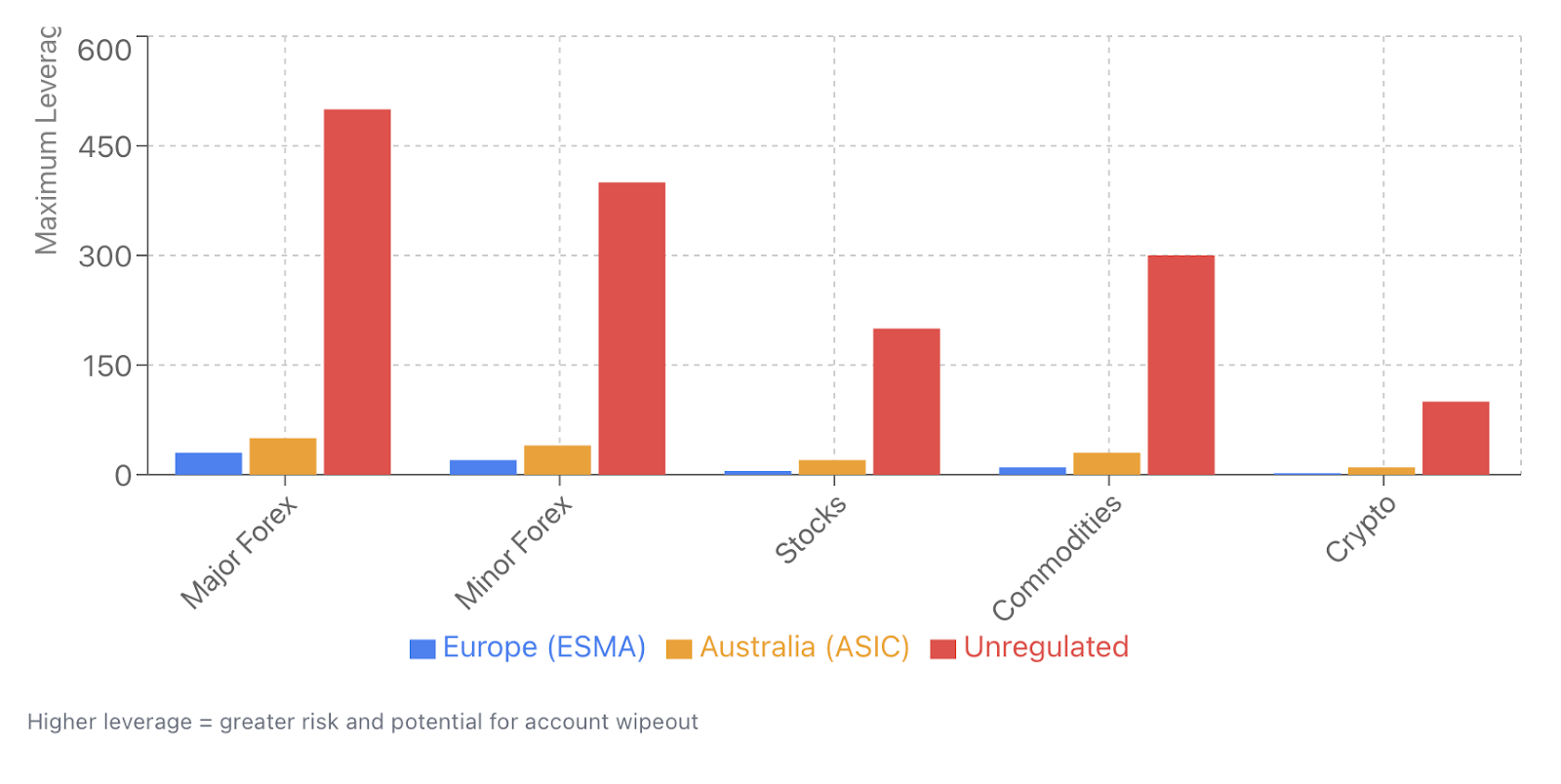
For example, IG is a global trading bookmaker that operates across several jurisdictions. Based on local regulation, they provide different leverage, protections, and product offerings to their clients. Their European clients have the ESMA protection, the UK clients are governed by FCA standards, and the Australian clients are regulated by ASIC regulation. While the platform is the same, the experience is different as the offerings vary.
Similarly, a broker like Pepperstone and eToro adjusts their models based on client location—for example, a trader in Germany can have different maximum leverage than a trader in the UAE or in Singapore.
Key Takeaway:
Ensuring compliance means ensuring your safety when trading. While regulations may sometimes feel constraining, remember that they are created for an important reason: CFD speculation can be truly risky. Regulations aim to protect the inexperienced traders from themselves and also protect traders from brokers with ill-intent.
As you explore your speculation strategies, you may run across certain regulations that you will need to be mindful of. Lower leverage, for example, will require a greater capital outlay for the same position size. Negative balance protection (discussed below) will also totally change your calculations regarding risk. Being aware of the regulations in your jurisdiction is part of your duty as a responsible speculator.
Take the time to verify that any broker you might choose is properly regulated before you trade. Verify their license in a reputable jurisdiction with real regulating oversight in place. Don't be too quick to chase maximum leverage at the expense of basic catastrophes; any extra risk is seldom worth the extra marginal value.
Master Speculation Through Practice and Knowledge
At the heart of CFD trading lies speculation. You have learned what speculation is -- short-term trading focused on predicting price movement rather than holding assets long-term. You are aware of common strategies -- day trading, trend following, swing trading, counter-trend. You understand the benefits of speculation - lots of liquidity, leverage, and market variety, but you'll need to balance this to reduce risk - especially around volatility, leverage working against you, and unpredictable markets.
The practical guide has walked you through picking platforms, executing trades, managing positions, and protecting your capital with stop-losses, position sizing, and diversification - while illustrating how significantly global regulations vary from strict protections in Europe to virtually none in other countries and why compliance is important for your safety.
Lastly, risk management and strategy planning isn't a nice to do. This is the difference between a trader that persists and grows their account, and a trader who loses everything fast. Set your stop-losses. Only risk a small percentage per trade. Keep a trading log. When you've practiced the mechanics in a demo account, then trust it enough to trade live.
Speculation requires more discipline than luck; preparation is always rewarded by the markets, while overconfidence is always punished and your hopes or fears are of absolutely no consequence. Your advantage lies in analysis, risk management, and emotional control not in stumbling upon a secret indicator or in perfectly executing your strategy.
So, you are ready to feel the angst of getting good at speculation? Start with a demo account on btcdana.com and test your speculation strategies there without risking even a single dollar.
You will get to feel the emotional reality of watching your trades fluctuate for you or against you. You will learn the mechanics of the platform and practice various strategies while building confidence, which only comes from practice. Remember, using real money follows virtual practice, do not skip this step.