




What is a Synthetic Position and Why it Matters in CFD Trading
CFD trading allows traders to speculate on future price movements without the responsibility of the underlying asset. You enter into a contract for difference with your broker and use leverage to create larger positions with lower initial capital commitments. CFD accounts for advantages such as flexibility and lower balance requirements and has a disadvantage of greater risk and potential losses.
This is where a synthetic position comes into play. A synthetic position is an instrument which replicates the payout profile of an underlying asset (long or short) with two or more different instruments. Think of it like this: instead of purchasing your green LEGO block directly, you would take your blue LEGO block and your yellow LEGO block, snap them together and make the same green color block you were after, but with two different building blocks.
In trading lingo, perhaps you use a combination of options to simulate a long enough stock position. For example, if you buy a call and sell a put at the same strike price, you create a position which has the same payout as underlying stock ownership. Same exposure, different block!
Why should you learn this? Three main reasons: flexibility, cost efficiency and risk management. Synthetic positions allow you to access a market or strategy that would otherwise be too costly or elaborate, provide creative ways to hedge existing positions, and to refine risk levels of your portfolio.
This will guide you through what you need to know about synthetic positions in CFD trading. We will cover the basic principles, walkthrough the various types of synthetic positions, review the benefits and drawbacks of synthetic positions, demonstrate how to execute synthetic positions on broker trading platforms, analyze regulatory considerations in different regions worldwide, and outline the common hazards and errors. At the end of this guide, you will have a good understanding of why synthetic positions are a base for advanced CFD strategies .
In practice: In the European and US options markets, traders are routinely using synthetic long positions to get stock exposure while managing their capital in a more efficient manner. Instead of purchasing 100 shares at $100 and tying up $10,000 of capital, a trader can use options to create the same exposure for a fraction of that cost.
Synthetic Position Definition and Core Principles
So, what is a synthetic position, at its core? Very simply, you use two or more financial instruments to simulate the profit and loss characteristics of a target asset you don’t own.
This works in essentially any financial market you can think of. Stocks, forex pairs, stock indices, hard commodities like gold or oil, and even cryptocurrencies can have synthetic positions built for them. The key idea is to understand how the instruments correlate to each other in a mathematical sense.
Let’s do some simple math for a moment (don’t get too worried about it). Suppose you have a directional bias that a stock needs to go up. You could buy the stock, but you could also buy a call option and sell a put option at the same strike (this is typically called a "naked put"). For the purposes of this example, let’s hypothetically say that mathematically:
Profit/Loss from (Long Call + Short Put) = Profit/Loss from Long Stock
So both positions will profit as the price of the underlying goes higher, and both positions will lose as the price of the underlying goes lower. The only difference is the path each position takes to get to the same point.
Let’s think about this again in terms of building blocks. You can either buy just a pre-made green block, or you can snap together a blue and yellow block to get the same green block. The parts are different, but the outcome is the same.
Imagine a stock is currently priced at $100. You desire upside exposure to this stock but don't want to tie up $10,000 for 100 shares of the stock. Instead, you will:
-
Purchase a $100 call option (which gives you the right to buy at $100), and simultaneously sell a $100 put option (which obligates you to buy at $100 if the buyer of the option exercises the option).
-
If the stock goes to $110, then your call would be worth $10 per share. In the case that it trades down to $90, your short put would be down $10. Clearly, you are simulating the response of someone that owns the stock outright.
To make it simple for your understanding, consider what it takes to build a model phone. Instead of purchasing the complete item, you purchase the individual parts to create the phone yourself (screen, battery, case) to build one that operates the same way.
The fantastic aspect of synthetic positions is precisely that - they are flexible, and they can often be utilized with less cost to you. If you are utilizing synthetic positions and directly purchasing the stock, you are not using the same purchase structure. Rather, you can bestow yourself the same equity exposure desired, whenever you want, oftentimes utilizing less capital!
Case Study: Traders in the foreign exchange (forex) market regularly employ synthetic positions. Let's say you would like to trade the EUR/GBP currency pair and your broker assigns wide spreads to this pair. In order to achieve the same synthetic EUR/GBP position, you could swap long EUR/USD and short GBP/USD (or vice versa), while likely improving the prices you get on each side of the synthetic position.
Common Types of Synthetic Positions and How They Work
Now that you have an understanding of the basic concept, let's look at the main types of synthetic positions you will come across when trading contracts for different (CFD) products. Each of these positions serve different purposes when you are bullish, or bearish, or if you want to replicate a more complex exposure.
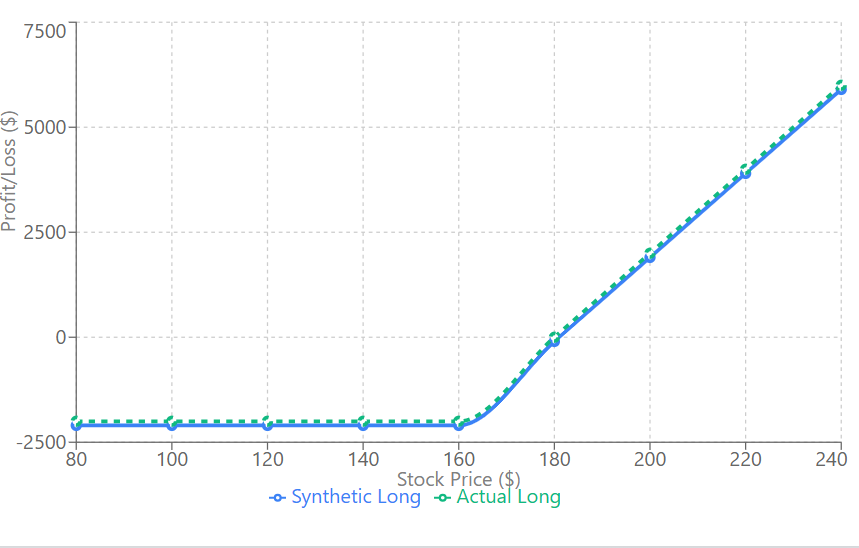
Synthetic Long Position
This may likely be the most common synthetic position you encounter. In this case, you achieve upside exposure without directly acquiring the underlying asset.
How it works: Buy a call option + Sell a put option (same strike or price and expiration date).
When the price of the underlying asset goes up, the call option will appreciate. When the price of the underlying asset decreases, your short put option will depreciate. The net position when the combined exposures are reconciled will act as though you "own" the underlying asset.
Why would someone utilize this position? The answer may be that you want leveraged exposure without having your capital tied up in the outright purchase of the position. Or you may simply be in a marketplace where direct ownership is either not allowed or inefficient in that you have no stock to buy or its too costly.
Synthetic Short Position
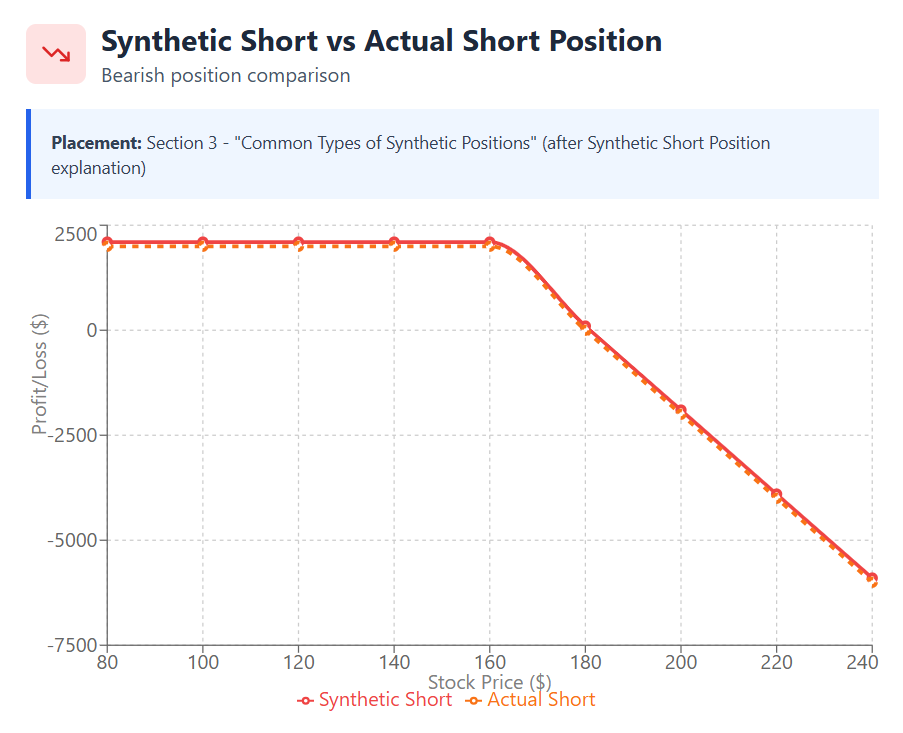
The synthetic short position is the opposite of a synthetic long position. It is where you're wagering on a decline in the price without actually taking a short position in the asset.
Here's how it works: you buy a put option and sell a call option (same strike and expiration).
If the price declines, it's not altogether unreasonable to presume your put option will be worth more than you paid for it. Alternatively, if the price goes up, your call position will lose value proportionate to how high the price rose. In effect, you have created a position that behaves like a traditional short position.
Why use it? Several assets are difficult or expensive to sell short, especially for the retail investor. Synthetic shorts allow you to express a bearish position through financial instruments that are often easier or more cost-effective to transact upon.
Synthetic Positions in Forex
Currency trading creates fun synthetic trading possibilities because currency trading relies on relative exchange rates.
For example, you have an opinion about the exchange rate value of EUR/GBP, but you don't like the spread that your broker offers to that currency.
Instead of transacting this observable exchange directly, you could transact in EUR/USD long position, and a short GBP/USD position. This creates synthetic exposure to EUR/GBP because you're long euros and short pounds, which is precisely what a long position in EUR/GBP does.
In this sense, it is like mixing paint colors. You want something like the color purple, but you don't have the exact purple you want, so you mix red and blue to create a derived shade of purple. Thus, they make the same purple (end result), but are produced from different materials (starting materials).
Index and Commodity Synthetic Positions
Get creative. You can gain exposure to an index or commodity by utilizing correlated assets.
For instance: You believe oil prices will increase, causing airline stocks to decrease (since higher fuel prices are detrimental to airlines), rather than trading oil directly you might:
-
Go long an oil ETF or an oil company CFD
-
Go short an airline stock CFD
By getting long oil and short airline stock, you are able to gain exposure to the relationship between oil and airlines, without providing direct exposure to the commodity market.
Let’s say you wish to trade the DAX 40 index in Europe but your broker’s DAX CFD has a prohibitive overnight financing cost. You could build a basket of the largest DAX components (i.e., SAP, Siemens, Allianz) in a weighting representative of the index to create a synthetic DAX position, and potentially obtain a better cost structure.
A beginner analogy: If you want to create a tasteful orange flavoring, but do not have oranges to use, you could mix tangerine and grapefruit flavors to approximate that citrus profile. They are not the same, but it will be close enough to achieve your desired outcome.
Benefits, Risks, and Hedging Strategies of Synthetic Positions
Similar to any trading strategy, synthetic positions offer both upsides and downsides. We can now address both sides for you to understand what you're dealing with.
The Positives
Flexibility: You get to recreate almost anything without the burden of ownership of the underlying asset. This is important when ownership is too expensive, heavily regulated, or simply unavailable from your broker. You are no longer bound by traditional market access restrictions.
Cost efficiency: Whether or not synthetic positions will be less expensive than directly holding an ownership position depends on the market and the instruments involved. An options premium might cost less than the capital you would reserve to just directly buy the underlying. In forex, pairing better spread pairs can produce lower transaction costs than trading an exotic pair directly.
Risk management: Synthetic positions can help preserve capital in hedging situations. Let's say you have a stock portfolio but you want to protect against possible short-term downside risk. You can create a synthetic short instead of selling your holdings (likely triggering taxes and missing out on long-term hold positions). Once the storm passes, you can unwind the synthetic position without losing your original stock.
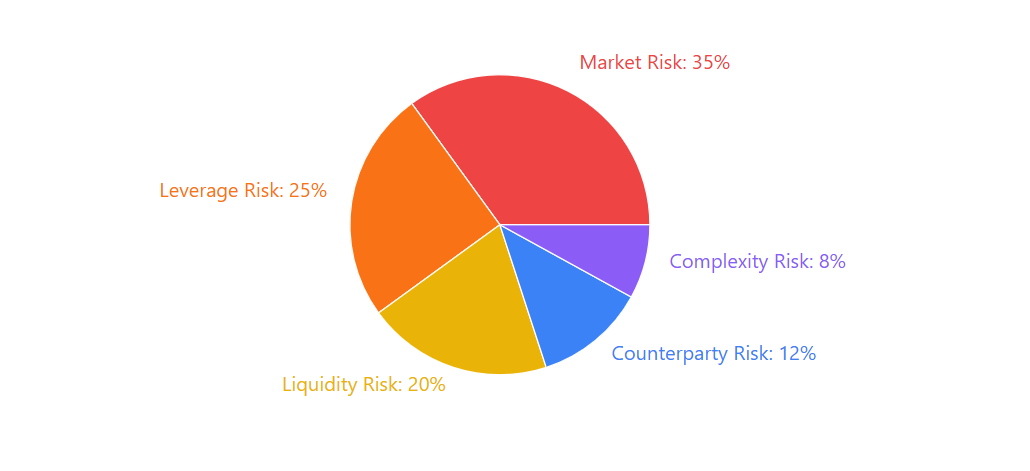
The Risks
Complexity and Learning Curve: Synthetic positions are not a great place to get started, as it is important to first clearly understand how multiple instruments behave with each other, how multiple instruments prices change in relation to each other, and how the market changes may impact those instruments. If you are wrong about these behaviors, it may result in unexpected losses.
Liquidity Risk: If one of the components of your synthetic position is trading in a market with less activity, you may have larger spreads or difficulty exiting when you want to exit. This is particularly true with options on smaller stocks and exotic forex pairs. Getting stuck in an illiquid position during volatility in the market is a nightmare scenario.
Counterparty Risk: Trading CFDs (especially OTC) exposes you to the financial stability of your broker(s). If your broker has any solvency issue, you may not be able to trade any of the positions you have related to the contracts the broker has sold you. In this case, a CFD position would be take on counterparty sporadic risk, however, this is less relevant with exchange-based instruments.
Leverage Magnification: CFDs are involved in leverage and options (therefore) have leveraged payouts. Synthetic positions involving leverage on top of leveraged payout instruments will burn through your account balance at a much larger scale than you may expect if you are taking a unfavorable position on the instrument. For an example, with a 5% decrease in the price of underlying assets that you have taken a position in on relatively larger contract, you may expect up to 50% loss in your account if you have taken a leveraged position of 10 times the contract.
Hedging Strategies Using Synthetic Positions
Now, let's discuss the practical side. What does it look like to use synthetic positions to mitigate risk?
For this example, you own equity shares of a tech company currently priced at $150 per share. While you believe in the long-term benefits of the stock, you're nervous due to its upcoming quarterly earnings announcement, which could result in significant price volatility. Instead of selling your underlying stock, you can create a synthetic short position through options. You accomplish this by incorporating two options: a put option and a call option.
-
In this example, you buy a $150 put option.
-
Lastly, sell a $150 call option.
If the quarterly earnings announcement results in your stock crashing to $120, you would naturally have a negative $30 per share delta on your stock. However, the synthetic short will now give you a $30 per share delta, leaving your overall value unchanged.
Thus, offsetting any loss on your stock is your synthetic short position. If the stock announces earnings resulting in a price gain and rises to $180, you would have essentially a -$30 delta from the synthetic short position. However, you also have a gain in stock value from $150 to $180. Thus, ultimately it represents a wash because, again, once you are "hedged," you essentially have your risk locked in at $150, and you may truly diversify your portfolio.
A possible analogy for beginners could be like adding a shield power-up to your player in a video game, before facing off with a tough boss. You're not avoiding the fight, but you give yourself an option to defend against full damage. Once danger passes, just like dropping your shield, you can go back to your normal strategy.
Advanced Strategy Tip: Some traders will create numerous synthetic positions across different assets in complex strategies to create hedges. You might have a portfolio of European stocks and create a synthetic short position on the STOXX 600 to hedge your pure unhedged market risk while maintaining full player exposure on individual stock selection. If the entire market collapses, your hedge relatively appreciates while your individual stock selection ideally outperforms its benchmark.
Regulatory Considerations: In Europe, ESMA (European Securities and Markets Authority) has significant limits on leverage for retail CFD trades, typically limited to 30:1 for major forex pairs or 5:1 for individual stock trades. There are these limits for a reason due to the risks we've already discussed. The rules reflect concerns that retail traders will blow their accounts because they will over-leverage synthetic strategies.
Takeaway? Synthetic positions afford very powerful tools for sophisticated traders, but they are not some magic ticket. While there can be great advantages related to flexibility and efficiency, there are significant drawbacks related to complexity, liquidity, and leverage. Before risking real capital, you must appreciate both sides.
How to Execute Synthetic Positions on CFD Platforms
Okay, let's put away the theory and talk about real-life implementation of synthetic positions on a CFD trading platform - this is the point where "the rubber meets the road."
What You Will Need From Your Platform
Not every broker has the adequate tools necessary to implement a synthetic strategy. Before you start, make sure your platform has:
Options Trading: If you are utilizing options to build your synthetic positions - which is the case among the majority of traders when working with stocks, you will want to ensure that your broker has options CFDs or exchange traded options.
Multiple CFD Contracts: If you are creating synthetic positions in forex or replicating an index, you will want to ensure that you have access to the relevant currency pairs or stock CFDs.
Leverage Controls: The ability to set and adjust leverage on a position by position basis. This will be important because you will be managing more than one instrument at the same time.
Portfolio Management Tools: Many good platforms will allow you to see all your positions together, to calculate your net exposure and track how your synthetic position is performing as a whole versus the legs separately.
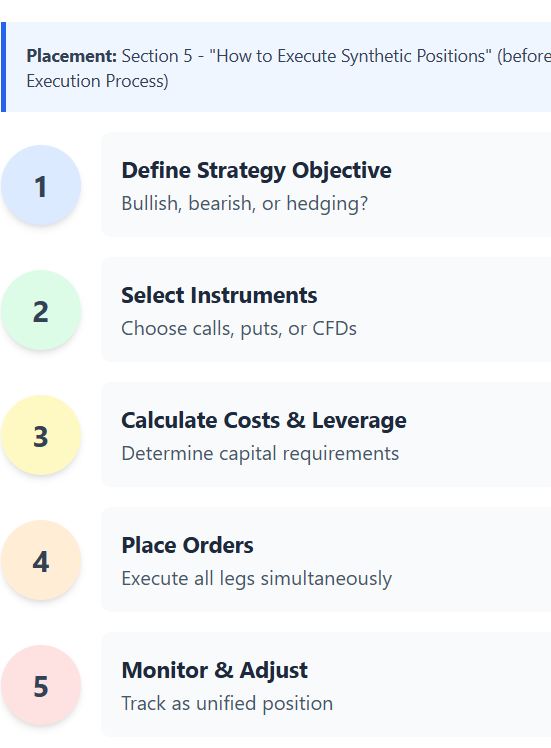
Step-by-Step Execution Process
Let's go through the steps to create a synthetic long position on a stock using a CFD platform.
Step 1: Establish the Objective of Your Strategy
The very first step, before placing any orders, you must be crystal clear on what you are attempting to achieve. Are you speculating on upside, hedging downside, or freeing up capital? Your objective will determine what synthetic structure you use and how you manage the risk.
For this example, let's assume you want upside exposure to Apple stock (trading at $180), but you are reluctant to deploy $18,000 to purchase 100 shares.
Step 2: Select Your Instruments
You select options to create a synthetic long:
-
Purchase 1 AAPL $180 call option (in 3 months)
-
Sell 1 AAPL $180 put option (also in 3 months)
Then you will check the premiums. For example, you find the options ask is $8 per share (for a total of $800) for the call option and $7 per share (for a total of $700) for the put option. Therefore, your net cost is $100, plus some margin for the short put.
Step 3: Establishing Leverage and Margin
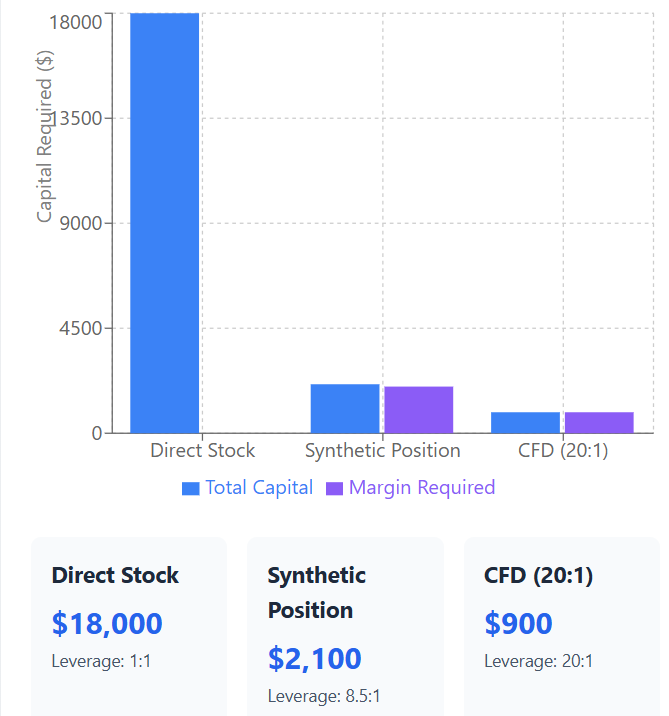
Your particular broker will impose margin to the short put position as you have unlimited downside risk. Assume they require $2000 in margin. So your overall capital requirement is approximately $2100 ($100 net premium plus $2000 margin) versus $18000 for outright share acquisition.
To calculate effective leverage: You are controlling $18000 worth of stock with $2100 dollars of capital or, roughly, 8.5 to 1 leverage.
Step 4: Order Placement
When placing orders, be sure to enter as close to simultaneously as possible for both legs. In order to mitigate legging risk, some order entry platforms offer something called "spread orders". If you have selected a trade that includes two legs, it's best to select the spread option to ensure both legs have the same fill and are executed together.
-
Order 1: Buy to open 1 call on AAPL, $180 strike, expiring [date]
-
Order 2: Sell to open 1 put on AAPL, $180 strike, expiring [date]
Step 5: Monitor Your Position
Once you have finished filling, monitor the synthetic position as a unit. For example, if Apple goes to $190, in this case, the long call and short put will both gain value (the call increases and the put declines in cost to buy back). If Apple falls to $170, both positions will lose value (the call will decrease while the put will increase in cost to cover).
You can set alerts at the price levels that you are interested in. You might be interested in taking profit or closing if Apple hits an arbitrary $200, or you might want to cut your loss if you must cover the position at or around $165.
Application Scenarios
For hedging: For example, if you owned 100 shares of Apple and you have bearish sentiment on the stock due to fear that over the short term there will be a weakness in Apple's stock. You can enter a synthetic short position by buying a put + selling a call to limit your profits from your long shares. If the stock should decline, your synthetic short mutes your losses when you get the profit from the synthetic short position.
For speculation: You are bullish on the NASDAQ 100 index, however, use a CFD with NASDAQ that may have expensive overnight financing. Instead, create a synthetic long position with options rather than using a CFD. You can replicate the NASDAQ with a large basket of the largest tech size stocks (Apple, Microsoft, Amazon, Nvidia, etc.). This will give you essentially the same exposure but with a better overall cost structure.
For Multi-Asset Portfolios: Think about managing a portfolio that consists of equities, currencies, and commodities. Your goal is to increase or decrease your exposure without liquidating your core positions. For instance, you may want to reduce your exposure to equities and take on some synthetic short exposure; or perhaps you want to increase your exposure to a commodity, e.g., oil or gold, and therefore take on synthetic long positions.
Aim of Strategy → What Instruments → Cost → Place Order → Monitor and Modify
Professional Example: Suppose you are a trader wanting to take long exposure to the NASDAQ. You see that the new account platform includes that there is a 0.05% exposed daily financing charge on its NASDAQ 100 CFD. Upon rough calculations, this means that in three months your costing would be roughly 4.5% in financing.
Rather than use their CFD, you would pay less costs using call options on the NASDAQ ETF (QQQ), whilst concurrently selling put options at the same strikes. The costing you established would give you no exposure in daily financing at all, thus making your synthetic position cheaper to hold during the duration of your exposure.
Beginner Analogy: You are in a racing simulator practicing before you get onto the racetrack. You are learning how the mechanics work, how the car feels, and you are building comfort while risking very little. For synthetic positions, you could practice starting a synthetic position in a demo account where you can learn how to enter and manage a synthetic position with a multi leg account before you put your real cash at risk.
Cost and Profit Calculations
Let's put numbers to our Apple example:
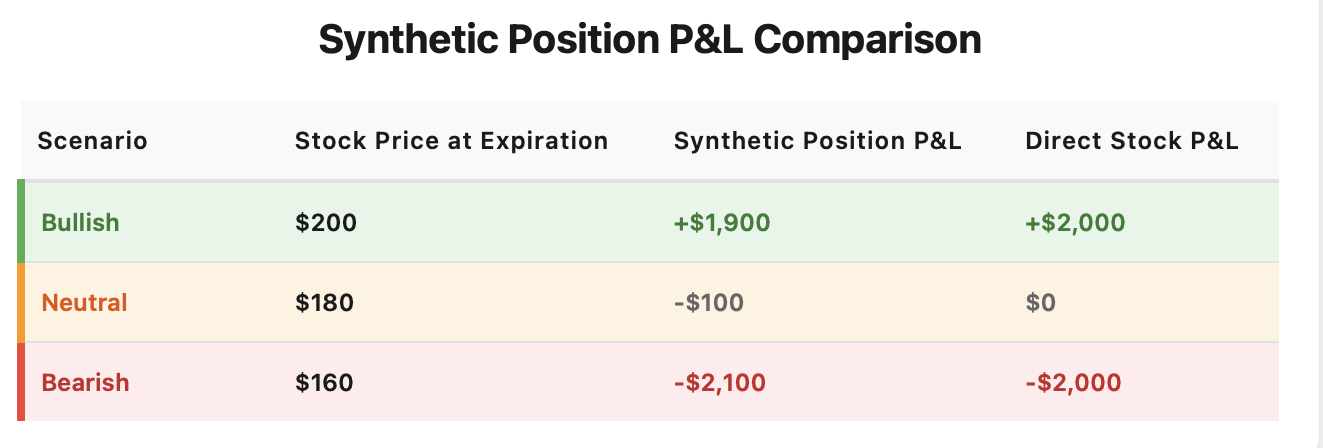
Take note that the synthetic position is slightly underperforming owing to the net premium that was paid, but the capital efficiency (assuming $2,100 instead of $18,000) may more than make up for it if you can use the saved capital elsewhere.
Regulatory Context: In Australia, ASIC (Australian Securities and Investments Commission) mandates that CFD brokers deliver clear risk warnings and ensure clients comprehend leverage and its impact. Prior to executing a synthetic position, Australian brokers must likewise assess your knowledge of the product and/or your experience in underlying asset trading. In the least, make sure you meet these requirements and understand what you are doing before executing either a synthetic or underlying position.
The simple takeaway here is that you, the trader, must clearly define your strategy goals prior to placing a trade. Understand the costs, understand your leverage (if applicable), and have a plan for monitoring and more importantly adjusting your position either after placing the position or shortly after placing the position. Synthetic positions are not designed for the set-and-forget type of trade. Time and knowledge must be allocated in some form to have a good grasp of what each part of the position adds to the overall total exposure.
Global Applications and Regulatory Landscape of Synthetic Positions
Furthermore, synthetic positions are not a theoretical concept. Synthetic positions are used by traders across the globe and while they are used by traders, the rules governing synthetic positions will differ widely based on what part of the globe you are in.
Europe: ESMA Regulations and Retail Protection
European regulators have taken a protective stance toward retail CFD traders. After having too many retail accounts blown up, ESMA (European Securities and Markets Authority) imposed a series of strict leverage limits in 2018.
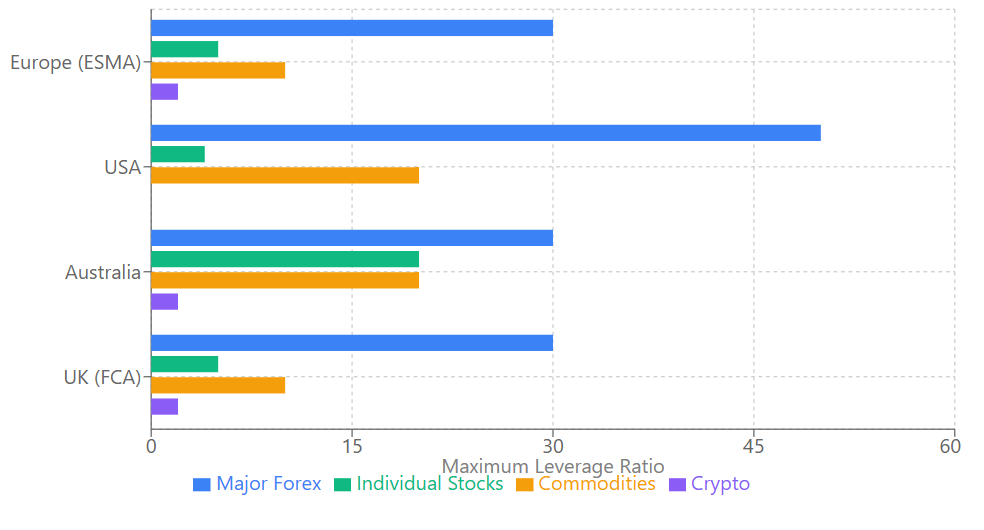
The rules are as follows:
-
30:1 on major forex pairs
-
20:1 on minor forex, gold, and major indices
-
10:1 on commodities (excluding gold)
-
5:1 on individual stocks
-
2:1 on cryptocurrencies
The limits apply, of course, to synthetic positions simply because they limit each leg of the position's leverage. For example, if you are building a synthetic long using stock options, your exposure to the stocks is limited to 5:1.
ESMA also requires brokerages to have negative balance protection (they cannot come after you for losses in excess of your no longer previous account balance) as well as standardized risk warnings. These are good protections, but they also mean that a European trader can't access to the same leverage levels as you may find in other jurisdictions.
Application: A trader in Germany wants to trade the DAX 40 index. Instead of open a leveraged CFD on the DAX index at 20:1, the trader creates a synthetic position that consists of individual DAX components with futures-sized exposures of 5:1. The trader gets diversification while staying within the regulatory requirements.
United States: Options Market Dominance
The United States has the most advanced options marketplace in the world. Therefore, synthetic positions are significantly more common in the US. American traders will use option strategies throughout the stock market, ETFs and indices, being that almost all-dimensional stocks have an option market.
The critical distinction is that most synthetic positions in the United States are created with exchange-traded options instead of CFDs (CFDs are actually forbidden in the United States for retail traders). On the one hand, using exchange-traded options could reduce counterparty risk. On the other hand, using exchange-traded options has different tax treatments and margin requirements than using CFDs.
For example, the New York trader has created a synthetic long position on Tesla through LEAPS (long-term equity anticipation securities). The New York trader buys the call and sells the put two years into the future and can have multi-year exposure through the synthetic long position, but without the capital necessary to purchase the underlying shares outright.
Australia: ASIC Oversee and Risk Disclosure Requirements
The ASIC (Australian Securities and Investments Commission) has a broader definition of leverage than the ESMA so the ASIC does not cap leverage. However, they have extensive risk disclosures and client suitability assessments.
When Australian CFD brokers provide their CFD products, they will:
-
Provide target market determinations (indicating who the product is suitable for)
-
Provide disclosures about the percentage of retail clients losing money (typically 70-80% of their retail clients lose money)
-
Evaluate client knowledge before allowing complex strategies such as synthetic positions.
For example: An Australian trader with a platform such as Pepperstone creates a synthetic gold position by entering an AUD/USD and an XAU/USD position. The trader utilizes the correlation of the Australian dollar with gold to
Latin America and Middle East: Retail Access Through International Brokers
In areas with less established local markets, retail traders frequently use international CFD brokers to trade global assets. Synthetic positions are one method to gain exposure to markets that the retail trader has no way to gain access to directly.
For example, let's say a trader located in Brazil desires exposure to European stocks, but that trader's broker only provides exposure to local Brazilian stocks, incurs a currency conversion cost to convert BRL to the Euro, or incurs a different friction. The trader approaches their CFD broker that offers multi-currency accounts that enables them to build synthetic positions on EU blue chip companies and/or take advantage of some of the friction cost.
Illustration: Another trader located in the UAE may use synthetic positions to speculate on the movement of oil prices using a currency pair approach (many of the Middle Eastern currencies are oil correlated) and/or using CFDs on the energy sector as well.
Brokerage Examples in Regions of the World
IG Group (UK/Global): Provides a wide range of CFD and options products across multiple jurisdictions with the ability to set synthetic positions in opportunities in stocks, forex, and indices. In addition to the extensive products they provide, IG Group has educational content available on synthetic strategies.
Pepperstone (Australia): A well-known and well-liked broker for both forex and CFD traders, Pepperstone offers tight spreads in currency pairs that make synthetic positions in forex quite the efficient tool. Pepperstone is regulated by ASIC based in Australia and provides some of the strongest protections for clients.
Interactive Brokers (US/Global): Interactive Brokers does provide a full range of CFD products as option for their international clients, and whilst the US clients are unable to trade CFDs through their Interactive account, they are able to access some of the more robust options market to set synthetic positions instead.
Visual: World map highlighting key regulatory regions: Europe (ESMA), USA (SEC/CFTC), Australia (ASIC), Asia-Pacific, Latin America, Middle East
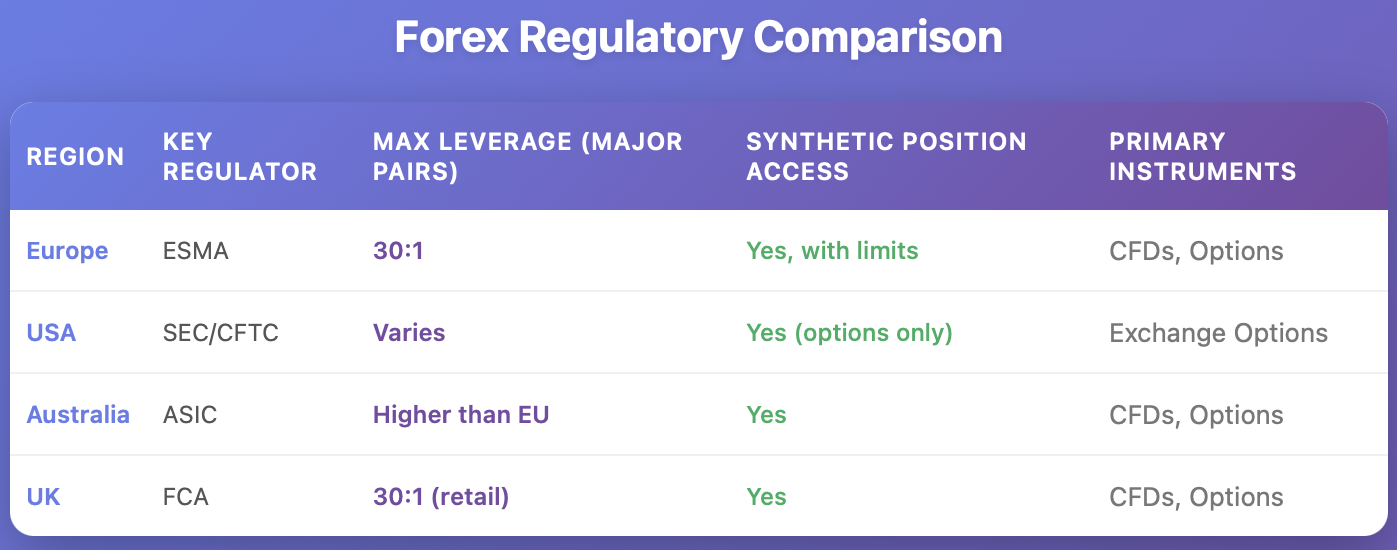
The international regulatory situation is significant, as it dictates what tools you can use and how much of an edge you can apply. Before applying any synthetic strategy, with capital or for educational purposes, check your local regulations and check if your broker is operating within the law in your jurisdiction.
The bottom line is that synthetic positions are used everywhere, but how you access synthetics and what restrictions you have are contingent on where you live and trade. You should always check if your strategy fits within local rules and regulations before risking your capital.
Common Mistakes and Beginner Pitfalls in Synthetic Positions
Now let's jump into the mistakes where traders go wrong with synthetic positions. These are mistakes that happen all the time, but they can lose you quite a bit of your capital. Learning from these mistakes will always be cheaper than figuring it out yourself.
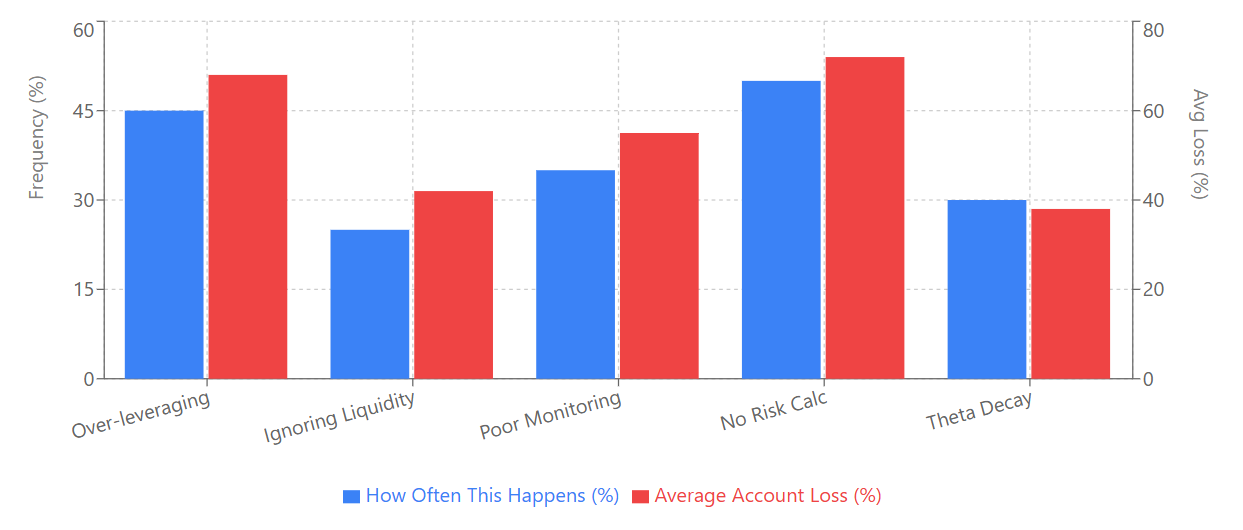
Mistake 1: Thinking Synthetic Positions Are Without Risk
This is the biggest misconception. Because beginners hear the word "synthetic," they assume it is artifice or somehow less susceptible to market risk. This is absolutely not the case - a synthetic position will always have the same risk exposure as the underlying asset you are replicating, plus there are new risks associated with complexities of a synthetic position and leverage.
Actual Impact: A trader builds a synthetic long position on a stock and believes since it’s synthetic, there’s limited downside. The stock falls by 30% in one week in reaction to terrible earnings, and their synthetic position is down just the same as if the underlying shares were owned directly. They paid option premiums and received margin calls on the short put.
True Understanding: Synthetic positions replicate risk profiles regardless of dealing in synthetic instruments themselves. It’s the same market exposure as the direct underlying shares, so adding a combination should not fool an investor into thinking that the risk just goes away.
Mistake 2: Disregarding Leverage Amplification
Embedded leverage starts with most CFDs and options. When a synthetic position is built with leveraged instruments, you are adding leverage on top of leverage. This can blow up in your face faster than you realize.
Actual Impact: A trader with a $5,000 account builds a synthetic position with 20:1 leveraged CFDs that is controlling $100,000 of exposure. A 5% adverse move in the underlying asset results in their entire account being wiped out. They thought they were being clever with a synthetic strategy but were in fact dangerously over-leveraged.
Proper Understanding: Always sum up your total exposure on each leg of the synthetic position. You must aggregate the notional amounts, know your effective leverage, and size positions in a manner that, if adverse moves happen to be realistic, you won't ruin your account. A sound rule of thumb is never risk more than 2% of your account on any one position, whether it is a synthetic position or not.
Mistake 3: Not Accounting for Liquidity Risk and Slippage
All synthetic positions contain many instruments. If one leg trades in a thin market, you can be left with a terrible price when you want to exit.
Real-Life Impact: A trader creates a synthetic position with options on a small-cap stock. Everything looks perfectly fine until they try to close the synthetic position as the market goes into panic. The bid-ask on one of the options went from $0.10 to $1.50. They lose a ton of money just from slippage, even though the stock barely moved.
Beginner Analogy: It's like building a LEGO with little pieces but missing one critical piece to make it stable. The whole thing is at risk of falling apart. The missing or illiquid piece may cause the whole trading strategy of you whole to fail.
Correct Understanding: Before creating any synthetic position, ensure that all of its components are liquid. Analyze bid-ask spreads, trading volume, and if you are using options, open interest as well. Do not put on synthetic positions with illiquid instruments, unless you are able to hold until expiration, or accept a poor exit price.
Mistake 4: Not Monitoring All Legs of the Position Together
Many new traders will monitor each leg of a synthetic position separately. This is a bad idea! The components of a synthetic position can sometimes act differently than expected, especially as expiration approaches or there is surprise volatility.
Professional Example: A trader establishes a synthetic short position on a stock, but only monitors the long put side. To their surprise, the stock rallies and the short call is losing money at a faster pace because of an increase in IV. The trader closes the losing leg prematurely, thus leaving with a unhedged long put option while the stock continues to rally, and the put option loses money. The trader has gone from a defined risk synthetic position, to a naked speculative trade.
Correct Understanding: A synthetic position should be treated as a position, not a collection of individual components. Monitor the P&L of the overall position, not its individual components. If using a broker’s platform, use tools that can report on your combined exposure. Employ price and/or P&L alerts for the overall position, not just single components.
Mistake 5: Misjudging Time Decay in Options-Based Synthetics
When utilizing options to form synthetic positions, time decay (theta) has an impact on both legs, but not always at the same magnitude. Newer traders discount this effect as it chips away at the value of the position, specifically on an expiration come close.
Meaningful Example: A trader builds a synthetic long position using expiration in two weeks. The underlying crate neither moves higher or lower and therefore to the trader's conclusion, has significantly a change since they they believed the stock would only have a range of movement. However, both the long call, and short put have depreciated in value due to the decay of theta (time). So their net position incurs a loss, although they met their position positively as they observed an accurate observation that the underlying wasn't going to move a lot.
Proper Understanding: As a rule longer-dated options (3+ month) will have a significantly less loss in value on a daily basis from theta decay. Again, if you are building synthetic options based positions, try to use longer expirations to avoid theta impact, unless you wish to trade theta decay as part of your strategy.
The Missing LEGO Piece Analogy
This visual can help to recall these mistakes, constructing a synthetic long is like trying to build a complex lego model. If you lose a piece, don't know how the pieces come together to build, or use the wrong pieces that don't fit, the whole building will collapse. Each of the mistakes presented has a missing or broken piece that is pivotal to a meaningful trading experience.
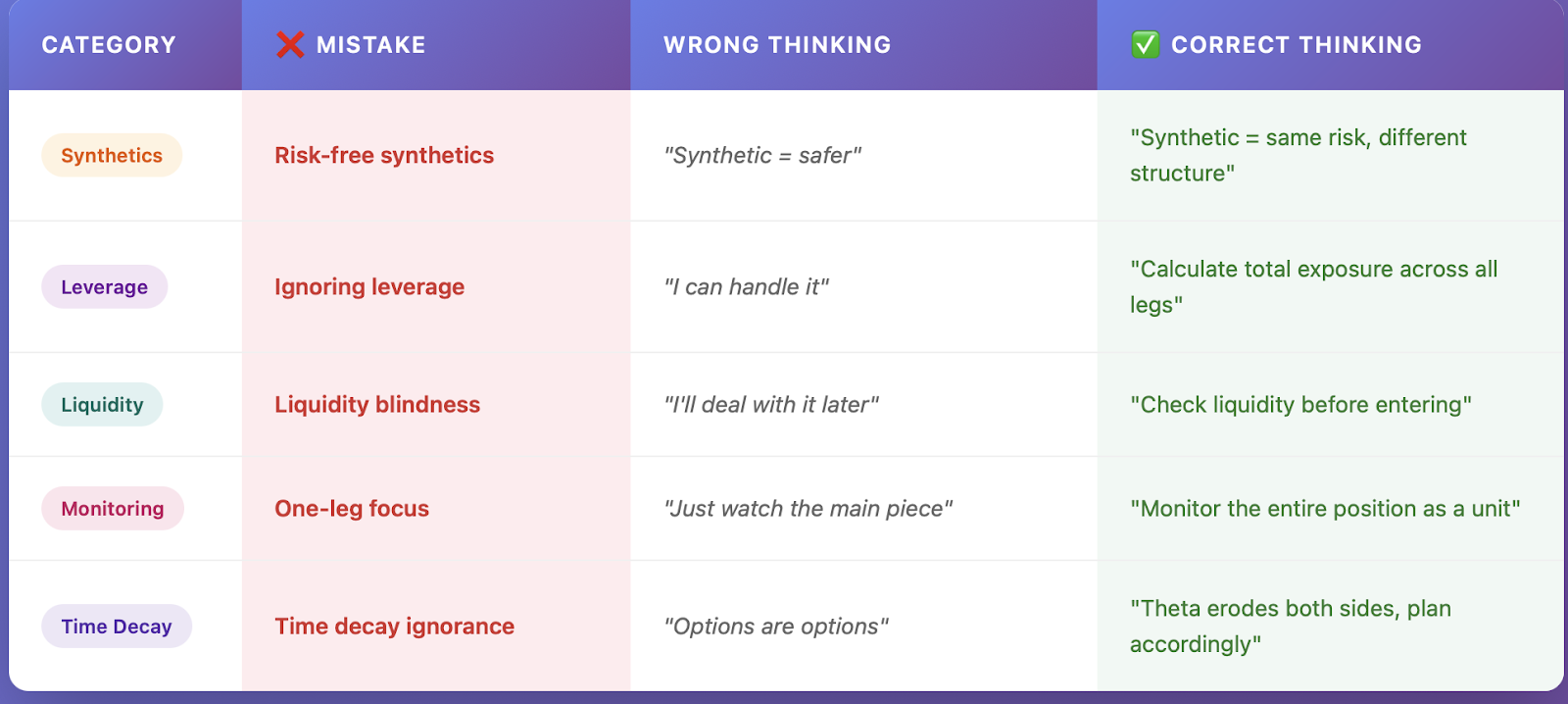
Data from Europe and the United States suggest that retail CFD trader studies are showing 70–80% lose money, with overleveraging and trying to understand some of the complex strategies being the primary culprits. Many of these uninformed losses relate to trying to employ more sophisticated strategies, like synthetic positions, without understanding the education, experience, or risk management that a proper trading framework requires.
Synthetic positions are great and powerful tools in this regard, but they aren’t a shortcut to getting easy money; please treat them as complex strategies. Respect that complexity. Understand all the risks involved. Consider the size of your leverage relative to your position size.
Never assume you are more intelligent than the market (and all its participants) are. And every professional trader who has made all of these mistakes hopefully with small position sizes had to start somewhere. Make sure to educate yourself on the principles before attempting to size into a larger position.
Conclusion & Actionable Steps for Mastering Synthetic Positions
One of the most flexible instruments in CFD trading are synthetic positions. These are essentially contracts that allow you to replicate the profit and loss exposure of an asset through a customized combination of other instruments.
We have focused on the four different categories (synthetic longs, synthetic shorts, forex combinations, and index replication), examined the fundamental math behind each position, and identified both the benefits (flexibility, cost, risk exposure) and risks (complexity, liquidity, magnifying, counterparty risk) to using these position types.
You have learned how to trade your chosen synthetic position using a CFD platform, have seen examples of synthetic positions being used in different markets across the globe, and have reviewed the regulatory landscape in Europe, the USA, Australia and more. Perhaps most importantly, we have reviewed a number of the common mistakes that can trip up new entrant traders, such as thinking synthetics are without risk and ignoring the compounding or magnifying effects of leverage.
So what is next?
Understanding synthetic positions is not about memorizing formulas and copying instructions from a blog. It is about developing a practical understanding of how different instruments interact, experimenting with managing positions yourself, and developing some risk management discipline.
First, education. Don't just jump into a live trading with real money. Spend some time to understand the instruments available to you on your platform. If you're looking to use options, understand how calls and puts work in isolation and then start thinking about how they interact. If you're using forex synthetics, understand how the currency pair correlations behave.
Utilize a demo account. Seriously. Most brokers will offer you a paper trading account that you can use to practice building synthetic (or any position) while being able to manage that position without risking your capital. Test the strategies. Be able to see how the legs react with each other. Make mistakes in the demo environment, they can be educational without being expensive.
Start small and simple. When you do transition to a real account, do so at the simplest synthetic structure possible. Start with a basic long/short synthetic position using options with good liquidity. Don't attempt to build a multi-asset, multi-leg position right away. Get comfortable with the simpler structures first.
Be obsessive about knowing your risk. Prior to engaging in any synthetic position, know precisely how much you can reasonably lose if all went wrong. Understand your effective leverage across all legs, to ensure that whatever the worst case scenario could look like, it wouldn't blow your account up.
Continue your education. Synthetic positions are widely employed by both professional traders and institutions for sophisticated portfolio management and hedging profits or risks. There is always more to learn: advanced option strategies, attribution trading strategies in forex, multi-asset hedging strategies, to name just a few.
The traders who succeed with synthetic positions are the traders who view them as tools, not as "magic tricks," and they realize flexibility and capital efficiency come with added complexity and management requirements. They show respect for leverage and size their positions accordingly.
Your Next Steps:
Many professionals started their career journey just like you are – if they were curious about synthetic positions, they were not very sure at the beginning how to put them into practice. They spent time studying synthetic positions and practicing on demo accounts, knowing they were building competence from the small, real trades they took. This is how you move ahead.
If you are ready to start learning and moving forward with appropriate support, tools, and assistance, consider checking out btcdana.com for educational material and to open a demo account to practice building synthetic positions with no financial risk.
Once you have gained experience with your strategies and understand how to build synthetic positions and how different market conditions affect your positions, you will have the confidence to apply your skills in real-time when you are ready to begin trading.
Grasping and executing synthetic positions will be an honest leap in your CFD trading skills. It may not be the easiest road to take your trading abilities, but it will provide you with possibilities of strategies that the overwhelming majority of retail traders will never avail themselves of. If you take your time, learn the right way, and respect the opportunity, you will go far.
Are you interested in trying out synthetic position strategies without using your personal trading capital? You can always open a demo account at btcdana.com, where you can practice how to build multi-leg positions in real market conditions, but with fake money.
Learn the mechanics first, and then you will have far more confidence when you decide to execute some trades with your own real money.